【Winter 2026】Electricity Bills Too High? Top 5 \"Amazon Best\" Heaters to Warm Up Freezing Japanese Homes
Published on January 13, 2026
Updated on June 11, 2026
Author:JapanLifeStart Editorial Team
Housing & Daily Life
How this guide is checked
Updated against official, partner, and reviewed site evidence where available.
Last updated: June 11, 2026
Source separation
Official or partner facts are separated from practical notes.
Fast-changing details
Prices, screening, documents, and rules can change.
Affiliate link handling
Some next-step links may be monetized.
Needs review: Approval, visa/tax/legal, availability, and campaign terms are not guaranteed. Confirm on the official or partner page.
💌
Send to Friends (Summary)
•【2026 Update】Before you despair over high electricity bills in Japan! We reveal the Top 5 heaters to buy during Amazon Black Friday (Ke-non, DeLonghi, etc.) and a trick to save ¥8,000/month. Achieve a comfortable winter with the ultimate insulation and humidification set.
Great for LINE / WhatsApp sharing
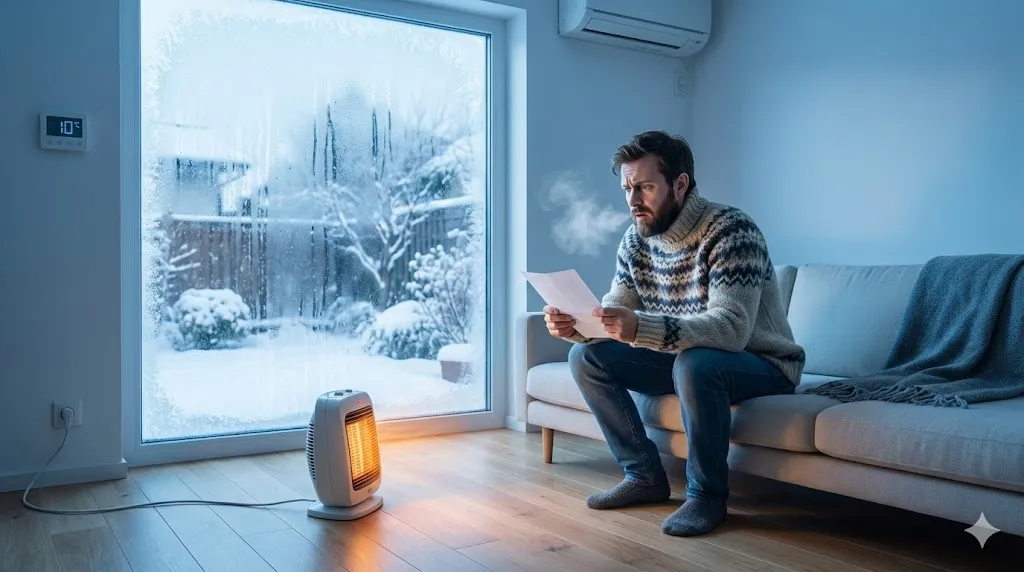
"I feel like it's colder inside my Japanese apartment than it is outside..."
This isn't a joke. Many foreign residents face this harsh reality during their first winter here and are left in shock. Then, a month later, the second shock arrives in the mailbox: the electricity bill. "¥40,000 (approx. $270)!? You have to be kidding me."
Every winter, the "JapanLife" forum on Reddit is flooded with painful cries of "I almost went bankrupt due to electricity costs."
Why is winter in Japan so brutal? The causes are the uniquely poor insulation performance of Japanese housing and energy prices that remain high and complex by global standards.
However, there is no need to give up. With the right knowledge and "efficient gear," it is possible to stay warm without breaking the bank.
In this article, based on the 2026 Amazon Black Friday and New Year sales data, we introduce the "Best Practice" heating set that "keeps costs down," "never dries out the air," and "warms you to the core."
The Shocking Truth! Japan's Heating "Electricity Cost" Ranking
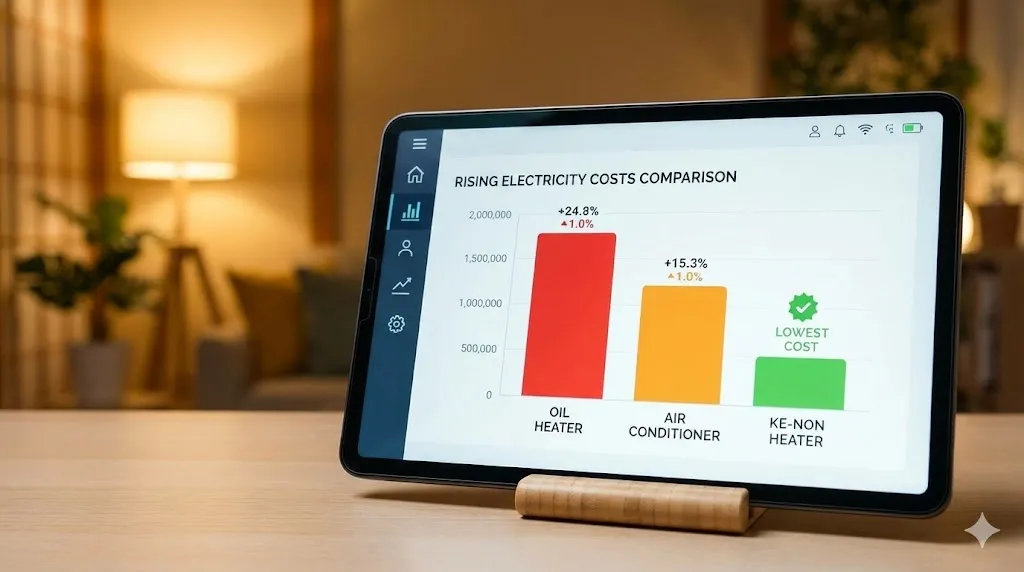
First, know your enemy. The biggest mistake many people make is buying a heater because the "device price is cheap." However, the real danger isn't the initial cost (device price), but the running cost (electricity bill).
Below is a cost comparison of major heating appliances based on the average electricity rate as of January 2026 (¥31/kWh).
Heating Appliance
Device Price
Power Usage
Cost Per Hour
Features
Air Conditioner (AC)
High
Low-Med
Approx. ¥3 - ¥53
Efficiency is king, but it dries out the air excessively.
Electric Fan Heater
Low
High
Approx. ¥37.2 (Constant)
The worst money pit. Approx. ¥900 for 24 hours.
Oil Heater
Medium
Med-High
Approx. ¥15 - ¥37
Comfortable, but takes a long time to warm up.
Ke-non Heater
High
Low-High
Approx. ¥6 - ¥40
Great balance of speed and energy saving.
Kotatsu
Low
Low
Approx. ¥3 - ¥5
Cheap, but the room itself remains freezing.
It’s a shocking fact, but if you keep using those small "ceramic fan heaters" sold on Amazon for a few thousand yen as your main heating source, it is not uncommon to receive a bill of ¥30,000 to ¥40,000 a month.
💡 Smart Saving: Switch Your "Power Company" Before Buying Gear
If you are still using a major legacy power company (like TEPCO), there is something you must do before buying heating appliances: Switch your electricity provider.
In particular, Octopus Energy frequently runs campaigns like "Winter Happy Hour," offering plans where electricity becomes extremely cheap during the day when solar power generation is high.
👨
I switched to Octopus and focused my laundry and room reheating during the day. That alone lowered my monthly bill by over ¥8,000.
Octopus Energy
[Referral Campaign Ongoing] If your bill feels high, switch immediately. Risk-free choice with ¥0 basic fee & ¥0 cancellation fee.
💸 Can't Pay the Bill? Emergency "Cash Securing" Hacks
"My bill this month is too high, I don't have enough for living expenses..." In such emergencies, utilize Japanese "Poi-katsu" (points activity) campaigns where you can secure cash on the same day using just your smartphone.
[Urgent] How to Get '¥20,000 Cash' Upon Arriving in Japan
TikTok Lite & Rakuten Card Strategy Guide. How to quickly supplement living costs with just your smartphone.
If you have small children, get a sore throat from AC wind, or work from home all day, choose this without hesitation.
The Ke-non Heater Sugudan is not just a heating appliance; it is an "investment" in your family's health.
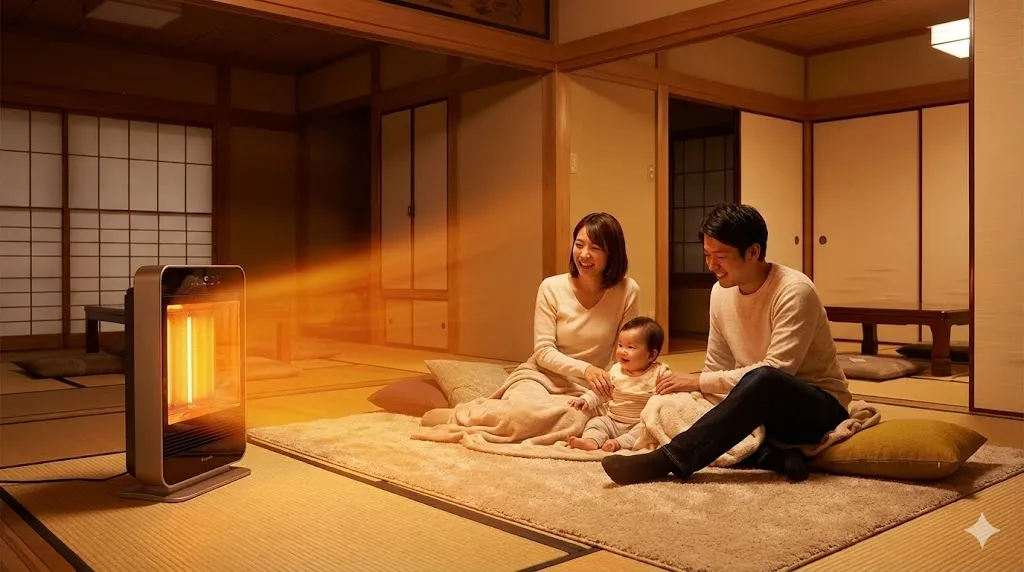
Using its patented "Triple Warm Current" technology, it radiates far-infrared rays from glass-ceramic panels on both sides. Unlike air conditioners, it doesn't blow dry hot air, and unlike oil heaters, you don't have to wait an hour for it to warm up. It realizes the dream comfort of being "warm immediately after switching on" while being "windless and silent."
Of particular note is safety. The surface temperature is at most around 60°C. Even if a child accidentally touches it, they won't get burned instantly.
User Review★★★★★5/5
Mike (Tokyo)
It was an expensive purchase, but worth it. My daughter was just born, and I can use it with peace of mind because there's no risk of burns and it doesn't pollute the air. I'm free from the dryness of the AC, and my sore throat is gone.
The price is high, ranging from ¥80,000 to ¥120,000, but considering the cost and hassle of visiting clinics for colds and skin issues, and above all the safety of your loved ones, the price is easily recoverable. While available on Amazon, the official site often offers better warranty periods and bonuses, so be sure to check.
Ke-non Heater Sugudan
[In Stock on Amazon] Next-gen heating with no dryness. Made in Japan with a 3-year warranty for a peaceful winter.
Silence and stability are required for bedroom heating. This is where Amazon's best-seller, DeLonghi, shines.
This Italian-born "Zero Wind Heating" is ideal for preventing throat dryness during sleep. While it lacks the instant speed of the Ke-non Heater, the price is affordable, starting from the high ¥10,000s. By using the 24-hour timer to set "ON 1 hour before sleep, OFF at wake-up," you can sleep comfortably until morning while keeping electricity bills in check.
DeLonghi Oil Heater Verdicaldo
Perfect for the bedroom. An entry model for zero-wind heating that won't dry you out.
"The bathroom before a shower is so cold I feel like I might die." To avoid the risk of 'heat shock' (a major health risk in Japan), Iris Ohyama's small heater is the answer.
Its appeal lies in the overwhelming speed at which hot air comes out just seconds after switching it on. If you get one with a motion sensor, it automatically turns off when you leave, eliminating waste. Using it for long periods will spike your electricity bill, but if you treat it strictly as a "sub-machine" for the dressing room or toilet, there is no better product. The price is also very cheap, just a few thousand yen.
Iris Ohyama High Volume Ceramic Fan Heater
Warms up in seconds. An essential unit for combating the cold in dressing rooms and toilets.
Buying the strongest heater means nothing if your house has "holes." By "impulse buying" the following two items on Amazon, your heating efficiency will improve dramatically.
1. [Insulation] Nitoms Window Insulation Sheet
Japanese windows are essentially holes that dump heat outside. By simply applying this Nitoms Window Insulation Sheet (commonly known as bubble wrap) with water, you can shut out cold air intrusion (cold drafts) and raise the room temperature by 2-3°C. This isn't magic; it's physics.
2. [Humidification] Zojirushi Steam Humidifier
When humidity rises, the perceived temperature also rises. The Zojirushi Steam Humidifier uses a simple structure of "boiling water to release steam," which means no filter cleaning is needed, mold is less likely to grow, and the warm steam helps raise the room's base temperature.
"Winter Failures" Foreigners Fall Into and How to Avoid Them
Finally, let's learn from the "failures" experienced by our predecessors on Reddit.
Failure 1: The Mold Nightmare
If you over-humidify fearing dryness or use kerosene heaters, condensation will form on cold windows, leading to moldy curtains and walls. To avoid being charged high cleaning fees when moving out, keep dehumidifiers like "Mizu-tori Zou-san" (Water-absorbing Elephant) or "Kabi Killer" (Mold Killer) from Amazon on hand.
Failure 2: Fire Risks
Fire accidents caused by old electric stoves or "octopus wiring" (overloading power strips) surge in winter. Just in case, be prepared to call 119.
Conclusion: Survive Japan's Winter by "Investing"
Winter in Japan is harsh, but with "good tools" and "smart knowledge," it is fully possible to live comfortably.
First, switch to Octopus Energy to lower your unit electricity price.
Invest in a Ke-non Heater for the living room to buy health and safety.
Apply Insulation Sheets to windows to stop heat from escaping.
Check the stock for Amazon Black Friday or New Year sales right now and fortify your "castle."
Ke-non Heater Sugudan
Low Stock. Check now and turn this winter into 'Spring'.
If you're thinking, "I'm fed up with this cold and these bills!", escaping to a Japanese resort area for the winter is another option.
With a live-in ski resort job ("Resort Baito"), utilities, rent, and food are all free. On top of that, you can save over ¥250,000 a month while working in an English-speaking environment.
[Winter Only] Save ¥250k/Month with ¥0 Rent & Food!
3 Reasons why foreigners should work at Japanese Ski Resorts (Niseko / Hakuba). The ultimate plan to escape utility bill hell.
Q: What is the best heating option for an apartment in Japan during winter?
A: For most Japanese apartments, an air conditioner with heat pump function is the most efficient and cost-effective heating option. Many apartments already have one installed. Space heaters (石油ファンヒーター for kerosene, or electric) are popular supplements for rooms without an air conditioner.
Q: Is Amazon Black Friday worth it for buying electronics and heaters in Japan?
A: Amazon Japan holds an annual Black Friday sale in late November, typically offering 20–50% discounts on electronics, home appliances, and heating devices. Prices are often competitive with other sales, but compare with Kakaku.com to verify it's actually a good deal versus the regular price.
Q: What is a こたつ and is it worth buying in Japan?
A: A kotatsu is a low heated table with a futon blanket — iconic Japanese winter furniture. Very energy efficient (only heats the space under the blanket) and incredibly cozy. Popular on Amazon Japan. A basic 75cm kotatsu set costs ¥10,000–20,000. Excellent for small apartments or living rooms.
Q: Do Japanese apartments include air conditioning for heating?
A: Most modern apartments (1990s+) include an air conditioner that has both cooling and heating functions. The landlord installs it as standard equipment. Older apartments or smaller studios may have only one unit, typically in the main room. Check before signing your lease.
Q: What electricity provider should foreigners use in Japan for the cheapest winter heating bills?
A: Comparing electricity providers via enechange.jp can save ¥1,000–3,000/month. Electric power deregulation (2016) allows residents to switch from Tokyo Electric (TEPCO) or Kansai Electric to cheaper alternatives like Eneos Electric, SoftBank Denki, or Rakuten Denki.
Yushi Yamamoto
CEO / Native Japanese Expert
Updated on: June 11, 2026
Disclaimer
※ The information in this article is accurate as of the time of writing. Laws and regulations may change, so please always check official sources for the latest information. We assume no liability for any damages resulting from the content of this article.