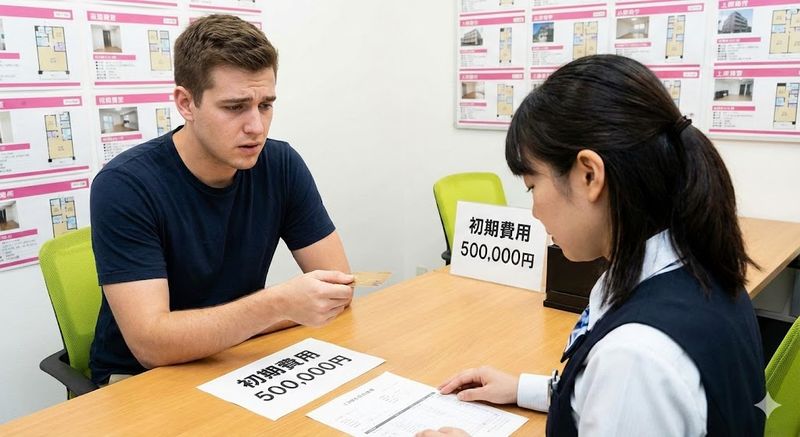
When renting an apartment in Japan, the first and biggest barrier you hit is the high "Initial Cost."
Generally, it is said to require about 4.5 to 5 months' worth of rent. If your rent is ¥80,000, a massive sum of approx. ¥400,000 to ¥500,000 disappears in an instant.
"I don't have that much money in my Japanese bank account yet."
"I'm scared to carry that much cash to the real estate agency."
For foreigners who feel this way, "Credit Card Payment" is a lifeline.
To give you the conclusion first: Paying initial costs by card is "possible, but not available at all properties or agencies."
However, if you know the right procedures, you can save your cash, earn points, and even split the payment over several months to lighten the burden.
In this article, we explain "Credit Card Payment Strategies" to smartly handle a ¥500,000 expense, along with tips for foreigners who might struggle with credit screening.
Earn over 5,000 points on initial costs
Get thousands of points with the sign-up campaign + 1% back on initial cost payments. Easily switch to installments later via the app.
Why Do Japanese Real Estate Agents Prefer "Cash"?
While checks and card payments are standard in many countries, "Bank Transfer" is still the mainstream method in Japan.
The biggest reason is the "Transaction Fee" that the real estate company has to pay to the credit card company.
If you pay ¥500,000 by card, the real estate company loses about 3–5% of that sale (¥15,000–¥25,000) as a fee to the card issuer. Because this reduces their profit, many landlords and small real estate agencies dislike card payments.
However, recently, major chains (like Able and Apamanshop) and agents specializing in foreigners are increasingly marking properties as "Initial Cost Credit Card Payment OK."
There are also many cases where "monthly rent cannot be paid by card, but the initial cost is OK," so it is important not to give up and ask.
3 Routes to Pay Initial Costs with a Credit Card
Here are the three main patterns for how you can actually make the payment.
1. Direct Card Payment in Store
This is just like shopping; you pay at the counter using a terminal with VISA, Mastercard, or JCB logos.
This is adopted by many major brokerage chains, but be aware that American Express (AMEX) and Diners are sometimes refused due to higher fees.
2. Online Payment Link (SumaPAY, etc.)
In this pattern, the real estate company sends you a "Payment URL" via email.
Systems like "Veritrans (SumaPAY)" are used, allowing you to complete the payment on your smartphone without visiting the store. This is extremely convenient if you want to finish payments before arriving in Japan.
3. BNPL Services (Buy Now Pay Later)
These are payment advancing services like "smooth" that you can use even if the real estate company doesn't support card payments.
The service company pays the initial cost to the real estate agent on your behalf, and you pay the service company back in installments.
While very convenient, be careful of the total payment amount, as fees often run around 18.0% annual interest.
[Simulation] What Are the Fees if I Split ¥500,000 "Later"?
"Paying all at once is tough, but the fees for specialized BNPL services are too high..."
In this case, a recommended hack is to pay the full amount with your existing credit card and then change it to "Installment Payment" (Bunkatsu-barai) later via your card company's app.
Let's look at the costs of splitting a ¥500,000 initial cost using a standard credit card (assuming an APR of around 14.75%).
| Payment Frequency | Monthly Payment | Total Fee (Interest) | Total Paid |
|---|
| One-time Payment | ¥500,000 | ¥0 | ¥500,000 |
| 3 Installments | Approx. ¥170,066 | Approx. ¥10,200 | ¥510,200 |
| 6 Installments | Approx. ¥86,733 | Approx. ¥20,400 | ¥520,400 |
| 12 Installments | Approx. ¥45,066 | Approx. ¥40,800 | ¥540,800 |
Calculated based on Rakuten Card's effective annual rate of 12.25%–14.75%.
Key Point:
If you choose 12 installments (1 year), it costs about ¥40,000 in fees. However, if this allows you to keep ¥500,000 cash on hand, you could consider it a cheap "peace of mind" fee.
Conversely, "Revolving Payment (Ribobarai)" carries the risk of extending the repayment period and ballooning fees, so be sure to choose "Installment Payment" (split by number of times).

4 Defensive Measures for Foreigners to Pass Screening with Card Payment
When foreign tenants hope to pay by card, specific troubles tend to occur. Prepare the following four points in advance.
1. Breaking Through the Limit Wall
Credit cards made immediately after arriving in Japan often have a usage limit set to ¥200,000–¥300,000. This isn't enough to pay a ¥500,000 initial cost.
Solution: Call your card company and apply for a "Temporary limit increase" for moving expenses. If you pass the screening, your limit can be raised to something like ¥1 million for just one month.
2. Watch the "Balance" on Debit Cards
If you use a Debit Card instead of a Credit Card, the full amount is deducted from your bank account the moment you pay.
If your balance is short by even ¥1, you will get an "Approval Error" and face an awkward moment at the real estate counter. Make sure to deposit money the day before.
3. Avoid "No Foreigners" Properties
Fundamentally, before worrying about card payments, you can't contract a property unless it accepts foreign tenants.
To save time, taking a shortcut by using agents or guarantor companies accustomed to foreigners, such as GaijinPot Housing Service or GTN, is recommended.
4. Have a "Backup" for Payment Errors
Credit cards issued overseas are prone to security locks on Japanese payment systems.
"VISA failed but Mastercard worked" is a common occurrence, so always bring two cards from different brands, or in the worst case, be prepared to withdraw cash from a convenience store ATM.
Recommended Services to Reduce Initial Costs or Pay by Card
Finally, here are two services perfect for foreigners who want to reduce the burden of initial costs.
Rakuten Card
A must-have card for life in Japan.
- No annual fee forever, and easy for foreigners to apply for (site language depends, but they have a track record of approving foreigners).
- If you pay ¥500,000 in initial costs, you get 5,000 points (worth ¥5,000) back.
- The app is user-friendly, and changing to "installments later" after payment is simple.
Village House
A smart choice for those who "don't want to pay initial costs in the first place."
- ¥0 Deposit, ¥0 Key Money, ¥0 Brokerage Fee, ¥0 Renewal Fee.
- Since the initial cost is only a few tens of thousands of yen (like pro-rated rent for the current month), you don't even need to worry about installment interest rates.
- Occupation is not questioned, and the screening is very flexible for foreigners.
Instead of 'splitting' costs, make them ¥0
¥0 Deposit, Key Money, Fee, and Renewal Fee. Screening is foreigner-friendly with no occupation requirements.
Frequently Asked Questions (FAQ)
Can I pay the Application Fee by card too?
In most cases, application fees (usually around ¥10,000–¥30,000) or earnest money must be paid via "Cash or Bank Transfer only." Card payments are generally used for the main contract payment (the large amount).
Does paying by card make rent negotiation harder?
Yes, that is a possibility. Since the real estate company is bearing the transaction fee, they often say, "If you pay by card, we cannot offer a discount."
Can I pay with a friend's credit card?
Absolutely NOT. The name on the rental contract and the name on the credit card must match. If it is a family card under the name of the contractor (or a family member living together), it may be accepted.
Summary
Initial rental costs in Japan are high, but by utilizing credit cards, you can enjoy the benefits of "earning points," "deferring payment," and "paying in installments."
- First, get a Japanese card like the Rakuten Card.
- Ask the real estate company right away, "Is card payment possible for initial costs?"
- If your limit is insufficient, apply for a "Temporary Limit Increase."
- If it still feels too expensive, choose a zero-initial-cost property like Village House.
Use these steps to start your new life without financial strain.