[2026 Guide] File Taxes in English! The 3-Hour Japan Tax Return for Side Hustles & Crypto
Published on February 14, 2026
Updated on June 11, 2026
Author:JapanLifeStart Editorial Team
Money & Cards
How this guide is checked
Updated against official, partner, and reviewed site evidence where available.
Last updated: June 11, 2026
Source separation
Official or partner facts are separated from practical notes.
Fast-changing details
Prices, screening, documents, and rules can change.
Affiliate link handling
Some next-step links may be monetized.
Needs review: Approval, visa/tax/legal, availability, and campaign terms are not guaranteed. Confirm on the official or partner page.
💌
Send to Friends (Summary)
•Dreading the "Kakutei Shinkoku"? This guide explains the dangerous "200,000 yen misconception," how to hide side hustles from your company, and the best English-friendly accounting software (freee/Taxnap) to finish your taxes in 3 hours.
Great for LINE / WhatsApp sharing
👨
The Japanese tax system is too complex... I'm scared to even open the envelopes from city hall...
Mid-January. Do you feel that anxiety when you see the "Gensen-Choshu-Hyo" (Withholding Tax Statement) arrive in your mailbox?
February 16th marks the start of Japan's tax return season (Kakutei Shinkoku). For foreigners who aren't fluent in Japanese, this annual event can be a nightmare. Especially if you have a "Side Hustle" or hold "Cryptocurrency (Crypto)," making a mistake in your filing can affect your visa renewal or lead to penalty taxes years later.
Many guides are too difficult to understand, leaving you asking, "So, what do I actually need to do?" Furthermore, there is a dangerous misconception that "if side income is under 200,000 yen, you don't have to do anything."
In this article, we thoroughly explain three key points for foreign engineers and freelancers:
The "Residence Tax Trap" and how to file without your company knowing.
Top 3 "God-tier Accounting Software" usable with zero Japanese (and translation hacks).
Crypto tax saving strategies corresponding to the 2026 tax reform.
By reading this, you will be able to complete your tax return smoothly using just your smartphone and PC—without hiring an expensive tax accountant—and potentially get back overpaid taxes (refunds).
Do I Need to File? The Dangerous "200,000 Yen Rule" Misconception
"If my side hustle profit is under 200,000 yen, I don't need to file a tax return."
Believing this rumor and doing nothing is likely tax evasion.
[Important] There is no "200,000 Yen Wall" for Residence Tax
There are two main types of taxes in Japan:
Income Tax (National Tax): Paid to the country. Exempt if side income is under 200,000 yen.
Residence Tax (Local Tax): Paid to your city/ward. Must be declared even if profit is just 1 yen.
In other words, even if you don't file a final "Income Tax Return," you must go to your city hall separately and file a "Residence Tax Declaration." If you forget this, it will result in unpaid taxes appearing on the "Tax Payment Certificate" required for Permanent Residency applications or visa renewals, potentially causing you to fail the screening.
Going to city hall just to declare residence tax is a hassle. We recommend filing a standard tax return with the tax office (National Tax) even if your income is under 200,000 yen. The data is automatically sent to your city hall, completing all procedures in one stop.
[Comparison] Top 3 Accounting Software Usable Even if Your Japanese is Weak
"I can't read Japanese tax terms (Kanji), so it's impossible."
Here are the strongest tools (weapons) for you. Japanese tax software has evolved, and you can create documents even with zero bookkeeping knowledge.
Automate Your Tax Return with freee
30-day free trial. Browser version works great with English translation tools to eliminate calculation headaches.
1. freee Accounting (Browser Ver.): The All-Rounder Printable in English
User Review★★★★★5/5
Editor's Choice
If you use the PC browser translation function, it effectively becomes an 'English Version'. The most balanced choice.
freee Accounting is Japan's No.1 cloud accounting software. Its biggest feature is that you can complete documents just by answering "Yes / No" questions, without knowing bookkeeping.
Foreigner Hack (Translation Hack):
Do not use the smartphone app; use the Google Chrome browser on your PC. If you use Chrome's "Right click -> Translate to English," the menus and questionnaires become almost perfect English.
Pros: Powerful bank/credit card integration. Fully supports Blue Return (650,000 yen deduction).
Best for: People with side hustles, freelancers, or crypto assets who have somewhat complex transactions.
Start by trying it for free and linking your bank account.
2. Taxnap: The "Tinder" Style Swipe App
User Review★★★★★4.5/5
Best for Side Hustle
Just 'Swipe Right' for expenses. The fastest option for Uber Eats or simple side hustles.
Taxnap is an innovative app where bookkeeping is done just by "swiping" like a dating app.
Pros: You can finish the work without thinking. It asks "Is this Business? Or Personal?", and you just swipe right or left. AI handles the categorization.
Cons: Since it's an app only, you cannot use browser translation (Requires approx. JLPT N3 level Japanese).
Best for: Uber Eats drivers, designers, engineers, and those with many simple transactions.
If you want to finish the tedious work in "seconds," this is the only choice.
Download Taxnap
Complete your tax return just by swiping. The trending app usable with zero accounting knowledge.
3. Money Forward Cloud Tax Return: Strongest Bank Integration
Money Forward can link with over 3,000 financial institutions. If you already use the budgeting app "Money Forward ME," data integration is seamless, making this highly recommended. It is suitable for people who use overseas remittances or multiple bank accounts.
Don't Let Your Company Find Out! Choosing "Ordinary Collection"
What company employees fear most is their main employer finding out about their side hustle.
99% of the time, the cause of discovery is the "Residence Tax Notification." The residence tax for your side hustle gets added to the notification sent to your company (for payroll deduction), and payroll staff notice, "Wait, this employee's residence tax is too high for their salary."
Evasion Technique: Check "Self-Payment"
There is only one way to prevent this. You must change a setting on "Table 2 (Second Table)" of the tax return form.
Open "Table 2" of the Tax Return.
Find the section "Matters concerning Residence Tax and Enterprise Tax."
Check the circle for "Deliver by Self (Ordinary Collection / 自分で納付)".
Just by doing this, the bill for your side hustle's residence tax will be sent to your home, and your company will not be notified. To use this technique, "daring to file a tax return" even if your profit is under 200,000 yen is the safest strategy.
What Foreign Freelancers Can & Can't "Expense" (Deductions)
The basis of tax saving is correctly claiming expenses. However, not everything counts as an expense.
Rent: House Apportionment
If you work from home, you can claim a portion of your rent as an expense (House Apportionment).
Standard: 20% to 30% (Based on the floor area of the workspace or usage time).
Caution: To claim 50% or more, you need clear evidence (floor plans or time logs).
Return Flight Tickets
A simple trip home (Home leave) is not an expense. However, it may be recognized as an expense if it includes:
Meetings with clients in your home country.
Attending industry conferences.
Local market research.
Note: You must record "who you met" and "work content," and calculate the cost based on the percentage of days you actually worked during the stay.
Cafe & Entertainment
Cafe costs for work are expenses. Drinking parties (Entertainment expenses) are OK only for meals with "people related to business." Always write the "Partner's Name" and "Purpose" on the back of the receipt.
[2026 Strategy] Crypto Tax and Saving Money
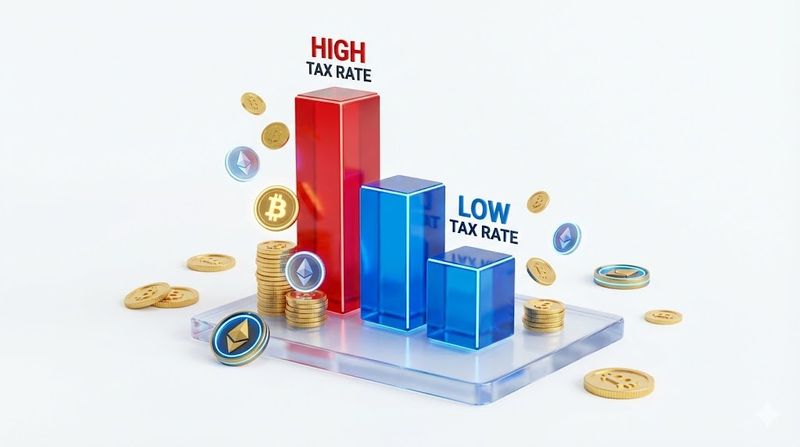
If you hold crypto assets like Bitcoin, be careful. Japan's current tax rate is up to 55% (Miscellaneous Income / Aggregate Taxation). However, major changes are planned for the 2026 tax reform.
Current Status (Until 2025)
Category: Miscellaneous Income.
Tax Rate: Combined with salary income, up to 55%.
Losses: Cannot be carried over to the next year (disappears that year).
Planned 2026 Reform (New Rules)
Separate Self-Assessment Taxation: Expected to change to a flat rate of approx. 20%, similar to stocks.
Loss Carryover: Losses may be carried over for 3 years.
Warning: Overseas Exchanges are Tracked
Thinking "If I use overseas exchanges (Binance or Bybit), I won't get caught" is a huge mistake. Japan participates in CRS (Common Reporting Standard), and overseas account information is shared with the Japanese tax office. Non-declaration will definitely be discovered.
If the calculation is too complex to handle, relying on a crypto-specialized tax accountant or calculation tool is an option.
Tax returns are not an "enemy." If done correctly, they are a chance to "get back overpaid taxes (Refunds)."
Especially with the Invoice System and Crypto Tax reforms coming in 2026, early preparation is key.
First, register for a free trial of accounting software and link your bank account. Just doing that will show you the numbers: "How much tax do I owe (or how much will I get back)?"
Q: Do foreign workers in Japan have to file a tax return every year?
A: Most salary workers don't need to file if their employer handles 年末調整 (nenmatsu chosei). You must file a 確定申告 if: you have two or more income sources, your annual income exceeds ¥20 million, you're self-employed or freelance, you want to claim home loan deductions, or you changed jobs and didn't get year-end adjustment.
Q: When is the tax return filing deadline in Japan?
A: The 確定申告 filing period is February 16 to March 15 each year for the prior calendar year. Filing online via e-Tax allows you to start from January 4 and submit any time in January–March. Late filing is possible but may incur late filing penalties if tax is owed.
Q: Can foreigners file a Japanese tax return online?
A: Yes. e-Tax allows online filing. You need either a My Number Card with IC chip reader, or your tax office-issued ID and password (obtained in person at the tax office). The system has basic English guidance but is primarily in Japanese. Tax software like freee or yayoi (confirming foreign use) can help prepare the forms.
Q: What is residence tax (住民税) and how is it different from income tax in Japan?
A: Income tax (所得税) is a national tax withheld from monthly salary. Residence tax (住民税) is a local tax (prefecture + municipality) at approximately 10% of prior year income, billed annually from June. First-year residents pay no residence tax until the second June. This creates a "deferred tax" shock for new arrivals.
Q: Can foreigners get a tax refund in Japan?
A: Yes. Common refund situations for foreigners: (1) leaving Japan mid-year means overpaid income tax, (2) first year with medical expenses over ¥100,000, (3) earthquake/disaster damage, (4) home purchase first year. File a 確定申告 or have your employer handle the adjustment. Refunds are paid to your registered Japanese bank account.
Yushi Yamamoto
CEO / Native Japanese Expert
Updated on: June 11, 2026
Disclaimer
※ The information in this article is accurate as of the time of writing. Laws and regulations may change, so please always check official sources for the latest information. We assume no liability for any damages resulting from the content of this article.






![[2026 Comparison] Rakuten Point vs V Point vs d POINT](/_next/image?url=https%3A%2F%2Fcdn.sanity.io%2Fimages%2Fs5zbl9nu%2Fproduction%2F64764f87e0bd63725773de1998f35969485517e2-1200x630.jpg%3Fauto%3Dformat%26q%3D72%26fit%3Dmax%26w%3D640&w=3840&q=75)