[2026 Guide] Japan's ¥30,000 & ¥100,000 Benefits for Foreigners: Eligibility, Deadlines & Plan B
Published on February 13, 2026
Updated on June 11, 2026
Author:JapanLifeStart Editorial Team
Money & Cards
How this guide is checked
Updated against official, partner, and reviewed site evidence where available.
Last updated: June 11, 2026
Source separation
Official or partner facts are separated from practical notes.
Fast-changing details
Prices, screening, documents, and rules can change.
Affiliate link handling
Some next-step links may be monetized.
Needs review: Approval, visa/tax/legal, availability, and campaign terms are not guaranteed. Confirm on the official or partner page.
💌
Send to Friends (Summary)
•"I heard about the ¥100,000 benefit, but I got nothing..." We explain the "Jan 1 Rule" and "Dependent Trap" blocking your payout, plus a "Plan B" to get ¥20,000 on your own immediately.
Great for LINE / WhatsApp sharing
[2026 Update] Japan’s ¥30,000 & ¥100,000 Benefit Money: When Will It Arrive? + How to Get ¥20,000 if You Missed Out
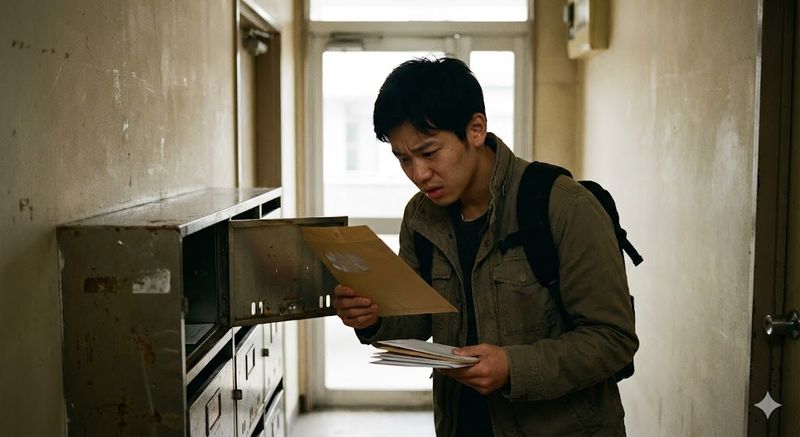
"I heard about the '¥100,000 Benefit' on the news. My friend got the envelope, but I haven't received anything... Why?"
As of 2026, Japan's benefit money system has become extremely complicated. The "¥100,000 for newly non-taxable households" and the "¥30,000 for inflation relief" are mixed together, causing confusion on social media. For foreign residents, specific rules like the "January 1st Address Rule" and the "Dependent Wall" mean that even if your income is low, you might be excluded.
In this article, we explain the latest charts to determine "how much you can get," and provide a "Plan B" to secure ¥20,000 to ¥30,000 on your own if you turn out to be "Not Eligible."
👨
Even if you aren't eligible for the government benefit, don't give up. I'll show you how to 'create' ¥20,000 yourself later in this article.
Which Benefit Money Can Foreigners Get in 2026?
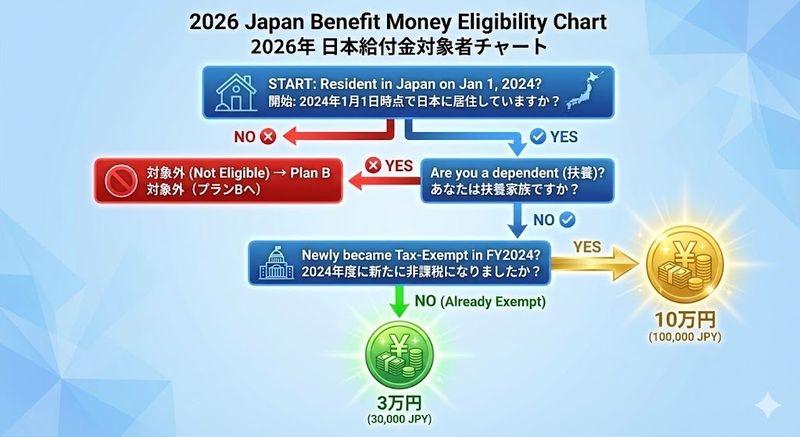
To conclude, for most foreign residents right now (Jan–Mar 2026), the realistic benefit is "¥30,000 (+ Child Addition)." You might have hoped for "¥100,000," but let's look at the conditions for each.
1. [¥100,000] For "Newly" Non-Taxable Households
This is a rescue measure for households that recently fell into poverty.
Target: Households whose income decreased in FY2024 (Reiwa 6), making them "Residence Tax Exempt" (Juminze Hikazei) for the first time.
Warning: If you received the "¥70,000" or "¥100,000" benefits in 2023 or 2024, you are NOT eligible (to prevent double dipping).
This is the main program right now. It covers a broader range of people, including those who received benefits in the past.
Target: Households that are Residence Tax Exempt as of the reference date (usually Jan 1, 2024, or Dec 1, 2024, depending on the municipality).
Timing: Notifications are arriving from late January to March 2026 in many municipalities.
Child Addition: An extra ¥20,000 to ¥50,000 per child (under 18) is added.
3. [Adjustment Benefit] Tax Cut Shortfall
This is a refund for those who couldn't fully benefit from the 2024 "Flat-rate Tax Cut" (¥40,000 cut). Payment for the shortfall is expected after Summer 2026 in many areas.
Prepare for Next Year's Benefit
If you file your taxes correctly and become 'Tax Exempt,' you could be eligible for future benefits. Start by organizing your expenses easily.
"My income is low, so why no notification?" In that case, you likely fell into one of these three traps.
1. The "January 1st Rule" Barrier
Japan's Residence Tax is determined by "Where did you live on January 1st?"
For FY2025 Benefits: Generally, if you did not have a registered address (Juminhyo) in Japan on January 1, 2024, you are not eligible.
Recent Arrivals: If you arrived in Japan on or after Jan 2, 2025, you have no tax record for the base year, so you are often treated as "Out of Scope" rather than "Non-Taxable."
2. The "Dependent" Trap
This is the biggest blind spot. Even if your annual income is under ¥1,000,000, you are excluded if:
You are a student claimed as a dependent by your parents (even if they are overseas, depending on tax treaty interpretation).
You are a homemaker claimed as a dependent by a high-earning spouse.
Many municipalities state: "Households consisting only of dependents of a taxable person are not eligible."
3. "Unknown Address" Trouble
Did you move recently? Even if you filed a "Move-in Notification" at the city hall, did you set up Mail Forwarding (e-Tenkyo) at the Post Office?
Government "Confirmation Letters" are often sent as "Do Not Forward" mail. If you aren't at the address, they are returned immediately.
[By City] When Will It Be Deposited? Latest Schedule
Procedures vary by municipality. Here is the movement as of January 2026 for major areas.
Municipality
Status
Estimated Schedule
Setagaya Ward (Tokyo)
Upcoming
Notifications sent from early Feb 2026. Payments start late Feb.
Okayama City
Ongoing
Sending starts Jan 27, 2026. Auto-deposit possible if account is registered.
Edogawa Ward (Tokyo)
Preparing
Separated into Non-Taxable (¥30k) and Income-Levy Only (¥1k). Approx 4 weeks after application.
Warning: Most municipalities have an application deadline of "3 to 6 months." If you ignore the envelope, your right to the money disappears. Open it immediately.
[Plan B] What to Do Immediately If You Are "Not Eligible"
If you are "Not Eligible," don't be depressed. There are ways to generate ¥20,000 to ¥30,000 yourself without waiting for city hall reviews. Unlike the benefit money, these are guaranteed if you take action.
1. Win the Right for "Next Year" via Tax Return (Taxnap)
Freelancers, Uber Eats drivers, and English teachers: Are you skipping your tax return (Kakutei Shinkoku) because it's "too much hassle"?
Actually, if you don't declare your expenses (smartphone bill, bicycle, part of rent) correctly, your income looks artificially high.
Risk: Your Residence Tax remains high, making you ineligible for benefits next year. Your National Health Insurance will also be expensive.
Solution: The tax return app Taxnap lets you complete expense entry with just swipes.
Benefit: By filing correctly and becoming a "Residence Tax Exempt Household," you gain eligibility for future benefits (potentially ¥50k–¥100k) and significantly lower monthly insurance premiums.
Finish Tax Return with a Swipe
English friendly. Win 'Tax Exempt' status for next year by filing correctly.
2. "Create" Your Own ¥20,000 Benefit (Rakuten Card/Mobile)
City hall takes a month to review your ¥30,000 application. This method is faster. By using Rakuten Group campaigns, you can get over 20,000 Points (¥20,000 equivalent).
Rakuten Card: 5,000 to 10,000 points for new sign-up & usage (depending on the timing).
Rakuten Mobile: If you are a Rakuten Card holder, there is a campaign giving 20,000 points back for your first application (as of 2026).
Combining these can secure an amount equal to or greater than the government benefit.
User Review★★★★★5/5
Editor's Pick
Easier than government paperwork. The 20,000 point return from Rakuten Mobile is practically a 'Benefit from a Company.' Check it out if you haven't yet.
Secure ¥20,000 Equivalent Now
Get points without waiting for the city hall using the Rakuten Mobile campaign. Start by preparing your card.
"Go to the ATM to process" or "Apply via email" is 100% a SCAM. Japanese city halls always send documents via postal mail. Never click URLs in suspicious emails.
Impact on Visa
Some worry, "Will receiving benefits hurt my visa renewal?" Receiving the benefit itself does not negatively affect your visa.
What is dangerous is "Unpaid Taxes." If you get the benefit money, pay off any unpaid Residence Tax or National Health Insurance first. The mindset of "Pay to Stay" (paying to maintain your residency) is crucial for life in Japan.
Summary: Check the Mailbox, Then Move to Plan B
The benefit system is complex, but if understood correctly, it's valuable financial support.
Check your mailbox for the envelope from your municipality.
If you are excluded due to the "Jan 1 Rule" or "Dependents," switch gears immediately.
Use Taxnap to prepare your tax return and aim for Tax Exempt status next year.
Use Rakuten Campaigns to secure immediate funds.
Take action now to survive and thrive in Japan smartly.
Related money task
If you have side or freelance income, review tax filing prep
This internal guide does not decide individual eligibility; it helps organize document prep and software options.
Q: What government benefits and subsidies can foreigners receive in Japan?
A: Foreigners with valid residence status are entitled to: child allowance (児童手当), childcare subsidies, employment insurance (雇用保険) unemployment benefits, health insurance coverage, pension benefits, welfare (生活保護) in extreme poverty cases, and various municipal-level subsidies. Eligibility depends on visa type and length of stay.
Q: Can foreigners receive unemployment benefits in Japan?
A: Yes, if you are enrolled in 雇用保険 (employment insurance), which is mandatory for employees working 20+ hours/week. When you lose your job involuntarily, you are entitled to unemployment benefits (基本手当) — typically 50–80% of your prior salary for 90–150 days depending on age and contribution period.
Q: What is the child allowance (児童手当) in Japan and can foreigners receive it?
A: 児童手当 is a universal child allowance for families with children under age 15 (expanded in 2024 to age 18). Foreigners with residence status can receive it. As of 2024, the amount is ¥15,000/month per child (ages 3 and under), ¥10,000 (ages 3–12), and ¥10,000 (ages 12–18, previously not covered).
Q: What benefits can foreigners get when their company goes bankrupt in Japan?
A: If your employer goes bankrupt owing unpaid wages, the Unpaid Wage Payment System (未払賃金立替払制度) under the Labour Standards Act allows workers including foreigners to claim up to 80% of unpaid wages (capped at about ¥2.82 million) from the government via Japan Industrial Safety and Health Association.
Q: Can foreigners on a spouse visa receive welfare (生活保護) in Japan?
A: 生活保護 (welfare) legally applies only to Japanese nationals per the Public Assistance Act. However, a 1954 ministerial circular allows foreigners with permanent residence, spouses of Japanese nationals, or long-term residents to receive welfare on a discretionary basis if destitute. It is not a right but a mercy application.
Yushi Yamamoto
CEO / Native Japanese Expert
Updated on: June 11, 2026
Disclaimer
※ The information in this article is accurate as of the time of writing. Laws and regulations may change, so please always check official sources for the latest information. We assume no liability for any damages resulting from the content of this article.





![[2026 Comparison] Rakuten Point vs V Point vs d POINT](/_next/image?url=https%3A%2F%2Fcdn.sanity.io%2Fimages%2Fs5zbl9nu%2Fproduction%2F64764f87e0bd63725773de1998f35969485517e2-1200x630.jpg%3Fauto%3Dformat%26q%3D72%26fit%3Dmax%26w%3D640&w=3840&q=75)