[2026 Edition] Conquering Coding Tests in Japan: Paiza vs. AtCoder vs. LeetCode
Published on January 25, 2026
Updated on July 20, 2026
Author:JapanLifeStart Editorial Team
Work & Study
How this guide is checked
Updated against official, partner, and reviewed site evidence where available.
Last updated: July 20, 2026
Source separation
Official or partner facts are separated from practical notes.
Fast-changing details
Prices, screening, documents, and rules can change.
Affiliate link handling
Some next-step links may be monetized.
Needs review: Approval, visa/tax/legal, availability, and campaign terms are not guaranteed. Confirm on the official or partner page.
💌
Send to Friends (Summary)
•[2026 Update] A thorough explanation of the coding test landscape for IT jobs in Japan. We reveal the priority of Paiza, AtCoder, and LeetCode, how to handle the "Language Barrier" foreigners face, and secret routes to getting hired without tests.
Great for LINE / WhatsApp sharing
"I want to work as an engineer in Japan, but is preparing with LeetCode enough?"
This is a common concern among many international engineers. To give you the bottom line: The Japanese IT recruitment market (especially for Web and Mega-ventures) has a "Galapagos-like" unique testing culture that differs slightly from global standards. If you are aiming for foreign affiliates like Google or Amazon, LeetCode alone is fine. However, if you are aiming for top-tier domestic Japanese companies, relying solely on LeetCode runs the risk of not even passing the document screening stage.
In this article, we will thoroughly explain the importance of Japan-specific platforms like Paiza and AtCoder, how to deal with tests if you cannot read Japanese, and even "backdoor routes" to win job offers without coding tests, based on the latest data for 2026.
Japan's Coding Test Landscape: Roles and Market Share of the "Big 3"
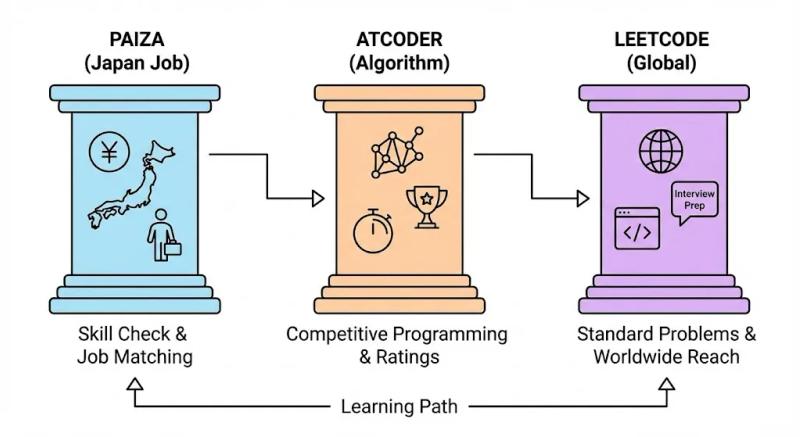
There are "three walls" in Japanese engineer recruitment. The role of each platform differs clearly, and you need to use them differently depending on the type of company you are applying to.
Comparison of the 3 Major Services
Item
Paiza
AtCoder
LeetCode
Main Use
Skill check linked directly to jobs
Competitive Programming (Contests)
Global standard interview prep
Target
Japanese Web & In-house Dev Companies
Mega-ventures & AI Companies
Foreign Affiliates & Global Firms
Key Indicator
Rank (S/A/B/C)
Color/Rate (Brown, Green, etc.)
AC Count & Contest Rating
Japanese Dependency
High (Questions are in Japanese)
Medium (Eng/JP available, but info is JP-heavy)
Low (English based)
Feature
Rank acquisition skips document screening
"Green" or higher = Immediate asset
Best for building basic stamina
Key Strategy for Each Platform
Paiza (Direct-to-Hire Type): This is the standard for Japanese web and in-house development companies. "Rank B or higher" is often a mandatory application requirement (cutoff line) for many companies, and without it, you often cannot even stand at the starting line.
AtCoder (Algorithm Specialized): This is a powerful weapon for companies that emphasize technical prowess, such as LINE Yahoo, Mercari, and AI startups. If you hold a "Green (Rating 800)" or higher, the coding test itself may sometimes be waived.
LeetCode (Global Standard): Essential for Rakuten (where English is the official language) and foreign companies. However, the reality is that many recruiters at traditional Japanese companies do not know how to evaluate LeetCode achievements.
👨
Conclusion: If aiming for foreign firms, use LeetCode. For Japanese mega-ventures, AtCoder. For general Japanese companies, Paiza is the strongest passport.
If you are unsure which platform you should focus on or want to know which companies you can pass with your current skills, consulting an agent familiar with corporate hiring standards is the shortest route. TechGo is particularly knowledgeable about the "behind-the-scenes" of engineer selection and can match you with companies that will maximize the evaluation of your track record.
Diagnose your market value with TechGo
TechGo is a high-return agent specializing in IT engineers. Professional advisors will diagnose where your coding skills are valued most for free. You might even find hidden 'test-exempt' job openings.
Instead of "vaguely preparing," having specific numerical goals is the key to success. Here are the benchmarks based on market data.
1. Adoption Rate and Status
Approximately 60-80% of Web-based in-house development and startup companies conduct some form of coding test. On the other hand, the implementation rate is lower for SIers and SES companies, where many cases only involve SPI (aptitude tests).
2. Target Passing Lines
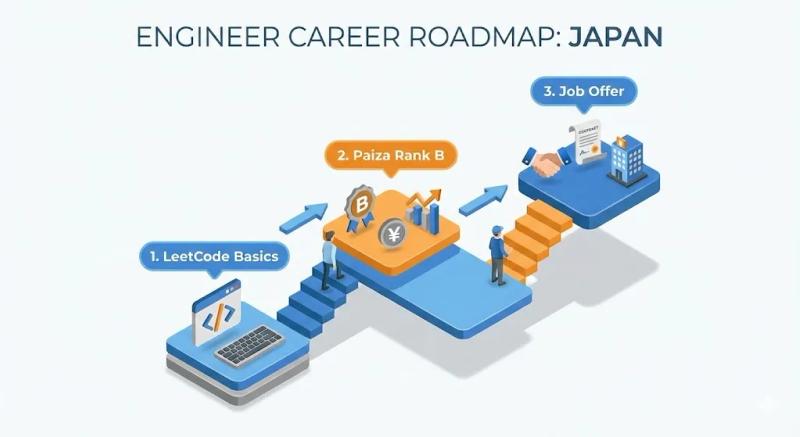
Paiza: First, acquire Rank B. This proves implementation skills for basic algorithms (loops, conditionals, array manipulation) and is the minimum line for many companies. Data suggests that acquiring Rank S can increase your average annual salary by approx. ¥830,000, so you should aim for S if you want a high salary.
AtCoder: It becomes a plus on your resume starting from Brown (Rating 400+). If you reach Green (Rating 800+), many companies will consider your algorithmic skills sufficient and treat you as an immediate asset.
3. Exam Format
Take-home formats are more mainstream than live coding over Zoom. It is common to have 60-90 minutes to solve 2-3 questions. While you can often choose languages like Python, Java, or C++ freely, be careful with execution speed differences depending on the language submitted (especially on platforms like Paiza).
[Real Survey] The Japanese Barrier & Translation Tools
On Reddit and SNS, international engineers are screaming: "I have the technical skills, but I failed because I couldn't read the Japanese problem statement."
Failure Story: The RPG Setting Trap
A characteristic of Japanese coding tests (especially Paiza) is that the problem text is often story-based (e.g., "Calculate items a wizard buys"). Even if the calculation is technically simple, candidates often run out of time trying to decipher the unique Japanese setting.
The Gray Zone of Translation Tools
AtCoder: Using translation tools (DeepL, Google Translate, etc.) during practice or contests is generally tacitly approved or permitted as an aid for understanding the problem (Note: AI code generation is prohibited).
Corporate Employment Tests: This requires caution. Depending on the web test monitoring system, browser translation extensions or moving focus outside the screen may be detected as "cheating."
Solution: Tech Japanese Vocabulary List
The safest measure is to memorize frequently used technical Japanese terms.
Just remembering these will dramatically improve your speed in understanding the problems.
For Those Bad at Tests: "Avoidance Routes" & Using Agents
"I just can't pass coding tests." "I'm not confident in my Japanese reading skills."
For such people, strategic avoidance routes exist.
1. Portfolio Hiring (Hiring Without Whiteboards)
Some companies will waive the coding test by evaluating your GitHub activity history or personal apps you have developed. This trend is particularly common in startups that value the ability to build "working products."
2. "Selection Adjustment" by Agents
This is the most realistic and effective method. When applying via an agent with a track record, the person in charge may negotiate with the company: "He has a sufficient GitHub track record, so can you waive (or relax) the test?"
Specialized engineer agents like TechClips Agent and TechGo have strong pipes with companies and can share trends in past questions or introduce you to "special selection routes" where offers are made without tests.
Find test-avoidance routes with TechClips Agent
TechClips specializes in high-salary, in-house development companies. They appeal your GitHub and portfolio directly to companies and support negotiations to skip disadvantageous test screenings.
Japanese coding tests test not only "technical skills" but also "Japanese specification comprehension skills." Use Paiza or AtCoder according to your target company and prepare efficiently. If you get stuck preparing alone, consulting an agent who knows the situation well to find a "test avoidance route" is also a smart strategy.
Succeed in your [Engineer Job](/en/work-study/it-engineer-career-change) change with TechGo
Full support from test prep to salary negotiation. Eliminate anxiety about coding tests and guide you to companies that properly evaluate you.
I struggled with the Japanese explanations on AtCoder, but thanks to the agent telling me past question trends, I got an offer from a mega-venture. Prior information gathering is truly important.
Save this guide for later?
You might need this information again. Bookmark this page to access it anytime.
Press Ctrl + D to Bookmark
Get the Latest Visa Updates
Receive important updates about visa requirements and new residence statuses directly to your inbox.
Share this article
Reading this in English?
Help improve English guides like this
If this guide helped but a phrase felt unnatural, your native check can make the next English article clearer for foreign residents in Japan.
Q: What is Paiza and how does it help foreign IT engineers find jobs in Japan?
A: Paiza is Japan's major IT job platform where your ranking (S, A, B, C, D) is determined by programming challenges. Achieving B rank or above allows you to receive job offers from partner companies without a traditional résumé screening. Particularly useful for foreign engineers whose Japanese résumés may be weak but coding skills are strong.
Q: What is AtCoder and does a high AtCoder rating help with Japanese tech job applications?
A: AtCoder is Japan's premier competitive programming platform. A rating of 1200+ (green, "有段者") is highly regarded and mentioned on résumés. Top Japanese tech companies (LINE, Mercari, DeNA, Recruit) actively recruit from AtCoder. For algorithmic roles, high AtCoder rating can substitute for traditional interview screening steps.
Q: How important are coding tests in Japanese IT company hiring processes?
A: Coding tests are standard at major IT companies in Japan (Mercari, PayPay, LINE, global tech). They typically involve 2–4 LeetCode-style algorithm problems of medium difficulty. Paiza challenges are simpler data manipulation tasks. Traditional Japanese companies (SES, system integrators) rarely use coding tests.
Q: What is the typical IT job interview process at a Japanese company?
A: Typical process: (1) Application/résumé screening, (2) Coding test (online), (3) First technical interview (algorithm + background), (4) Second interview (technical deep dive + cultural fit), (5) HR interview (offers, conditions). Total: 3–6 weeks. Global tech companies in Japan follow similar processes to their international offices.
Q: How should foreign engineers prepare for a technical interview at a Japanese IT company?
A: Preparation checklist: (1) 50–100 LeetCode problems (easy+medium), (2) Paiza B rank practice, (3) Review system design fundamentals (Designing Data-Intensive Applications), (4) Practice explaining solutions in Japanese (tech vocabulary), (5) Prepare STAR-format behavioral examples in Japanese or English depending on the company.
Yushi Yamamoto
CEO / Native Japanese Expert
Updated on: July 20, 2026
Disclaimer
※ The information in this article is accurate as of the time of writing. Laws and regulations may change, so please always check official sources for the latest information. We assume no liability for any damages resulting from the content of this article.