The Ultimate Guide to Recruitment Agents in Japan for IT Engineers & Programmers
Published on December 16, 2025
Updated on July 27, 2026
Author:JapanLifeStart Editorial Team
Work & Study
How this guide is checked
Updated against official, partner, and reviewed site evidence where available.
Last updated: July 27, 2026
Source separation
Official or partner facts are separated from practical notes.
Fast-changing details
Prices, screening, documents, and rules can change.
Affiliate link handling
Some next-step links may be monetized.
Needs review: Approval, visa/tax/legal, availability, and campaign terms are not guaranteed. Confirm on the official or partner page.
💌
Send to Friends (Summary)
•For engineers looking to switch jobs in Japan: A complete guide on English-friendly job boards, how to choose the right recruitment agent, and how to avoid common pitfalls during the application process.
Great for LINE / WhatsApp sharing
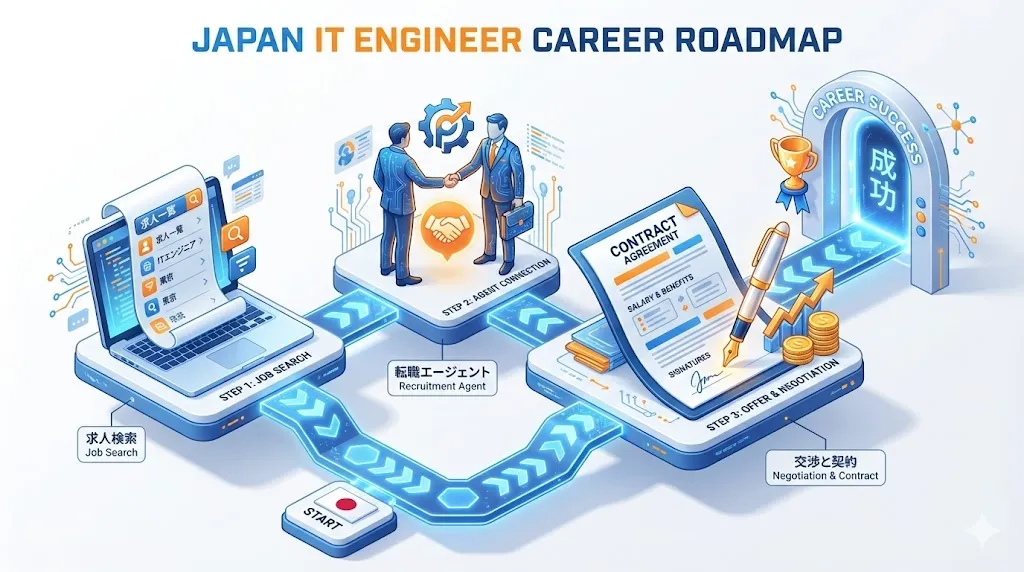
If you are looking to switch IT jobs in Japan, the fastest route is a three-step process: "Build a pool of options via English-friendly Job Boards" → "Negotiate conditions using a strong Agent" → "Run parallel applications while avoiding duplicate submissions."
Many foreign engineers tend to give up, thinking, "My Japanese isn't perfect." However, the reality is that high-class jobs that require only English are concentrated in Tokyo.
This guide hands you the "winning formula" upfront. All you have to do is follow the steps.
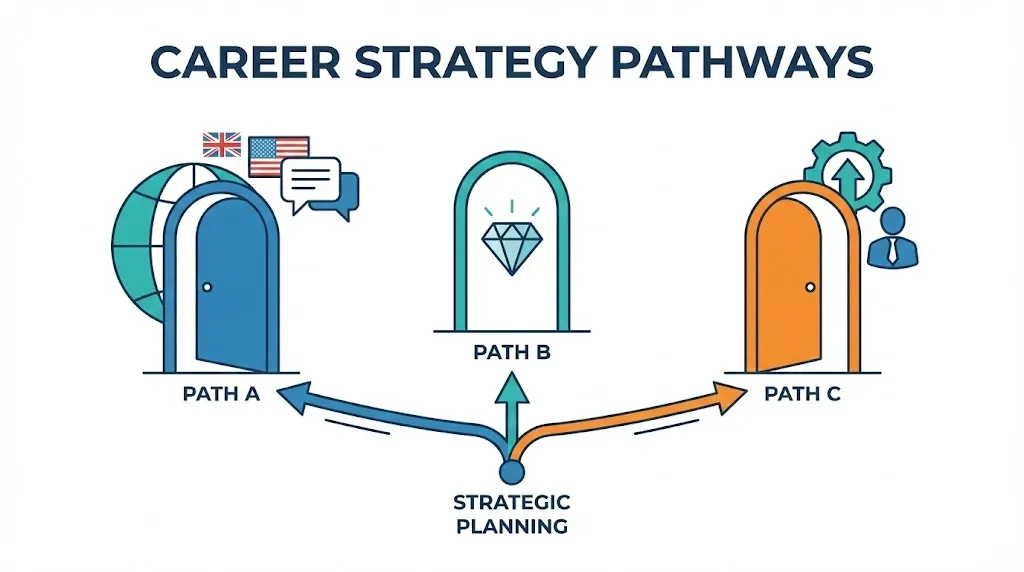
Conclusion: Which Route is Fastest for You? (3 Patterns)
First, decide which category fits you best.
A: You want to work primarily in English (Little to no Japanese confidence)
→ Start with TokyoDev or Japan Dev. This is the fastest path.
B: You are targeting Foreign Tech / High-Class roles (Salary bump)
→ Consult with Robert Walters (Tech), but keep using job boards for comparison to stay safe.
C: You are eyeing Global Japanese firms / Management roles (Manager/Specialist)
→ A "360-style" agency like JAC Recruitment, where consultants handle both sides deeply, will likely fit you best.
Browse English-Friendly IT Jobs
Check the market size on TokyoDev and Japan Dev first
How Japanese Recruitment Agents Work (Why it's free & the rules behind the scenes)
Let’s get one thing straight: Recruitment agents are basically free for job seekers.
In exchange, agents operate on a business model where they generate revenue upon "successful hiring by the company." This means if you get matched with an incompatible agent, you might experience "shoehorning" (being pushed into a job just so they can get the commission).
You only need to know two differences here:
Division-of-Labour Model
The Candidate Advisor (CA) and the Recruiting Advisor (RA - who talks to companies) are different people. Large agencies often use this pattern; they are good at gathering a large volume of job openings.
360 Style
One consultant looks after both the company and the candidate (JAC Recruitment uses this model). Their strength is that they know the company's internal situation and the "real background" behind the hiring.
Neither is strictly "correct," but choosing based on "how solid your requirements are" helps avoid failure.
If your requirements are set in stone (salary, role, work style are clear), the Division-of-Labour model works fine. If your requirements are still vague, the 360 Style is easier because they can help you refine your search based on "insider company info."
Reverse Engineering from Failures: The Recruiter "Red Flag" Check
Discussions on Reddit and social media regarding bad recruiter experiences usually converge on these patterns:
User Review★★★☆☆3/5
Reddit/SNS Consensus
Slow replies or ghosting halfway through
(= You are being treated as a low-priority candidate)
Being flooded with irrelevant job descriptions
(= They aren't reading your CV; just auto-sending based on keyword matches)
Being rushed to "Apply Now"
(= The agent's monthly quota is being prioritized over your career)
No realistic explanation regarding salary expectations
(= Weak negotiation skills, or they only introduce companies looking for cheap labor)
:::
The recommended way to avoid this is simple. Ask these 5 questions during the initial interview and gauge their reaction.
"Have you had any successful placements with conditions similar to mine in the last month?"
"Before I apply, what do you see as the company's main concerns regarding my profile?"
"What specific points will be evaluated during the interview?"
"Realistically, how many companies should I apply to in parallel?"
"How do you manage duplicate applications to the same company?" (This is crucial)
A decent agent will be able to answer these specifically and immediately. If they stumble, consider changing your representative.
Build Your Pool First: Who Should Use TokyoDev / Japan Dev
If you want to work primarily in English, the first thing you must do is go where the "English-friendly jobs gather."
TokyoDev operates as a job board specifically for English-speaking developers, providing lists of jobs that are open to overseas applicants.
Japan Dev similarly handles development jobs for English speakers and officially emphasizes "curation" (strict selection). A feature is the high number of Silicon Valley-style companies and companies adopting modern tech stacks.
The strongest advantage of these platforms is that it is easy to find jobs that premise an "English environment" from the start.
Pro Tip: Strategic Usage
Day 1: Narrow down to one job category (e.g., Backend / Mobile / Data).
Day 2: Narrow down your application axis to three criteria (Salary, Remote work, Tech stack).
Day 3: Apply to only 10 companies. (Mass applying will lead to management chaos and accidents later).
View Curated Jobs on Japan Dev
The place to find modern tech stacks and English environments
Aiming for Foreign/High-Class: When to Use Robert Walters (Tech)
If you want to "increase your salary" or "move into a foreign/global environment," the standard move is to enter through a specialized team like the Technology division of Robert Walters.
They have specialized teams for the IT/Tech sector, and the conversation level is different from generalist recruiters.
The winning strategy here is "Negotiation" rather than just searching.
Grasp the "market rate" using job boards, then give the agent comparison materials like "I'm seeing offers around X amount elsewhere" to strengthen your salary negotiation. This is the most reproducible method.
Management & Global Japanese Firms: When to Use JAC Recruitment
JAC Recruitment adopts the 360 style (same consultant for client and candidate) as its core strength.
In my experience, JAC is a great fit for:
People whose roles are IT but complex, such as "PM," "Engineering Manager," or "Specialist."
People who want to decide after understanding the company culture and organizational situation (e.g., who the boss will be).
People who want to minimize "post-hiring mismatch" (avoiding short-term turnover that hurts your CV).
Conversely, if you are a junior engineer prioritizing speed, it’s not too late to try them after hitting the job boards first.
Parallel Usage is Standard: Preventing Duplicate Application Troubles (Absolute Must)
Using multiple agents or media simultaneously is normal and recommended.
However, the worst-case scenario is a Double Booking accident (applying to the same company via different routes). Doing this damages your reputation with the company or halts the selection process.
Therefore, create a simple Management Sheet (Spreadsheet).
Company Name
Job URL
Application Date
Route (TokyoDev / Japan Dev / RW / JAC, etc.)
Contact Person Name
Current Status
Just having this one sheet eliminates almost all downsides of parallel applications. When talking to a new agent, always show this list and say, "I have already applied to these companies."
Aligning "Hirable Conditions" with Reality (Japanese, Experience, Location)
A common pattern for stalling seen on social media is running only on "what I want to do" without looking at "hirable conditions."
Using places like TokyoDev and Japan Dev, which have many jobs for English speakers, is a shortcut to solve this.
Also, eligibility for overseas applications varies clearly by media and job posting. If you are moving from abroad, prioritize job groups with clear tags like "Visa sponsorship available" or "Apply from abroad." Applying to jobs where this is ambiguous often results in wasted effort because you were "out of scope from the start."
Offer Negotiation: The Practicality of Raising Salary
Negotiation isn't about guts; it's about "Materials."
Here is how to create those materials:
Gather 3 "jobs with similar conditions" from job boards (Create a basis for the market rate).
Give the agent the premise that "I am comparing with other companies" (Create legitimacy for negotiation).
Look at conditions as a package, not just "Annual Salary," but also remote work, job title, and technical discretion.
While complaints like "weak offers / gap in expectations" are common, moving with a "comparison premise" from the beginning is the most stable approach.
For Freelancers & Remote Seekers: CrowdWorks Tech (100,000 JPY Bonus)
If you are looking for freelance projects or high-unit-price remote work rather than a traditional full-time position, CrowdWorks Tech is one of the top platforms in Japan.
Currently, they are running a referral program. If you register through the link below and work for at least one month, you will receive a 100,000 JPY "Support Bonus."
If you've read this far, checking these next two articles will further reduce your risk of failure.
Especially the "Bank Account" guide—trying to open one after getting an offer can sometimes be too late, so check it now.
Q: If I'm applying from overseas, where should I start?
A: First, look for jobs with "Visa sponsorship" on TokyoDev or Japan Dev. At the same time, update your LinkedIn profile and set your preferred location to "Japan" so recruiters can find you more easily.
Q: Where do I get stuck if I don't speak Japanese?
A: While development work often runs in English, contract documents and HR procedures may require Japanese. If you use an agent, confirm beforehand if they can support you with these administrative procedures.
Q: What is the appropriate number of agents to use simultaneously?
A: 2 to 3 is the limit for easy management. A combination of "1 English Job Board" + "1-2 Agents" is usually the best balance.
Save this guide for later?
You might need this information again. Bookmark this page to access it anytime.
Press Ctrl + D to Bookmark
Get the Latest Visa Updates
Receive important updates about visa requirements and new residence statuses directly to your inbox.
Share this article
Reading this in English?
Help improve English guides like this
If this guide helped but a phrase felt unnatural, your native check can make the next English article clearer for foreign residents in Japan.
Q: What types of IT engineering jobs are available for foreigners in Japan?
A: Main categories: (1) SES (System Engineering Service — client dispatching), (2) In-house development at product companies, (3) System integrators (SIer — project-based IT services), (4) Foreign tech companies with Japan offices (Google, Microsoft, Amazon, Meta), (5) Startups. Foreign engineers are most valued in web development, cloud infrastructure, AI/ML, and mobile development.
Q: What Japanese language level do I need to get an IT job in Japan?
A: It depends heavily on the company type: Global tech companies (English-first): N4–N3 sufficient. International startups: often English-only acceptable. Japanese product companies (Mercari, Paypay): N3–N2 expected for daily work. Traditional SIer: N2 almost mandatory. SES companies: N3–N4 often sufficient. N2 dramatically expands your options across all company types.
Q: How do I find IT jobs in Japan as a foreigner without experience?
A: Path for no-experience candidates: (1) Complete a coding bootcamp or self-study for 4–6 months, (2) Build a GitHub portfolio with 3+ projects, (3) Get Paiza B rank or above, (4) Apply to SES companies (lowest bar for hiring without experience), (5) Simultaneously apply to startups via Wantedly — some hire motivated candidates without experience.
Q: What is the hiring process like at Japanese IT companies for foreigners?
A: Typical flow: online application (or recruiter introduction) → document screening (resume/CV + GitHub) → coding test → 2–3 rounds of technical interviews → HR interview → offer. Traditional Japanese companies add: aptitude test (SPI), written essay. Process takes 3–8 weeks at startups and 6–12 weeks at large companies. Bring business cards (名刺) to in-person interviews.
Q: What salary should a foreign IT engineer expect in Japan?
A: Salary by experience level: Graduate/No experience: ¥3.0M–3.5M. 1–3 years: ¥3.5M–5.0M. 3–7 years: ¥5.0M–8.0M. Senior/Lead 7+ years: ¥7.0M–12.0M+. Global tech companies pay significantly above these ranges. Salaries at traditional Japanese companies are 30–50% below global tech; gaishikei and Japanese product companies are market-rate.
Yushi Yamamoto
CEO / Native Japanese Expert
Updated on: July 27, 2026
Disclaimer
※ The information in this article is accurate as of the time of writing. Laws and regulations may change, so please always check official sources for the latest information. We assume no liability for any damages resulting from the content of this article.