"I want to save money quickly in Japan," "Rent is so high I have no savings left"—these are complaints I hear constantly from my international friends.
Actually, Factory & Manufacturing Jobs are experiencing a quiet boom among foreigners who want to earn serious money. The reasons are simple:
✅ ¥0 Dormitory Fees (Utilities included): Zero burden for rent.
✅ ¥300,000 - ¥350,000 Monthly Income: Very realistic.
✅ JLPT N4 Level OK: Low hurdle for hiring.
Stop exhausting yourself with convenience store or restaurant shifts. In this article, I’ll teach you everything from a "senpai" perspective—from how to choose the right job site to earn smartly, to the real risks involved.

Why Factory Jobs Are Popular Among Foreigners [Save ¥840k/Year with Free Housing]
Truth #1: Free Dorm = Saving ¥840,000 Annually on Rent & Utilities
If you rent an apartment in Tokyo, rent alone can easily cost ¥70,000 a month. Add utilities, and you're looking at ¥80,000 per month. That's ¥960,000 a year in fixed costs.
But with factory jobs offering free dormitories, this entire cost becomes zero.
Even with the same gross monthly income of ¥250,000:
- Convenience Store (Paying Rent): Take-home pay approx. ¥170,000
- Factory (Free Dorm): Take-home pay approx. ¥250,000
The difference is ¥960,000 per year. That is massive.
Truth #2: Hourly Wage ¥1,400–¥1,800 + Late Night Allowance = ¥300k–¥350k/Month
The market rate for factory wages is ¥1,400–¥1,800. Plus, with overtime and late-night allowances piling up, exceeding ¥300,000 a month is standard.
| Item | Konbini (Tokyo) | Factory (Kikan-kou) |
|---|
| Hourly Wage | ¥1,200 | ¥1,600 |
| Overtime Pay | None | ¥2,080/hr |
| Late Night Pay | None | ¥400/hr |
| Monthly Income Ex. | ¥192,000 | ¥313,600 |
| Rent & Utilities | -¥80,000 | ¥0 |
| Possible Savings | ¥112,000 | ¥250,000 |
The difference is about ¥130,000 per month. That calculates to over ¥1.5 million in savings per year.
As you can see in Cost of Living in Tokyo: Real Breakdown of Rent & Utilities, saving money while living normally in Tokyo is incredibly hard. That's why the "¥0 Dormitory" perk in factories is essentially a cheat code for life in Japan.
Truth #3: JLPT N4 is OK. Hiring Barrier is Low
Do you think "I can't get a job without N2"? That's not true for factories.
If you have N4 level (basic daily conversation), you will almost certainly get hired. The reasons are:
- Simple tasks mean difficult Japanese is unnecessary.
- Understanding "safety confirmation instructions" is often enough.
- If you have "motivation" and "good health," you're hired.
In fact, I see many posts on foreign forums saying, "I barely speak Japanese but got hired."
[Trap Alert] Two Types of Factory Jobs: Kikan-kou vs. Dispatch [¥1 Million Difference]
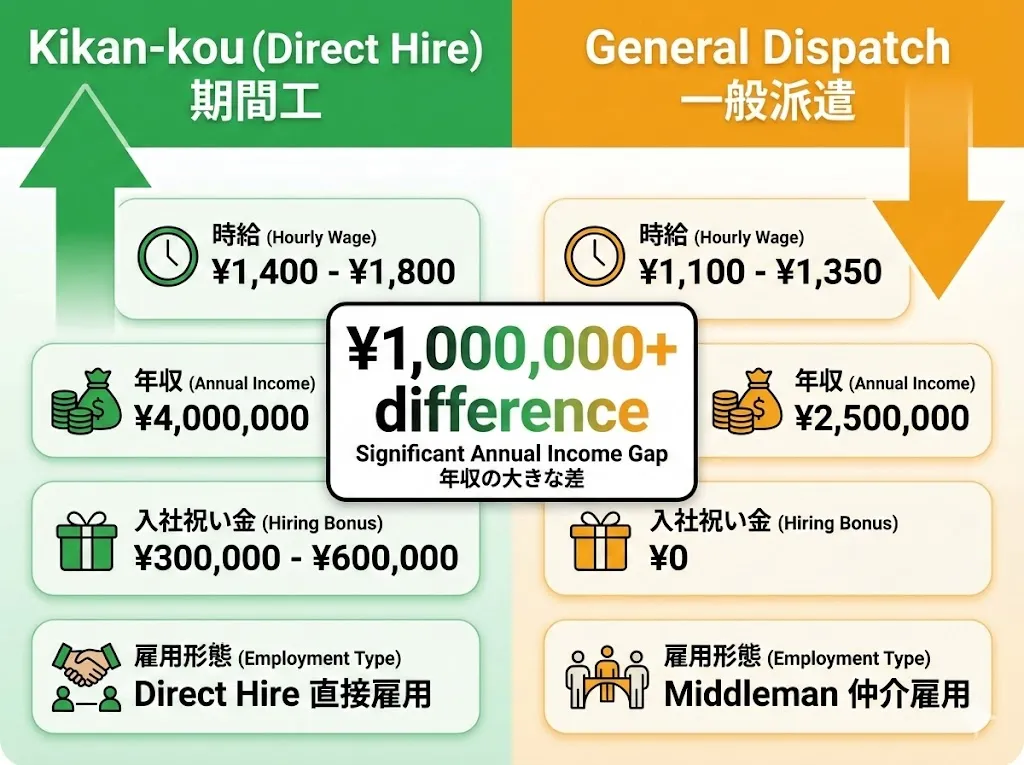
This is super important. There are two types of factory jobs, and choosing the wrong one can cost you over ¥1 million in lost annual income.
① Kikan-kou (Contract Employee): Direct Hire by Manufacturer [High Income]
- Employment: Direct hire by manufacturers like Toyota, Subaru, etc.
- Hourly Wage: ¥1,400–¥1,800
- Bonus: Joining Bonus ¥300k–¥600k + Completion Bonus
- Annual Income: ¥4 million is realistic
② General Dispatch (Haken): Via Agency [Lower Income]
- Employment: Dispatch company takes a cut
- Hourly Wage: ¥1,100–¥1,350
- Bonus: None
- Annual Income: Around ¥2.5 million
Conclusion: Aim for "Kikan-kou" or high-condition jobs.
Dispatch agencies will tell you, "It's easy to apply!" but in reality, they are taking about 30% of your potential wages. If you go for direct manufacturer hires or high-treatment jobs, all that money goes into your pocket.
The smart way is to compare jobs on major job sites.
Over 30,000 Jobs! Find Free Dorm & High Income Factory Jobs
Numerous listings from major manufacturers like Toyota & Nissan. Jobs with signing bonuses up to ¥500,000 + monthly income over ¥300,000 available. N4 level accepted. Free registration & consultation.
Top 3 Factory Job Sites & Agents Popular with Foreigners
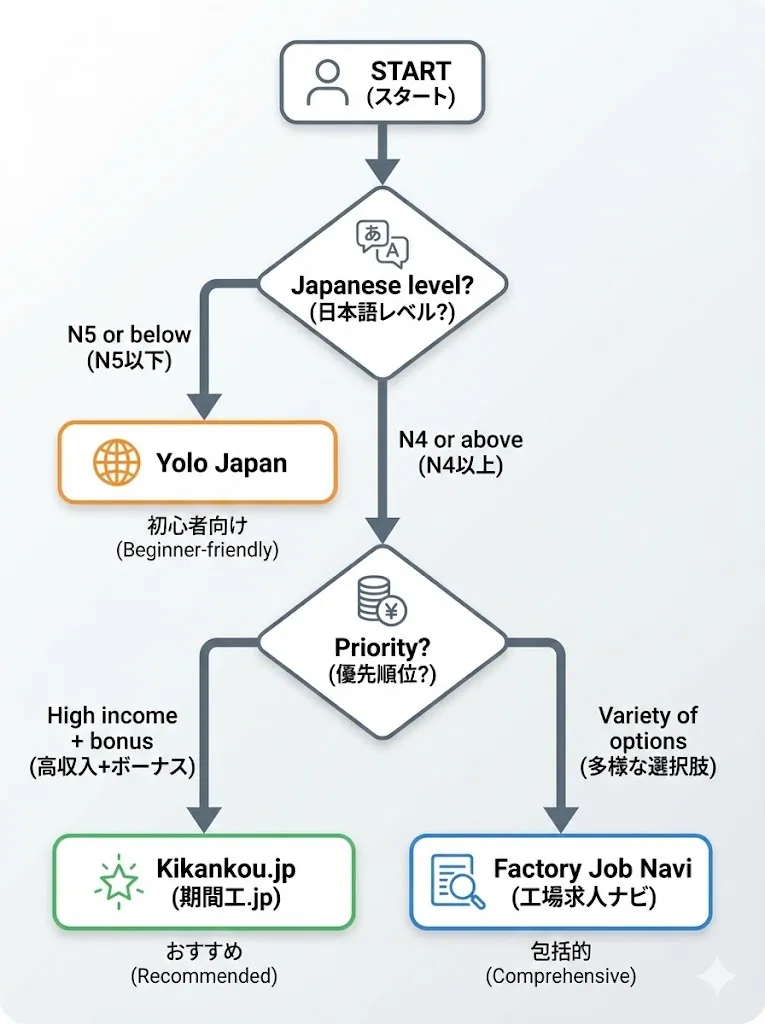
Which site should you actually use? Here are 3 recommendations based on your goals.
① Kojo Kyujin Navi: No.1 Job Count [Best Balance]
- Features: Over 30,000 factory jobs nationwide. Ranges from major manufacturers to SMEs.
- Hourly Wage: ¥1,200–¥1,800
- Signing Bonus: Up to ¥500,000 (depends on the job)
- Free Dorm: Can be filtered in search
- Japanese Req: N4–N3
- Rating: ⭐⭐⭐⭐⭐
Recommended for:
"I want to choose from many options," "I'm looking for high income with free housing," "I want to compare Kikan-kou and dispatch jobs."
Strengths of Kojo Kyujin Navi:
- Operated by Nisso Kosan, the industry leader.
- Abundant Kikan-kou jobs from Toyota, Nissan, Honda, etc.
- Many listings include photos of the dorms, so you can check beforehand.
- Japanese support available via Phone/LINE.
Find High Income & Free Dorm Jobs on Kojo Kyujin Navi
Over 30,000 factory jobs listed nationwide. Many offers with free dorms and signing bonuses. From major manufacturer Kikan-kou to light work. Free registration & consultation.
② Yolo Japan / GaijinPot: Foreign Language Support [For Beginners]
- Features: English & Vietnamese support. Foreigner-friendly UI.
- Hourly Wage: ¥1,100–¥1,350
- Free Dorm: Varies by job
- Japanese Req: N5–N4
- Rating: ⭐⭐⭐⭐
Recommended for:
"I'm not confident in my Japanese yet," "I want to apply in English," "I just want to start working."
③ Hello Work (Public Employment Service Office): Government Run [For Security]
- Features: Government-operated free job placement service. Has counters specifically for foreigners.
- Hourly Wage: ¥1,100–¥1,500
- Free Dorm: Depends on the job
- Japanese Req: N4–N3
- Rating: ⭐⭐⭐
Recommended for:
"I want to find a job securely through a public institution," "I want to consult with someone while deciding."
Summary Comparison Table
| Site Name | Hourly Wage Est. | Free Dorm | Japanese Level | Features |
|---|
| Kojo Kyujin Navi | ¥1,200–¥1,800 | ○ | N4–N3 | No.1 Listings, Many Major Manufacturers, Kikan-kou |
| Yolo Japan | ¥1,100–¥1,350 | △ | N5–N4 | Multilingual Support, Beginner Friendly |
| Hello Work | ¥1,100–¥1,500 | △ | N4–N3 | Public Institution, Free Consultation |
The Truth About "¥0 Dorm Fees" [Pros & Cons Explained]
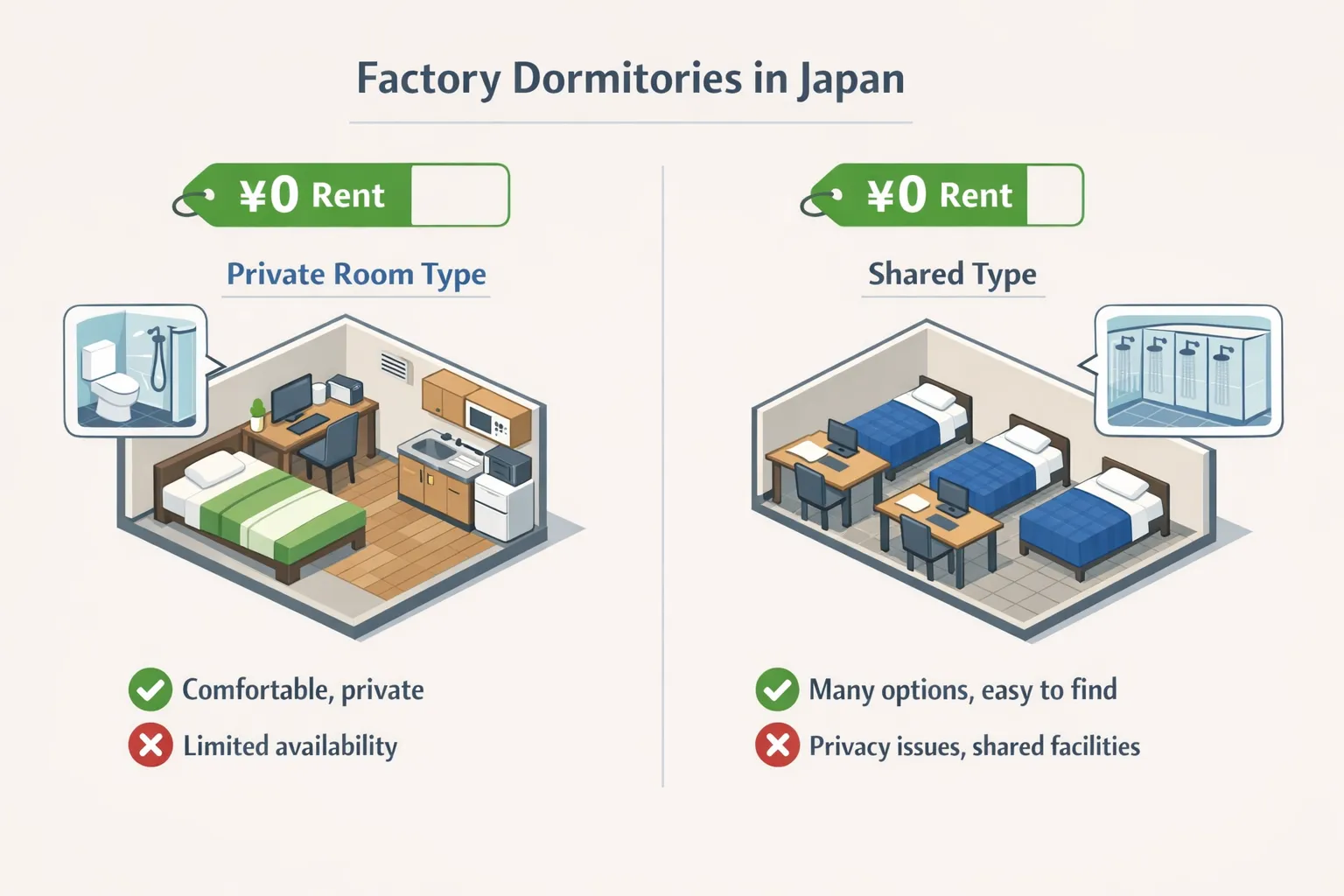
"Is free rent really true? Is there a catch?" I hear you. I'll be honest about the actual merits and demerits.
Merits: Living Costs plummet
① Completely Free including Utilities (Save ~¥70,000/month)
Not just rent, but water, electricity, and gas are often included. This alone saves you ¥70,000 a month.
② Furnished. Move in Immediately with Zero Initial Cost
Regular rentals require about ¥300,000 in key money and deposits, but factory dorms come fully furnished. Fridge, washing machine, bed, AC—it's all there. You can start living with just one suitcase.
③ Zero Commute Time (On-site or Walking Distance)
Dorms are usually right next to the factory (or on the grounds), so commute time is 5–10 minutes. Zero stress from crowded trains.
Demerits: Don't Expect Luxury
① Possibility of Shared Bath/Toilet (Shared Dorms)
A common horror story on forums is "Shared bathroom was hell." Even with major manufacturers, older dorms might have shared baths and toilets.
Recently, private room types (with unit baths) are increasing, but always check before applying. Kojo Kyujin Navi has many listings with photos, making it easier to check.
② Isolation in Rural Industrial Zones
Factories are often located in rural industrial zones, not cities. There's nothing around. Driving 20 minutes to a convenience store is normal.
The loneliness of "nowhere to go on weekends" and "can't make friends" can be mentally tough.
③ Strict Rules (Curfews, No Visitors)
Some dorms have curfews or ban visitors (friends). Not suitable for those who value privacy.
Solution:
If the dorm doesn't suit you, save up for a few months and rent your own apartment. Check out the Complete Roadmap to Renting an Apartment in Japan.
[By Visa Type] Requirements for Foreigners in Factory Jobs
For those worried, "Can I work in a factory with my visa?", here are the conditions by visa type.
① International Student: Permission to Engage in Activity other than Permitted (Up to 28 hrs/week)
- Status: ○ (Restricted to 28 hours/week)
- Note: Time management is strict for night shifts. Exceeding the limit is illegal labor.
② Dependent / Spouse Visa: No Restrictions
- Status: ○ (Full-time OK)
- Note: None. You have the most freedom to work.
③ Specified Skilled Worker (Type 1 - Manufacturing): Stable Employment
- Status: ○ (3 Fields: Machine Parts, Industrial Machinery, Electric/Electronics)
- Salary: ¥250k–¥300k/month
- Exam: JFT-Basic (Japanese) + Manufacturing Skill Exam
Getting a Specified Skilled Worker visa allows you to move to stable employment. Worth considering if you want to work long-term.
④ Technical Intern Training: Via Supervising Organizations Only
- Status: ○ (Individual application not possible)
- Note: This is for those already in Japan as trainees. Does not apply to those looking for jobs independently.
[Real Life] Simulation: How to Earn ¥300k/Month
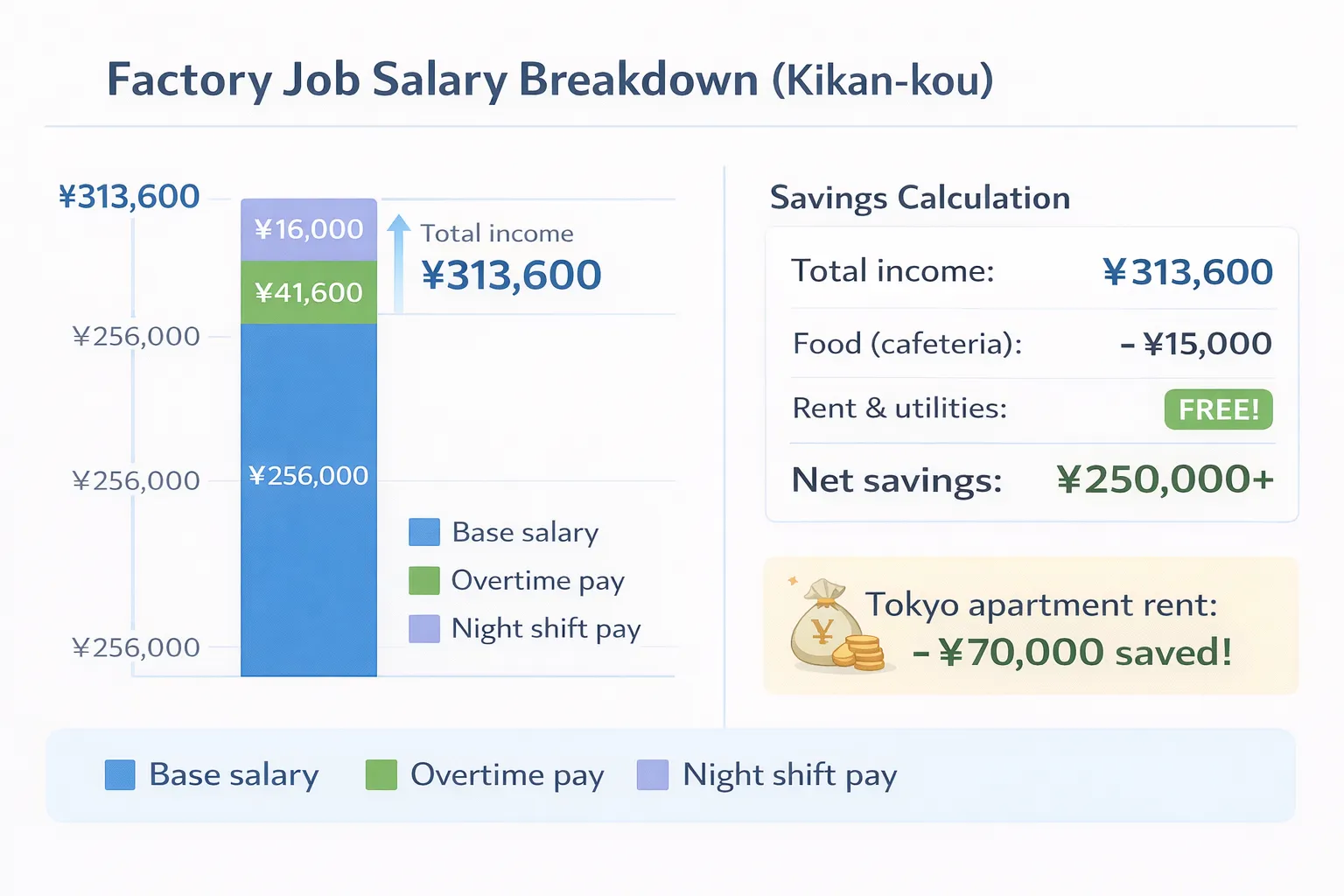
"Can I really earn 300k?" Here is an actual salary model.
Model Case (Kikan-kou / N4 Level)
- Base Wage: ¥1,600 × 160 hours = ¥256,000
- Overtime: ¥2,080 × 20 hours = ¥41,600
- Late Night: ¥400 × 40 hours = ¥16,000
- Total Monthly Income: ¥313,600
Expenses:
- Dorm/Utilities: ¥0
- Food (Cafeteria): ¥15,000
- Others: ¥50,000
Possible Savings: ¥200,000 – ¥250,000 / month
Comparison: Tokyo Convenience Store Job
-
Konbini in Tokyo:
- Income: ¥180,000
- Rent: ¥70,000
- Utilities: ¥10,000
- → Savings: ¥100,000/month
-
Factory (Kikan-kou):
- Income: ¥310,000
- Rent/Utilities: ¥0
- → Savings: ¥250,000/month
Difference: ¥1.8 million per year!
This is the power of "¥0 Dorm Fees." Working the same hours, you can save nearly double.
You Can Earn ¥300k Too! Check Free Jobs Now
Many high-income jobs like the simulation above are listed. Jobs with free dorms and signing bonuses available. Free registration & consultation.
[Hired with N4] Factory Job Application & Interview Guide
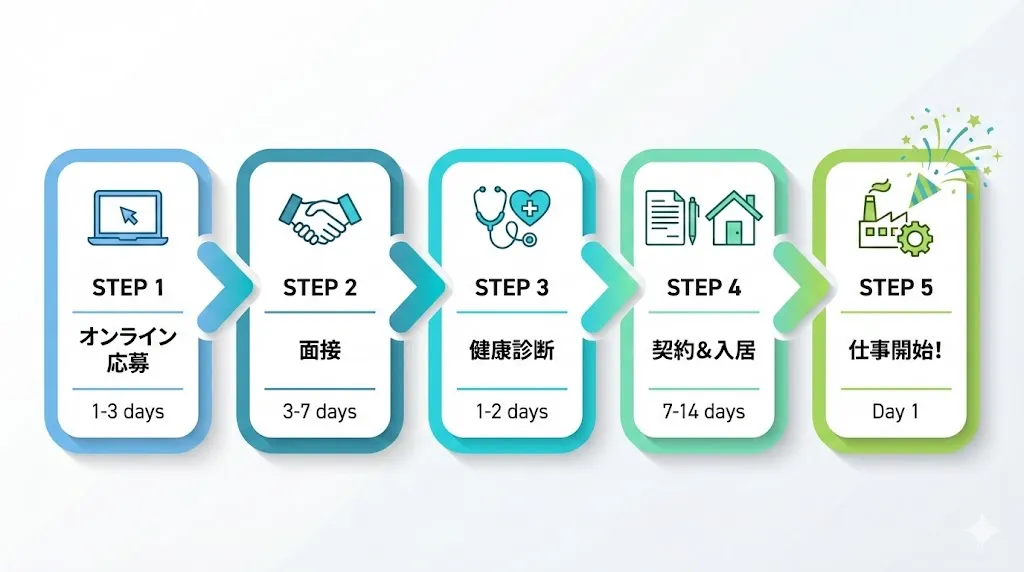
"My Japanese isn't great, will the interview be okay?" It's normal to be anxious. But factory interviews are easy if you prepare.
Preparing Documents
① Resume (Japanese)
- Template: Search online for "Rirekisho Foreigner" (履歴書 外国人) to find templates.
- Key Phrases for Motivation:
- "I want to work for a long time." (Nagaku hatarakitai desu)
- "I am confident in my physical strength." (Tairyoku ni jishin ga arimasu)
- "Since there is a dormitory, I can work with peace of mind." (Ryo ga aru node anshin shite hatarakemasu)
② Copy of Residence Card & Passport
Mandatory. You cannot apply without these.
Top 5 Interview Questions
| Question | N4 Level Answer Example |
|---|
| "Can you work night shifts?" | "Hai, dekimasu!" (Yes, I can!) |
| "Is overtime okay?" | "Daijoubu desu. Takusan hatarakitai desu." (It's okay. I want to work a lot.) |
| "Why do you want to work at a factory?" | "Okane wo tametai desu. Shorai no benkyo no tame ni." (I want to save money. For my future studies.) |
| "When can you start?" | "Raishu kara daijoubu desu." (I can start from next week.) |
| "How long do you plan to work?" | "Ni-nen kurai hatarakitai desu." (I want to work for about 2 years.) |
Tip: Just appeal to your "motivation" (yaruki). Even if your Japanese isn't perfect, a smile + clear "Yes/Hai" will get you hired.
About Health Checks
There is a health check before hiring. Check items:
- Vision / Hearing
- Back pain check (due to heavy lifting)
- Blood pressure / ECG
If you are healthy, there is no problem.
[Danger] Risks & Solutions Before Working in a Factory
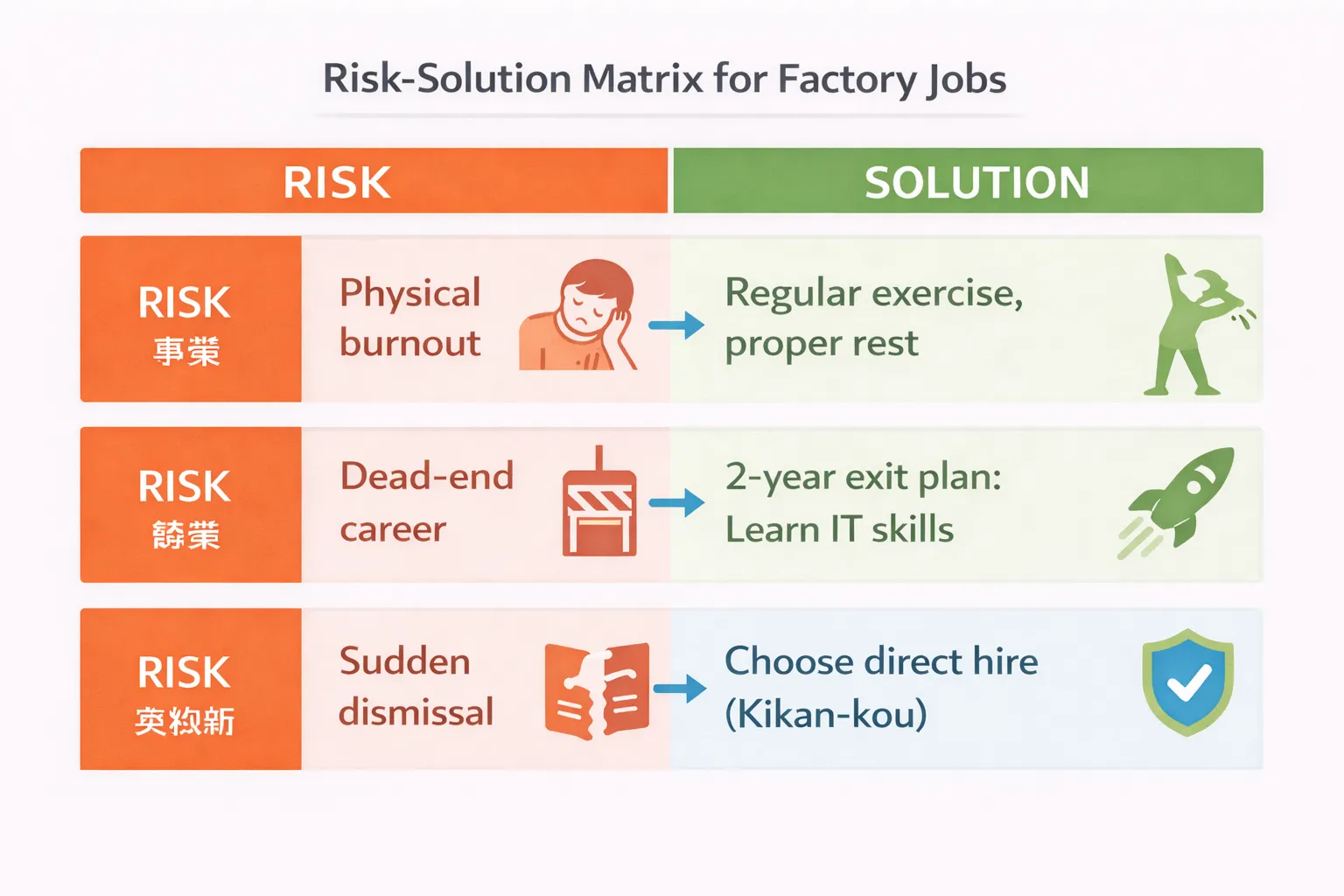
"Factories pay well, but there must be downsides, right?" — Exactly. I won't hide the real risks.
Risk #1: Physical Burnout
Problem:
Repetitive simple tasks often cause tendonitis, back pain, and sleep disorders. Night shifts are especially tough.
Solution:
- Stretch and exercise on days off.
- Secure enough sleep time.
- Report immediately if you feel pain (it gets worse if you endure it).
Risk #2: Career Dead-end
Problem:
Factory work doesn't teach you many transferrable skills. If you stay too long, it becomes hard to switch to other industries.
Solution:
Decide to "Quit in 2 years" and build an exit strategy.
Use the money saved in the factory to:
The factory is a "waypoint." Use the money earned here to invest in your next step.
Risk #3: "Haken-giri" (Sudden Layoffs)
Problem:
When production drops, dispatch staff are the first to be fired. Foreigners are often targeted.
Solution:
- Choose "Kikan-kou" (Direct Hire) → More stable than dispatch.
- Register with multiple job sites (Insurance).
- Keep at least 3 months of savings secure.
Frequently Asked Questions (FAQ)
Q1: Can I really get hired with JLPT N4?
A: Yes, you can. Especially for simple tasks (line work, picking), N4 level Japanese is sufficient. However, you need to understand safety confirmation instructions (e.g., "Stop", "Dangerous").
Q2: Is "¥0 Dorm Fee" really completely free?
A: For Kikan-kou jobs at major manufacturers (Toyota, Subaru, etc.), it is often completely free including rent and utilities. However, if it's via a dispatch agency, there may be cases where it's "effectively free (offset by attendance allowance)" or "equipment lease fees are separate," so be sure to check before applying. Kojo Kyujin Navi clearly states dorm conditions, so it's safer.
Q3: Which is better, Kikan-kou or Dispatch?
A: If you want to earn big in a short period (2-3 years), "Kikan-kou (Direct Hire)" is the only choice. With joining bonuses and completion bonuses, there is an annual income difference of over ¥1 million. You can compare both types on Kojo Kyujin Navi.
Q4: What visa do I need?
A: International Student (28 hr limit), Dependent/Spouse Visa (No limit), and Specified Skilled Worker Type 1 (Manufacturing 3 fields) are eligible. You cannot work on a Tourist Visa.
Q5: Can women work in factories?
A: Yes. There are many jobs suitable for women, such as light work (inspection, packing). However, heavy lifting jobs are centered around men.
Conclusion: "Earning" in a Factory is Correct. "Staying Forever" is Not. [Exit Strategy is Key]
Factory and manufacturing jobs are the strongest method to maximize savings in a short time.
Recap of this article:
✅ Save ¥840,000/year with Free Dorms
✅ Monthly income over ¥300,000 is realistic (for Kikan-kou)
✅ JLPT N4 level is OK. Easy to get hired.
✅ However, you should move to the next step in 2-3 years.
How to use your factory earnings?
- Get Specified Skilled Worker Visa → Move to stable long-term employment.
- IT Study → Level up at a Coding Bootcamp.
- Startup / Return Home Funds → Start a business in your home country.
However, there are other jobs with "Free Housing":
The factory is not the "Goal," it's the "Starting Line." Earn smartly here and jump to your next stage!
Find High Income & Free Dorm Jobs Now!
Over 30,000 factory jobs listed nationwide. Major manufacturer Kikan-kou with signing bonuses up to ¥500,000. JLPT N4 level accepted. Free registration & consultation. Take the step to change your life today.
Related Articles: