【Escape the Exploitation】5 Hidden Criteria for Foreign Engineers to Instantly Spot a "Black Company"
Published on January 21, 2026
Updated on July 1, 2026
Author:JapanLifeStart Editorial Team
Work & Study
How this guide is checked
Updated against official, partner, and reviewed site evidence where available.
Last updated: July 1, 2026
Source separation
Official or partner facts are separated from practical notes.
Fast-changing details
Prices, screening, documents, and rules can change.
Affiliate link handling
Some next-step links may be monetized.
Needs review: Approval, visa/tax/legal, availability, and campaign terms are not guaranteed. Confirm on the official or partner page.
💌
Send to Friends (Summary)
•"If you quit, we'll cancel your visa" is a lie! We provide a complete guide for foreign engineers to identify exploitative "Black Companies" using 5 specific checklists (including fixed overtime and SES return rates), along with concrete methods to escape exploitation and switch to ethical "White Companies" or freelancing.
Great for LINE / WhatsApp sharing
Do you believe that "working in Japan is supposed to be painful"?
Has your boss threatened you, saying, "If you quit, I'll revoke your visa"?
If so, you are not experiencing "Japanese culture"—you are a victim of a Black Company.
Many foreign engineers are forced to work for less than half of a fair salary simply because they do not know Japanese labor laws. In this article, based on Japanese law and market data, we publish a checklist to determine if your company is "dangerous."
We will also show you the "escape route" to break free from this structure of exploitation and secure the salary and freedom your skills deserve.
Warning: Is Your Workplace Safe? The "Black Company" Diagnosis Checklist
Exploitation targeting foreign engineers has clear "numerical standards." Judge not by emotion, but by the numbers.
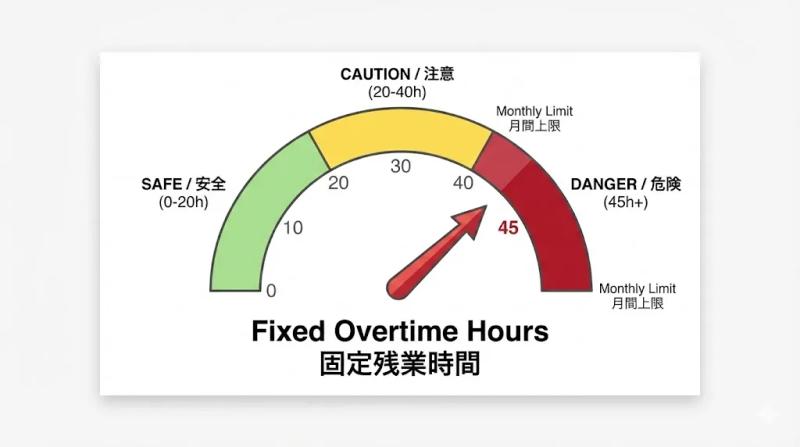
1. "Fixed Overtime" Exceeds 45 Hours per Month
Danger Signal: Your employment contract lists "Fixed Overtime Pay (Minashi Zangyo)" covering 45 hours or more.
The Truth: 45 hours a month is right before the legal "Karoshi Line" (death from overwork). Companies that build this into your base salary from the start intend to work you to your limit. Under Japan's Labor Standards Act, the limit for overtime work is generally 45 hours per month. Including 45 hours of overtime in your fixed salary from day one is essentially a declaration that they plan to "make you work the maximum overtime limit every month."
White Company Standard: Usually 0 to 20 hours, at most within 30 hours.
Action: Check the "Fixed Overtime Pay" section of your Contract immediately.
2. SES "Salary Return Rate" is 50% or Less (or Undisclosed)
Danger Signal: The company refuses to tell you the "Unit Price" (Tanka) the client is paying for you.
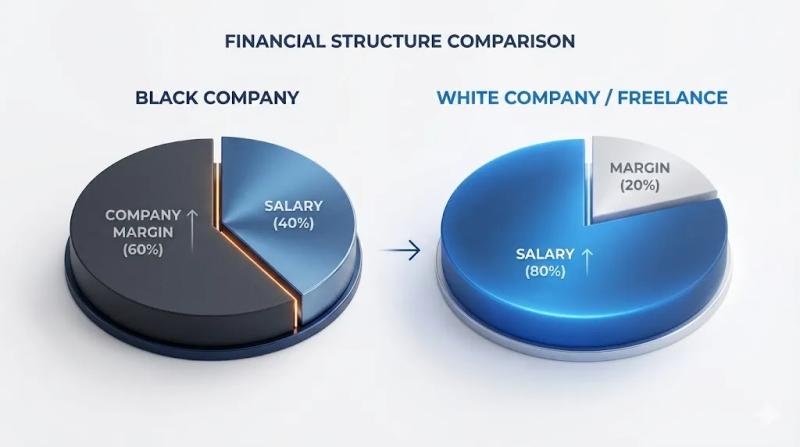
The Truth: In the SES (System Engineering Service / Client Resident) business, if you are earning the company ¥800,000/month but your take-home pay is only ¥300,000, how would you feel? In this case, the return rate is only 37%. The remaining 63% is being exploited by the company while doing nothing.
Excuses like "educational costs" or "visa support fees" are just that—excuses.
Fair Line: For ethical SES companies or freelancers, the standard return rate is 70% to 80% (Monthly salary of ¥560,000 or more).
Action: Companies that do not disclose the unit price are almost certainly taking a cut of more than 50%.
👨
My company won't tell me the unit price... Does that mean they might be taking more than half of my salary?
Exposing the "2 Big Lies" Used to Bind Foreigners
The threats Black Companies use to stop you from quitting have no legal force. Do not be deceived.
Lie 1: "We will cancel your visa if you quit (Visa Blackmail)"
Legal Basis: Companies do not have the authority to cancel visas. That authority belongs solely to the "Immigration Bureau."
Reassurance: Even if you leave the company, your visa does not expire immediately. Legally, you have a 3-month grace period after resigning to look for a new job. Even if the company tells you to "return to your home country tomorrow," you have absolutely no obligation to obey. You are protected by Japanese law.
Lie 2: "Pay back the training & visa fees (Illegal Penalty)"
Legal Basis: This is a violation of Article 16 of the Labor Standards Act. Contracts that state "if you quit, you must pay a penalty" are invalid, even if you signed them when you joined.
Action: Tell them, "That is a violation of the Labor Standards Act. I will consult a Lawyer." They will likely go silent for fear of legal repercussions.
Escape Routes: Career Strategies to Avoid Exploitation
Once you realize your current environment is "Black," the next step is action. Choose the best "shelter" based on your Japanese level and skills.
Route A: For those tired of Client Resident work (SES) [ShanaisSE Tenshoku Navi]
Are you tired of "Client Resident" (SES) work, where you are sent to a different office every day and have to build relationships from scratch?
As an In-house SE, you can settle down in your own company's office and focus on developing in-house services.
Visa renewals are also smoother with stable listed companies or reputable firms. Free yourself from the anxiety of "when will my contract be cut?"
Escape the SES Hell
No more client sites! If you want to build a stable career with in-house development, go to an agent specializing in In-house SEs.
Route B: For those who want to raise their salary with technical skills [TechGo]
Even if your Japanese is at N3 level, if you have modern skills like Python, Go, or AWS, your salary can go much higher.
There is no need to stay at a company that doesn't understand your value.
TechGo is a high-class recruitment agent specializing in IT engineers. With professional salary negotiation, it is not uncommon to see a salary increase of ¥1.5 million.
Route C: For those who want transparent return rates [PE-BANK / Midworks]
If you cannot forgive the company's "middleman cut," the strongest option is freelancing or working for a "transparent return rate" company.
PE-BANK: Even if you live in rural areas, they have abundant projects, and the margin rate (fee) is completely disclosed.
Midworks: Although you are a freelancer, it comes with benefits comparable to full-time employees (salary guarantee, insurance). It is perfect for a freelance debut where visa stability is a priority.
Go 'Freelance' with no middleman cut
Return rates over 80% are the norm. Break free from company exploitation and keep what you earn.
"Evidence Preservation" and "Preparation" to Start Immediately
Before deciding to resign, please collect the following evidence. These will become your "weapons" in the unlikely event of trouble with the company.
Pay Slips: For the past 2 years.
Employment Contract: The one from when you joined.
Records of Working Hours: Photos of time cards or daily work memos.
Recordings of Harassment: Be sure to record statements like "I'll cancel your visa."
Conclusion: Your Life Does Not Belong to the Company
Staying in a "Black Company" endangers not only your career but also your health and visa stability.
There are many companies in Japan that value foreign engineers.
Start by registering with the agents introduced today and knowing "your true market value (appropriate annual salary)." That is the first step toward your escape.
User Review★★★★★5/5
Editor's Choice
First, check your market value with 'ShanaisSE Tenshoku Navi'. Registration is free, and you can consult about visas and your career.
Save this guide for later?
You might need this information again. Bookmark this page to access it anytime.
Press Ctrl + D to Bookmark
Get the Latest Visa Updates
Receive important updates about visa requirements and new residence statuses directly to your inbox.
Share this article
Reading this in English?
Help improve English guides like this
If this guide helped but a phrase felt unnatural, your native check can make the next English article clearer for foreign residents in Japan.
A: ブラック企業 (black company) refers to employers with predatory labor practices: excessive unpaid overtime (サービス残業), verbal abuse by management (パワハラ), illegal or near-illegal employment conditions, poor work-life balance, and high turnover rates. Foreign workers are particularly vulnerable due to language barriers and less familiarity with Japanese labor law.
Q: What are the biggest red flags of a black company for foreign engineers in Japan?
A: Red flags: (1) No mention of fixed overtime compensation (固定残業代) or extremely high fixed overtime (80+ hours), (2) Interview with no concrete job description, (3) Pressure to sign contract same day, (4) Glassdoor/Vorkers reviews showing 1-star ratings with "パワハラ" mentions, (5) SES company that can't tell you which client site you'll be dispatched to.
Q: How can foreigners check if a Japanese company is legitimate before joining?
A: Verification methods: (1) Search company name on 転職会議 (tenshoku-kaigi.com) or Vorkers (now OpenWork) for employee reviews, (2) Check 労働基準監督署 (Labor Standards Inspection Office) violation records, (3) Verify company registration on the National Tax Agency corporate search, (4) Ask in gaijin engineering communities (Facebook groups, Reddit r/japanlife).
Q: What Japanese labor rights does a foreign worker have when working for a black company?
A: All foreign workers with valid work status have the same rights as Japanese workers under Japanese labor law: (1) Minimum wage, (2) Paid annual leave (年次有給休暇), (3) Social insurance (健康保険・厚生年金), (4) Employment insurance (雇用保険), (5) Protection from illegal dismissal (不当解雇). Contact ハローワーク or Sōgi Rōdō for advice.
Q: What should a foreigner do if they are stuck in a black company in Japan?
A: Steps: (1) Consult 総合労働相談コーナー (free, anonymous, multilingual in major cities), (2) File a complaint with the Labor Standards Inspection Office (労働基準監督署) if overtime is unpaid, (3) Start job hunting immediately — the job market for engineers is strong, (4) Consider using a 退職代行 (resignation agency) if your employer is making it difficult to quit, (5) Consult a 弁護士 (lawyer) for severe cases of unpaid wages or illegal dismissal.
Yushi Yamamoto
CEO / Native Japanese Expert
Updated on: July 1, 2026
Disclaimer
※ The information in this article is accurate as of the time of writing. Laws and regulations may change, so please always check official sources for the latest information. We assume no liability for any damages resulting from the content of this article.