
Money & Cards / Money & Cards
This article may contain affiliate linksLearn moreBest Credit Card in Japan for Foreigners (2026): Rakuten vs EPOS vs Nexus
Published on January 27, 2026
Updated on June 11, 2026
Author:JapanLifeStart Editorial Team

Money & Cards
Updated against official, partner, and reviewed site evidence where available.
Last updated: June 11, 2026
Official or partner facts are separated from practical notes.
Prices, screening, documents, and rules can change.
Some next-step links may be monetized.
Needs review: Approval, visa/tax/legal, availability, and campaign terms are not guaranteed. Confirm on the official or partner page.
Recommended next step
Credit-card approval often stalls at SMS, ID checks, and payment history, so these setup routes stay visible early.
Before applying, check the destination page for current eligibility, from-abroad or domestic application options, required documents, and support languages.
This page contains affiliate links. We may earn a commission from purchases or sign-ups, at no extra cost to you. Learn more
Great for LINE / WhatsApp sharing
Quick answer: For most foreign residents in Japan in 2026, the best credit card is the Rakuten Card — no annual fee forever, 1% point return, and a screening process that is fair to foreigners if you avoid the three input traps explained below. If you want a card the same day with in-person help, choose the EPOS Card at a Marui store. If you keep getting rejected, build your Japanese credit history with the deposit-type Nexus Card.
Last updated: 2026-06-11
"I've been in Japan for six months, I have a mobile phone and a bank account, but I've been rejected for a credit card three times. Do I have no credit?"
No, it's likely not your fault. In many cases, the Japanese financial system simply isn't fully optimized for "long foreign names" or the specific format of Residence Cards.
In this article, we will guide you through the "application form traps" (like the middle name issue) that many foreigners stumble upon, and carefully select three credit cards that are actually easy to get approved for.
From the technical tricks to pass the Rakuten Card screening, to the "final weapon" Nexus Card for when you can't get approved anywhere else, this is your complete guide to obtaining the weapon known as "Credit" for your life in Japan.
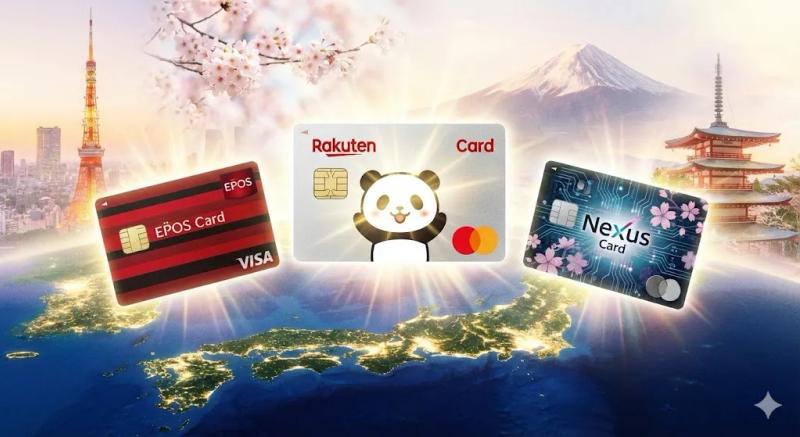
No annual fee forever, 1% point return, sign-up bonus included
A credit card usually comes after your SIM card and bank account — see our First Week in Japan Checklist for the full setup order.
Let's start with the conclusion. The following three cards are currently the easiest to make and offer the biggest benefits for foreigners living in Japan.
| Feature | Rakuten Card | Epos Card | Nexus Card |
|---|---|---|---|
| Rating | ★★★★★ (Best) | ★★★★☆ | ★★★☆☆ (Final Option) |
| Annual Fee | Free Forever | Free Forever | ¥1,375 (Tax included) |
| Approval Difficulty | Medium (Watch for typos) | Low (In-person support) | Very Low (Deposit type) |
| Issuance Speed | 1 week - 10 days | Same day (In-store pickup) | Approx. 2 weeks |
| Recommended For | All foreign residents | People unsure about Japanese forms | People who keep getting rejected |
Verdict: First, try the Rakuten Card for its overwhelming convenience and point rewards. If you are worried about typing in Japanese or need a card immediately, go for the Epos Card. If you have been rejected in the past, the standard route is to build your Japanese credit history with the Nexus Card.

The Rakuten Card is said to have the highest ownership rate among foreigners living in Japan. Why is it so popular? The answer lies in its "ease of approval (if you input correctly)" and "massive point rewards."
I pay my electricity, gas, and rent all with my Rakuten Card. Just doing that earns me over 1,000 points every month, which I use to buy lunch at convenience stores.
The Rakuten Card screening process itself is fair to foreigners. However, many people are automatically rejected due to "character limits on the input form" or "bank account name mismatches." If you avoid the "3 Traps" introduced below, your probability of approval will skyrocket.
An essential for life in Japan. Start here.
Note: If you need detailed English instructions and screen explanations, please open the separate article "【Practical】Rakuten Card Application Guide: Tips for English Input and How to Avoid Rejection" in a new tab and follow along.
Our research shows that most foreign rejections are due to "technical errors" rather than "lack of credit." Be sure to observe the following three points.
Many Japanese systems have character limits (e.g., around 10 full-width characters) for name fields.
This is the most common cause. If the "Katakana" name you enter on the card application does not match the "Katakana Name" registered with your bank exactly (down to the existence of a space), it will error out.
Reference: For checking account names or if you don't have an account yet, see "【2026 Edition】Complete Guide to Opening a Japanese Bank Account for Foreigners".
If you enter a monetary amount in the "Cashing Limit" (Cash Advance) field on the application form, the screening becomes very strict.
For those worried about completing everything online, or who want a card immediately, the Epos Card is ideal.
The Epos Card is issued by the department store "Marui". If you go to the "Epos Card Center" in the store, staff will support your application using a tablet. They will scan your Residence Card and assist with input, helping you avoid the risk of rejection due to Japanese typing errors.
After getting rejected by Rakuten online, I went to Marui in Shibuya and made an Epos Card. The staff was kind, and I received the card that very same day.
Instant issuance available & Automatic Overseas Travel Insurance
Rejected by Rakuten and Epos...? The "Last Resort" in such cases is the Nexus Card.
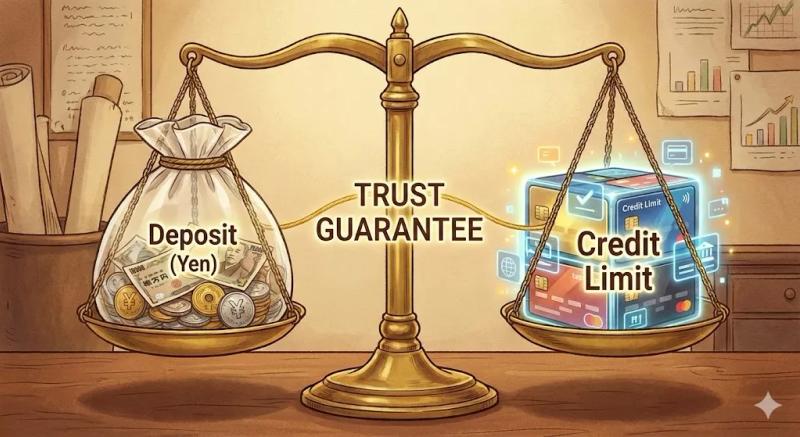
Nexus Card is a type of card where you deposit a "guarantee" beforehand. For example, if you deposit ¥50,000, a card with a ¥50,000 limit is issued.
The biggest advantage of using the Nexus Card is that, unlike a debit card, your "Credit History" is recorded in Japan's CIC (Credit Information Center).
This is the most reliable "Credit Building" strategy for foreigners who are struggling with screening to gain trust.
Get issued reliably with a deposit type. It becomes a bridge to your next step.
Yes. The screening process at major issuers like Rakuten Card is fair to foreigners — most rejections are caused by technical input errors (name character limits, Katakana mismatches with your bank account) rather than lack of credit. Deposit-type cards like Nexus Card are available even after repeated rejections.
The Nexus Card has the lowest approval barrier because it is deposit-based — your deposit becomes your limit, so approval is nearly guaranteed. Among regular cards, the EPOS Card is the easiest in practice because Marui store staff help you complete the application in person.
It is very difficult. Many card companies will not approve you if your remaining period of stay is short. It is safer to apply after renewing your visa and receiving your new Residence Card.
It depends on the reason. If you were rejected due to annual income or delinquency, wait 6 months for the credit inquiry record to disappear. If the cause was an input error or bank account mismatch, you may pass immediately by applying for a different card (like EPOS or Nexus).
Yes — and it is often easier than expected. Apply with your occupation as "Student" rather than "Part-time job." Card companies view students as future prime customers supported by parents, so you can often pass the screening even with an income of ¥0.
A credit card is a "Proof of Trust" from Japanese society. Having one makes paying for smartphones in installments, online shopping, and renting apartments much smoother.
First, try applying for the Rakuten Card, which offers the biggest benefits, using the "Cash Advance 0 Yen & Post-Application Account Setup" techniques introduced in this article. If that still doesn't work, don't hesitate to start building your track record with the Nexus Card.
Next Step:
No Annual Fee & #1 Approval Rate: Rakuten Card
Related money task
This internal guide does not decide individual eligibility; it helps organize document prep and software options.
Open the tax return software guideYou might need this information again. Bookmark this page to access it anytime.
Receive important updates about visa requirements and new residence statuses directly to your inbox.
Reading this in English?
Help improve English guides like this
If this guide helped but a phrase felt unnatural, your native check can make the next English article clearer for foreign residents in Japan.


![[2026 Comparison] Rakuten Point vs V Point vs d POINT](/_next/image?url=https%3A%2F%2Fcdn.sanity.io%2Fimages%2Fs5zbl9nu%2Fproduction%2F64764f87e0bd63725773de1998f35969485517e2-1200x630.jpg%3Fauto%3Dformat%26q%3D72%26fit%3Dmax%26w%3D640&w=3840&q=75)
A: Yes. The screening process at major issuers like Rakuten Card is fair to foreigners — most rejections are caused by technical input errors (name character limits, Katakana mismatches with your bank account) rather than lack of credit. Deposit-type cards like Nexus Card are available even after repeated rejections.
A: The Nexus Card has the lowest approval barrier because it is deposit-based — your deposit becomes your limit, so approval is nearly guaranteed. Among regular cards, the EPOS Card is the easiest in practice because Marui store staff help you complete the application in person.
A: It is very difficult. Many card companies will not approve you if your remaining period of stay is short. It is safer to apply after renewing your visa and receiving your new Residence Card.
A: It depends on the reason. If you were rejected due to annual income or delinquency, wait 6 months for the credit inquiry record to disappear. If the cause was an input error or bank account mismatch, you may pass immediately by applying for a different card (like EPOS or Nexus).
A: Yes — and it is often easier than expected. Apply with your occupation as Student rather than Part-time job. Card companies view students as future prime customers supported by parents, so you can often pass the screening even with an income of ¥0.

CEO / Native Japanese Expert
Updated on: June 11, 2026
※ The information in this article is accurate as of the time of writing. Laws and regulations may change, so please always check official sources for the latest information. We assume no liability for any damages resulting from the content of this article.