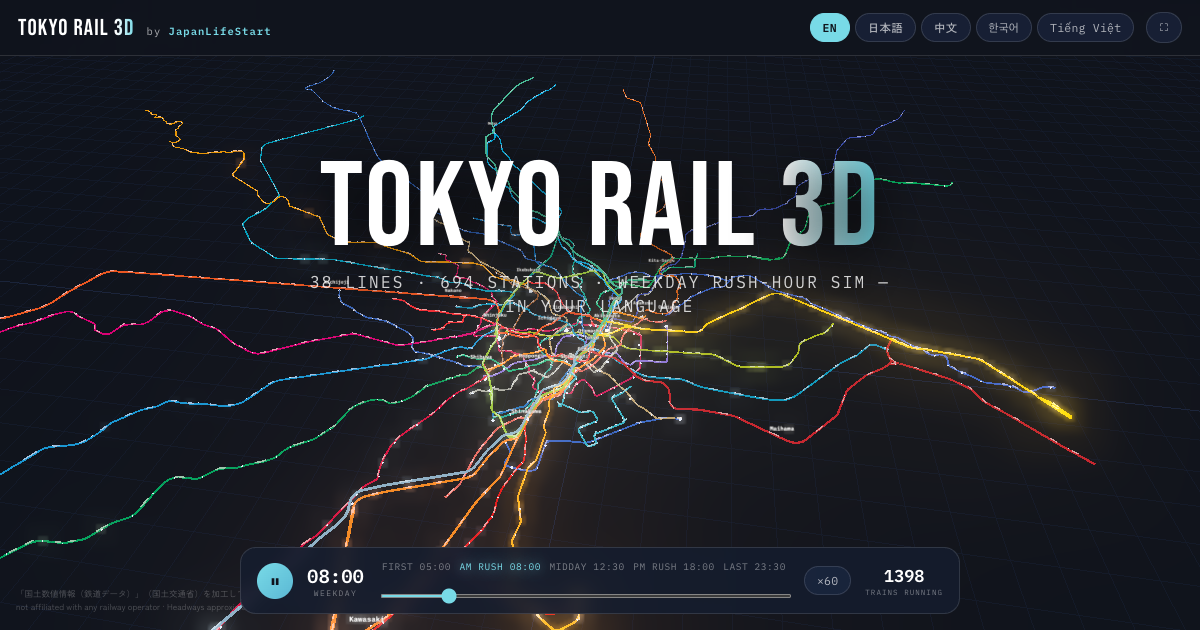
No explanation. Just touch it.
説明はいらない。触ったほうが早い。
The frame below is the real model, live. Drag to rotate, scroll to zoom, click a glowing train and hit 🚇 Cab view to ride it. The timeline at the bottom jumps between rush hours.
INTERACTIVE 3D RAIL MAP — TOKYO · BY JAPANLIFESTART
JR, Metro, Toei and private lines — one living 3D model of the whole railway city.
東京の鉄道38路線・694駅を、実座標と深度で立体再現。 朝ラッシュから終電まで、平日ダイヤの列車が目の前で動き出す。
NO INSTALL · RUNS IN YOUR BROWSER · PC RECOMMENDED · *WEEKDAY SIMULATION AT 08:00
SCROLL ▾数字で見る、鉄道都市トーキョー
38 lines run by about 15 companies — JR, Tokyo Metro, Toei and 11 private operators — the maze that confuses every newcomer, color-coded in one model.
Placed from national geodata with real coordinates. Big hubs are labeled in Roman letters and Japanese.
Subway lines are drawn at their real depth layers — the newest lines dig the deepest (approximate values).
Simultaneous trains at 08:00 in the weekday headway simulation. At midnight it thins out to a few hundred.
説明はいらない。触ったほうが早い。
The frame below is the real model, live. Drag to rotate, scroll to zoom, click a glowing train and hit 🚇 Cab view to ride it. The timeline at the bottom jumps between rush hours.
模型として眺める。乗客として乗り込む。
REAL 3D NETWORK
Every line is drawn from Japan's official railway geodata (MLIT N02) at real coordinates. See which line dives under which — the crossings no flat route map can show.
WEEKDAY TIMETABLE
Trains run on approximate weekday headways: every 2–3 minutes at rush, thinning to late-night intervals. Jump between first train, 8AM crush, midday and last train.
CHASE & CAB VIEW
Pick any glowing train and the camera locks on. Switch to the driver's-cab view and watch the oncoming traffic — goosebumps guaranteed at Yamanote rush hour.
STATION CARDS
Click a station for its lines, transfer partners, approximate platform depth and how often trains are coming right now.
5 LANGUAGES
The whole UI switches between English, 日本語, 中文, 한국어 and Tiếng Việt. Station names show both Roman letters and Japanese.
THE OPERATOR MAZE
Tokyo's biggest newcomer trap is that "the train" is actually many companies — 15 in this model alone. Toggle operators on and off and the system finally makes sense.
地下は、先着順。
The Ginza Line of 1927 sits just under the street. Lines that came later mostly had to dig beneath their seniors — a century of history stacked like geological strata. Broadly, the later the line, the deeper it runs; the Oedo Line of 2000 holds the record.
−38 m is a 13-story building — downward. An underground skyscraper you descend by escalator.
Horizontal: year opened / Vertical: approximate representative depth per line (per-line approximation used in the model).
遊び方は、3ステップ。
One click and underground Tokyo appears in your browser. Drag to rotate, scroll to zoom. Start with a lap around the Yamanote loop.
Jump the timeline to AM RUSH. Trains pour out every 2–3 minutes — the density of a Tokyo morning, visible at last.
Click a glowing train to chase it, then hit Cab view for the front-window seat. Enjoy the trip to the terminus.
日本で生活を始める人のために — by JapanLifeStart
This model is a free project by JapanLifeStart — guides for living in Japan, written for foreigners. If the trains confuse you, these are the next reads:
Take one look at the tunnels that carry you every day. Tomorrow's commute will feel a little different.
Launch the model ▶ FREE