[2026 Latest] Foreigners Buying a Home in Japan! Banks That Pass Mortgage Approval Without Permanent Residency

Japan's real estate market continues to attract foreign residents with its stability and long-term value. As of 2026, the combination of a weaker yen, post-pandemic recovery, and urban redevelopment has driven a surge in foreigners seeking to purchase property in major cities like Tokyo and Osaka. For expats — whether on corporate assignments or hired locally — the biggest hurdle is often mortgage approval (住宅ローン審査).
Most Japanese banks list Permanent Residency (PR) as a key requirement for home loans to foreigners. But does that mean you can't buy a home without PR? The answer is NO.
This guide covers the 2026 reality, real-world experiences from Reddit's expat communities, the actual conditions required, and which banks — including SMBC Trust Bank PRESTIA, SBI Shinsei Bank, and Suruga Bank — are open to lending to non-PR foreigners.
Chapter 1: The "No PR" Wall — The 2026 Reality
The main reason Japanese banks prioritize PR is the perceived "flight risk" — the fear that a foreign borrower might return to their home country, leaving a 35-year mortgage unpaid. PR is treated as strong proof of long-term commitment to Japan.
Real Voices from the Expat Community (Reddit, 2025–2026)
In threads on r/japanlife and similar communities, common themes include:
- The Down Payment Pressure
Even for Japanese nationals, low-down-payment loans exist. But for non-PR foreigners, "20% is the floor — some banks demand 30–50%" is a recurring observation.
- The Broker Relationship Factor
"I got approved by a major Japanese bank, but only because my real estate broker had a long-standing relationship with them." Using a specialist expat agent matters enormously.
- The Japanese Spouse Advantage
"Having a Japanese spouse drops the difficulty by several levels" is practically consensus — they can act as guarantor or enable pair loans.
Chapter 2: Essential Requirements for a Mortgage Without PR
1. Stable Employment & Tenure
- Long-term visa: Work visa (Engineer/Specialist), Highly Skilled Professional, Spouse visa, etc.
- Tenure: Minimum 1–3 years with the same employer. Recent job-changers, contractors, and new self-employed applicants face tougher screening.
2. High Income Threshold
Banks like SMBC PRESTIA typically require a minimum annual income of ¥5 million+. High-earning expats (¥7M–¥10M+) are at a significant advantage over the general threshold (¥3M).
3. Substantial Down Payment
A minimum 20% down payment (LTV 80%) is the baseline proof of financial commitment. Some banks require 30% or more for non-PR borrowers.
4. Group Credit Life Insurance (団信 Dansin)
Enrollment in group life insurance is mandatory. You must be enrolled in Japan's health insurance and have a clean medical history.
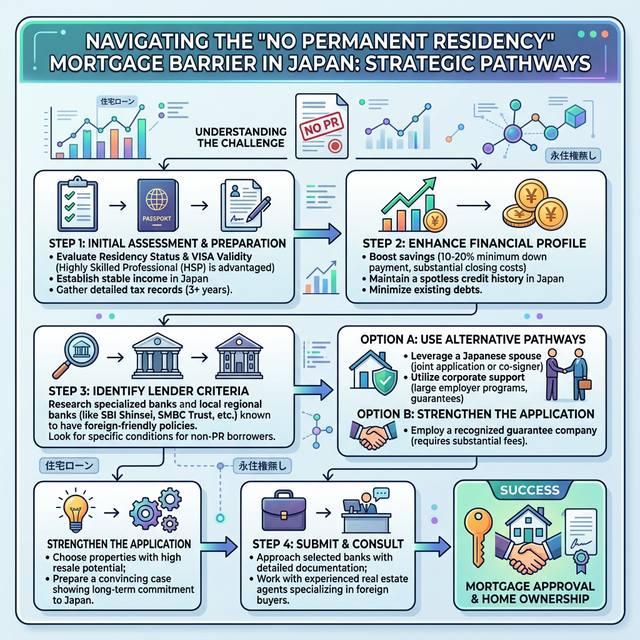
Chapter 3: Top 3 Expat-Friendly Banks (No PR Required)
1. SMBC Trust Bank PRESTIA
The most well-known foreigner-friendly lender in Japan — inheriting Citibank's retail operations, it offers excellent English support.
- PR required?: No. Work visa is acceptable.
- Loan amount: ¥10M–¥500M
- Income: Approx. ¥5M+ annual
- LTV: ~80% (20% down payment expected)
- Rates: Variable and fixed options available; slightly higher than mega-banks but includes full English support.
- Verdict: The #1 option for high-income expats.
2. SBI Shinsei Bank
Popular in the expat community for its favorable rates and digital-friendly process.
- PR required?: No, but conditions apply.
- Spouse requirement: If no PR, a Japanese citizen or PR-holding spouse is typically required as guarantor.
- Loan amount: Up to ¥500M
- Tenure: 2+ years at a stable employer
- Verdict: Excellent rates (potentially below 1% variable) for expats with a Japanese spouse.
3. Suruga Bank
The only major bank with a formally designated "Home Loan Plan for Non-Japanese Only".
- PR required?: No — long-term intent to settle is sufficient.
- Guarantor required?: Generally not (subject to screening).
- Loan amount: ¥0.3M–¥600M; condos up to 50-year terms
- Language: Must understand mortgage terms in Japanese (no interpreter allowed).
- Verdict: The best option for single expats without a Japanese spouse — but rates are higher than digital banks.
Honorable Mentions
- Tokyo Star Bank: PR not required; Japanese language proficiency matters.
- Mizuho / SMBC (mega-banks): Possible if PR application is in progress, down payment is 30%+, or employer is a top-tier global company.
Chapter 4: The Japanese Spouse Advantage
A Japanese (or PR-holding) spouse dramatically lowers your risk profile:
- Guarantor (連帯保証人): Opens access to SBI Shinsei and other banks requiring one.
- Pair Loan (ペアローン): Combine incomes to maximize borrowing power; even mega-banks may consider this.
- Better Rates: Lower perceived risk = potential interest rate discounts.
Chapter 5: Document Checklist
- ✅ Residence Card (在留カード): Valid with sufficient remaining term.
- ✅ Passport: For identity verification.
- ✅ Certificate of Residence (住民票): All family members listed.
- ✅ Tax Records / Tax Payment Certificate: 2–3 years of income and tax history.
- ✅ Withholding Tax Slip (源泉徴収票): Employer-issued; 2–3 years.
- ✅ Certificate of Employment (在籍証明書): From your workplace.
- ✅ Health Insurance Card: Proof of enrollment in Japan's health system.
- ✅ Registered Seal (実印) + Certificate of Seal Registration (印鑑証明書): Required for all major property contracts.
Chapter 6: Understand Your Full Living Cost Picture First
Owning a home means monthly repayments plus property tax, condo management fees, and repair reserve funds. Build a solid budget before applying.
For a baseline on living costs and rental market rates in Tokyo, check out:
👉 Tokyo Living Costs & Rent Guide for Singles
Should You Get PR First?
The expat community's top advice: if you're 1–2 years away from PR eligibility (e.g., Highly Skilled Professional 80+ points = 1 year), get PR first. Mega-bank fixed rates of 0.3–0.5% vs. higher expat-track rates can save you millions of yen over the life of the loan.
Chapter 7: Essential Pre-Purchase Step — Investigate the Neighborhood
One of the most underestimated risks for foreign buyers is neighborhood trouble (近所トラブル). Garbage rules, noise disputes, and mandatory neighborhood association (町内会) participation can create serious friction stemming from cultural differences — and potentially push you to sell a home you just bought.
Before committing to a purchase, we strongly recommend having a professional investigate the real living environment and neighborhood atmosphere. Services like Tonarisk let you proactively uncover potential issues before you move in, giving you peace of mind from day one.
Conclusion: The Key Is a Professional Agent
There's no reason to give up on homeownership in Japan just because you lack PR. Banks like SMBC PRESTIA and Suruga Bank are actively lending to foreign professionals.
Your action plan: save a 20%+ down payment, build stable tenure at one company, and maintain a clean credit and tax history in Japan.
Above all: find a specialist real estate agent with strong bank relationships. In Japan, who brings the deal to the bank is just as important as your own financial profile.
Ready to find out what you can borrow? Contact a specialist today for a pre-approval simulation based on your visa status and income.
Disclaimer: Information in this article reflects conditions as of 2026. Bank requirements, interest rates, and required documents are subject to change. Always confirm the latest details directly with each financial institution.


