Rent vs. Buy: Is Renting Furniture & Appliances Actually Cheaper? A Complete 2-Year Cost Comparison [2026]
Published on January 8, 2026
Updated on June 11, 2026
Author:JapanLifeStart Editorial Team
Housing & Daily Life
How this guide is checked
Updated against official, partner, and reviewed site evidence where available.
Last updated: June 11, 2026
Source separation
Official or partner facts are separated from practical notes.
Fast-changing details
Prices, screening, documents, and rules can change.
Affiliate link handling
Some next-step links may be monetized.
Needs review: Approval, visa/tax/legal, availability, and campaign terms are not guaranteed. Confirm on the official or partner page.
💌
Send to Friends (Summary)
•Planning a 1-2 year stay in Japan? "Buying cheap" often leads to high disposal costs and stress. We thoroughly compare the total costs of Nitori vs. Rental Services to find the smartest financial choice for your life in Japan.
Great for LINE / WhatsApp sharing
Rent vs. Buy: Is Renting Furniture & Appliances Actually Cheaper? A Complete 2-Year Cost Comparison [2026]
"I'm only planning to stay in Japan for 1 to 2 years. I'll just buy cheap furniture and appliances from Nitori or Amazon and sell them when I leave."
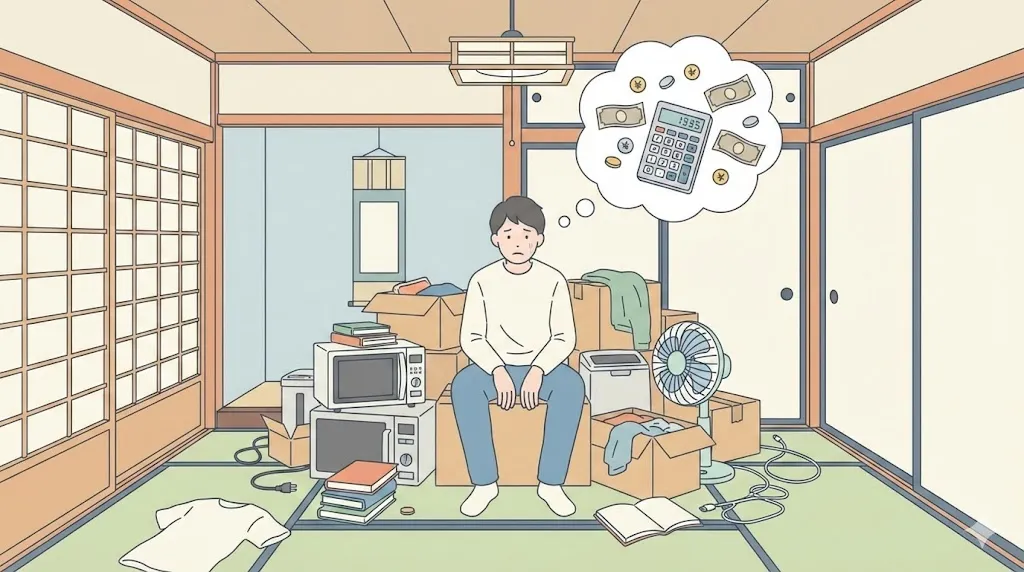
If this is your plan, be warned: it could lead to tens of thousands of yen in guaranteed losses and a state of "Panic Disposal" right before you return home.
Japan's "Home Appliance Recycling Law" and procedures for "Sodai Gomi" (oversized garbage) are stricter and more expensive than almost anywhere else in the world. Furthermore, with the rise of cheap "generic" appliances, the secondhand market has collapsed. The "Sayonara Sale" strategy that worked in the past is no longer viable.
In this article, we thoroughly simulate the total costs (initial cost + disposal fees) of "Buying" vs. "Renting (Subscription)" for a 1–2 year stay. We will derive the "mathematically correct answer" to protect your wallet and your time.
[Verdict] Staying Less Than 2 Years? Renting is King. "Buying" Carries Hidden Liabilities.
To give you the conclusion first: if your stay is less than 2 years (24 months), renting is overwhelmingly advantageous, both financially and mentally.
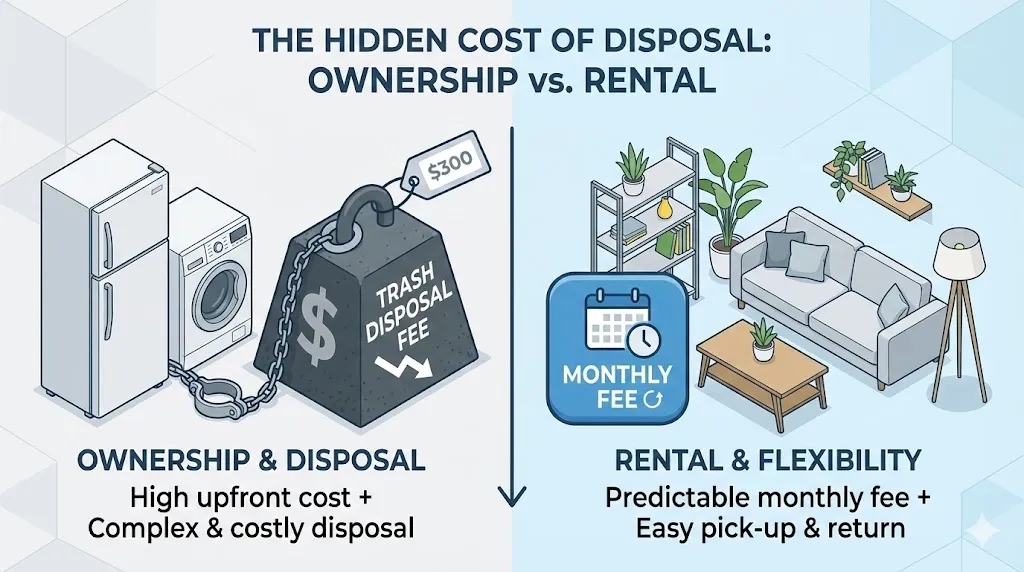
Most people only look at the "product price" they pay at the store. However, owning furniture and appliances in Japan means carrying a "liability (disposal cost)" that you must pay when you move out.
👨
People often think 'buying is cheaper monthly,' but when you calculate the ¥10,000–¥20,000 expense to throw things away at the end, plus the hassle of paperwork, renting often turns out to be cheaper overall.
Approximate Break-even Points
Stay of 1 year or less: Renting is overwhelmingly cheaper (Approx. 50% less than buying).
Stay of 2 years: Costs are comparable, but renting wins when you factor in "zero disposal hassle."
Stay of 2+ years: In terms of raw numbers, "Buying" becomes cheaper, but the decision depends on how much you value QOL (new items, design).
Thorough Simulation: Nitori's Cheapest Set vs. 3 Rental Companies
We answer the question readers want to know most: "So, how much does it cost in the end?"
We compared the "Total cost for 2 years" for acquiring the four essentials for a new life (Fridge, Washing Machine, Microwave, Bed).
Pattern A: "Cheapest Purchase" via Amazon/Nitori
This plan involves buying generic appliances and a cheap legged mattress.
Initial Cost: Approx. ¥75,000
[Important] Disposal Cost at Move-out:Approx. ¥16,000
The stress of moving items out & booking collection: Priceless
Total for 2 Years:Approx. ¥91,000
Note: "I'll just sell it" is a fantasy. Unless it's a famous domestic brand manufactured within 3–5 years, the purchase price at recycle shops is almost "¥0," or conversely, you will be charged a disposal fee.
Pattern B: Renting a Used Set from "Kasite! Dot Com"
This uses the industry's lowest-priced rental service.
Total for 2 Years:Approx. ¥53,000 (Includes shipping, collection, and consumables replacement)
This is approx. ¥40,000 cheaper than buying. Moreover, when you move out, they come to collect everything with just one phone call, so there are absolutely no disposal procedures.
The downside is that you receive "used items," so you cannot choose the design or the level of wear and tear.
If you just want to keep costs down
Industry lowest price! Overwhelming cost performance with no credit card or screening required.
Pattern C: Using "Cosmo" or "Rakuriars" for New/Stylish Furniture
This plan is for those who feel "physiologically unable to use used items" or "don't want to live in a tacky room."
Total for 2 Years:Approx. ¥140,000 – ¥160,000
This is more expensive than buying, but the price difference is an investment in "Hygiene of new items," "A stylish room," and "Zero disposal hassle." In the next section, we will dig deeper into this "investment value."
For Those Prioritizing "QOL" Over "Cheapness": The Value of Subscriptions That Buying Can't Offer
If you don't just want to "survive" but want to comfortably enjoy your life in Japan, we recommend next-generation subscriptions that dramatically increase your QOL (Quality of Life) for a little extra cost.
Cosmo SubscRental: "Better than IKEA" Design at Nitori Prices
"Kasite! Dot Com" is cheap, but your room inevitably ends up looking like a "Showa-era student dorm." On the other hand, if you buy stylish furniture, disposing of it when you leave is a real nightmare.
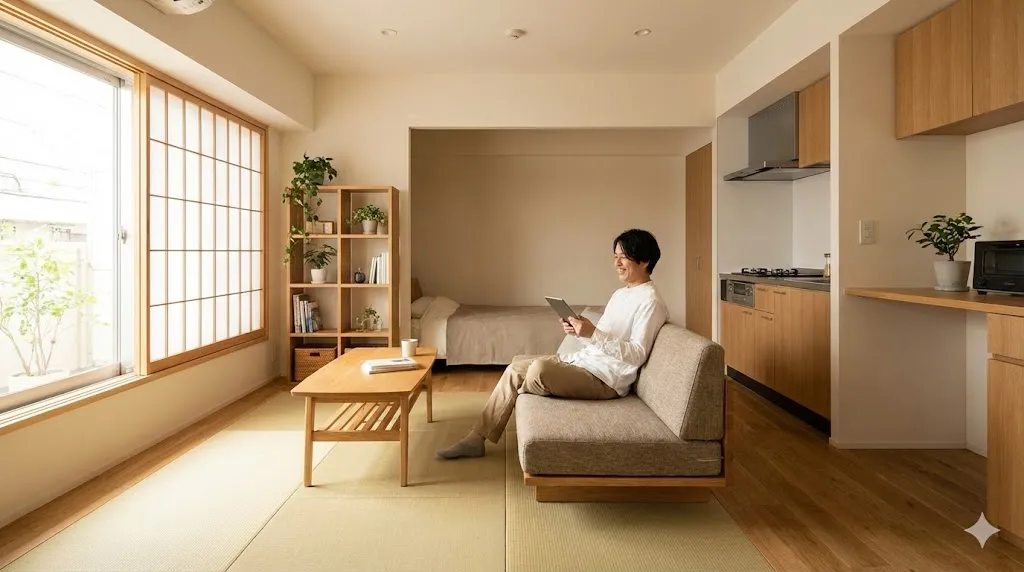
With Cosmo SubscRental, you can get high-design furniture and the latest brand-new appliances with ¥0 initial cost.
Exchangeable if you get bored: The "fluidity" to change your interior according to the season or your mood is a benefit you don't get with ownership.
Purchase option available: If you like an item, you can pay the difference and make it yours.
If you want to live in a stylish room
¥0 initial cost. Realize your ideal room immediately with design furniture and new appliances.
Rakuriars: The Final Answer for Those Who Demand "Brand New"
The most common concern from foreign residents and female users is: "I physically can't handle a bed or washing machine that strangers have used (Hygiene issue)." But buying new makes throwing it away difficult...
Rakuriars solves this dilemma.
Guaranteed Brand New: Everything delivered is new. These are not items used by someone else previously.
Long-term plans are a deal: Monthly costs are significantly reduced for contracts of 2 years or more.
Lump-sum payment supported: You don't have to worry about monthly payments, making it perfect for international students.
User Review★★★★★5/5
User Voice
I absolutely wanted a brand new bed, so I chose Rakuriars. It offers the best of both worlds: the 'cleanliness of new items' you get from buying, and the 'ease of letting go' you get from renting.
If hygiene is your top priority
All items guaranteed brand new. Avoid the risks of buying while starting a clean new life.
Why is Japanese "Sodai Gomi" (Oversized Garbage) So Difficult?
Finally, let me explain why I emphasize the "hassle of disposal" so much. Japan's garbage disposal rules can be the "final trap" for foreigners.
Complexity of the Process: It is normal to wait 2 weeks to 1 month for reservations via the internet or phone.
Buying Stickers at Conbini: You must purchase stickers (fees) for the correct amount for each item category.
The Hurdle of Carrying Out (The Hardest Part): You must carry the items out to the designated spot by yourself by 8 AM on the designated day. Moving a fridge or mattress out of a room alone is heavy labor. If you hire a "Benri-ya" (handyman), it costs ¥10,000–¥20,000, ultimately making your "cheap purchase" expensive.
You should consider the rental service fee as including an "insurance premium to avoid this future hardship."
The era where "just buying for now" was the correct answer is over. Especially for stays of less than 2 years, buying is a high-risk choice economically and in terms of time when you include disposal costs.
Choose a style of "usage" wisely that fits your length of stay and what you seek in life (Cheapness vs. Comfort). Avoid the chaos when returning home and enjoy your life in Japan until the very end.
Save this guide for later?
You might need this information again. Bookmark this page to access it anytime.
Press Ctrl + D to Bookmark
Get the free Moving in Japan checklist
A practical 14-day checklist for city hall, utilities, SIM, internet, and moving tasks.
Share this article
Reading this in English?
Help improve English guides like this
If this guide helped but a phrase felt unnatural, your native check can make the next English article clearer for foreign residents in Japan.
Q: Is renting furniture cheaper than buying for a 1–2 year stay in Japan?
A: For stays under 12 months, renting is almost always cheaper when you factor in disposal costs for large items (refrigerators and washing machines can cost ¥3,000–5,000 each to dispose of). For 2+ year stays, buying from Nitori at sale prices with secondhand resale often wins.
Q: What is the most expensive part of setting up a furnished apartment from scratch in Japan?
A: Refrigerator and washing machine together cost ¥30,000–80,000 new. Add a bed, desk, and kitchen items and you can easily spend ¥100,000–200,000. Rental services for a full set typically run ¥10,000–20,000/month.
Q: Can foreigners rent furniture in Japan without a Japanese credit card?
A: Some furniture rental services (like Clas) accept overseas credit cards. Others require a Japanese card. GTN Mobile's ecosystem includes a Mastercard that can be used for these rentals, solving the chicken-and-egg problem.
Q: What are the best furniture rental services in Japan?
A: Clas is the most popular subscription service with no minimum term. Rentio is good for appliances. Nayami-wa-irimasen and similar services offer full-room sets. Prices vary significantly so compare total cost including delivery and pickup fees.
Q: What happens to rented furniture if I leave Japan unexpectedly?
A: You can cancel most rental services and arrange pickup, though cancellation fees may apply for early termination. This is one major advantage of renting over buying — no need to sell or dispose of large items when you depart.
Yushi Yamamoto
CEO / Native Japanese Expert
Updated on: June 11, 2026
Disclaimer
※ The information in this article is accurate as of the time of writing. Laws and regulations may change, so please always check official sources for the latest information. We assume no liability for any damages resulting from the content of this article.