[Essential Guide] Can't Pay Your Japanese Pension? How to Apply for Exemption and Protect Your Visa
Do you panic when you see those blue or pink envelopes from the "Japan Pension Service" in your mailbox?
Many foreigners feel anxious, thinking, "I can't afford to pay ¥17,000 every month!" or "Will my visa be denied if I don't pay?"
Actually, Japan has a legal system that allows you to be exempted (¥0 payment) or postpone payments if your income is low.
The worst thing you can do is ignore it and leave it "Unpaid" because you don't have money. This can have a fatal impact on future Permanent Residency applications and visa renewals.
In this article, we explain the mechanism of the Japanese pension exemption system, how to apply, and the knowledge you need to avoid losing out in the future.
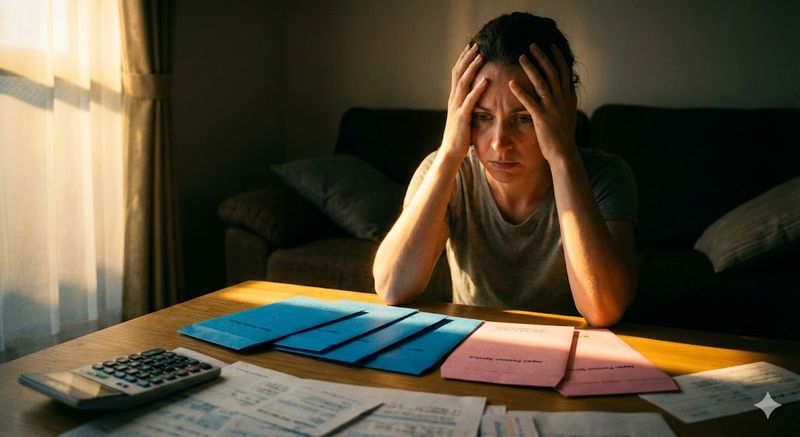
"Unpaid" vs. "Exemption": The Difference Between Heaven and Hell
First, you must understand that even though both result in "not paying," the legal treatment is as different as heaven and hell.
- Unpaid (Mino): You will continue to receive reminder letters. In the worst case, there is a risk of seizure of bank accounts or property. Also, when applying for visa renewal or Permanent Residency, the evaluation from the Immigration Bureau will be negative.
- Exemption (Menjo): The government officially recognizes that "you do not need to pay in your current economic situation." Since this is a legal procedure, there is no negative impact on your visa. Furthermore, it counts as part of the "eligibility period (10 years)" required to receive a pension in the future.
In short, if you don't have money, don't leave it as "Unpaid"—simply apply for "Exemption" properly.
Especially with recent legal amendments and changes in operational policy, pension payment records are being scrutinized more strictly during Permanent Residency examinations.
The 2026 Issue: Can't Renew Your Visa Due to Unpaid Pension?
A summary of the trend toward 'stricter residence status' under the new administration and the measures foreigners must take immediately. A must-read if you are aiming for Permanent Residency.
Two Exemption Systems Available for Foreigners
There are two main systems available for foreigners. Choose the one that fits your status.
1. Special Payment System for Students (Gakusei Nofu Tokurei)
This applies to students attending universities, graduate schools, junior colleges, or vocational schools in Japan. Most international students fall under this category.
- Condition: Your income must be below a certain level (most international students clear this).
- Benefit: Insurance premium payments are postponed while you are in school.
- Note: This is strictly a "postponement." Unless you "back pay" (Tsuino) after you start working, it will not be reflected in the pension amount you receive in the future (though it counts towards the eligibility period).
2. General Exemption / Payment Postponement System
This applies to people who are not students but are unemployed or have low income (part-time jobs only, etc.).
Depending on your previous year's income, the exemption amount is decided in four stages:
- Full Exemption (Payment amount ¥0)
- 3/4 Exemption
- Half Exemption
- 1/4 Exemption
If you have lost your job, you can often qualify for a 'special exception' exemption regardless of your previous year's income if you have a Separation Notice (Rishoku-hyo). Consult your local municipal office immediately.
Essential Before Applying! The "Tax Return" Barrier
Here is a point where many foreigners stumble.
When you try to apply for exemption at the municipal office, the counter staff might say:
"We have no proof of your income from last year. Please file a tax return at the tax division first."
Japanese government offices are compartmentalized. The Pension Office or National Pension Section does not know your income.
If you haven't filed a Resident Tax declaration (or Tax Return), the office cannot grasp your income situation and cannot process the review.
Even if your income was ¥0 or you were only receiving remittances from your home country, you need to file a Tax Return declaring "My income in Japan is ¥0".
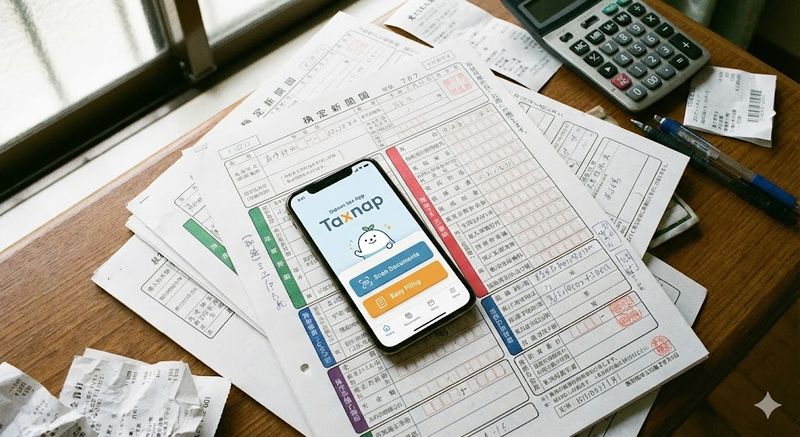
If you are worried that "Tax return documents are too difficult to read" or "I don't know what to write," use a convenient app to get it done quickly. This is the shortest route to exemption.
Complete with a Swipe! Tax Return App 'Taxnap'
No need to struggle with complex Japanese tax forms. Just answer questions and swipe to finish your tax return. Rapidly gaining popularity among freelance and side-job foreign users.
If you are not sure about the difference between "Year-End Adjustment" and "Tax Return" in the first place, please check the basic knowledge in the article below. Even company employees may be eligible for a refund.
Year-End Adjustment vs. Tax Return: What's the Difference?
Explaining how company employees can fill out documents to get a tax refund. Check which one is necessary for you.
Step-by-Step Guide to Applying for Exemption
Once you have finished declaring your income (or if you have already done so), it's finally time to apply for exemption.
- Location: The "National Pension Section" (Kokumin Nenkin-ka) of your local City Hall or Ward Office.
- Items to Bring:
- Basic Pension Number Notice (or Pension Book)
- Residence Card (Zairyu Card)
- Student ID (if you are a student)
- Separation Notice (if you are unemployed)
- Application Form: Fill out and submit the "National Pension Contribution Exemption/Payment Postponement Application Form" available at the counter.
The staff at the counter are often helpful, so if you say, "I cannot pay my pension. I want to apply for Exemption," they will teach you how to fill it out.
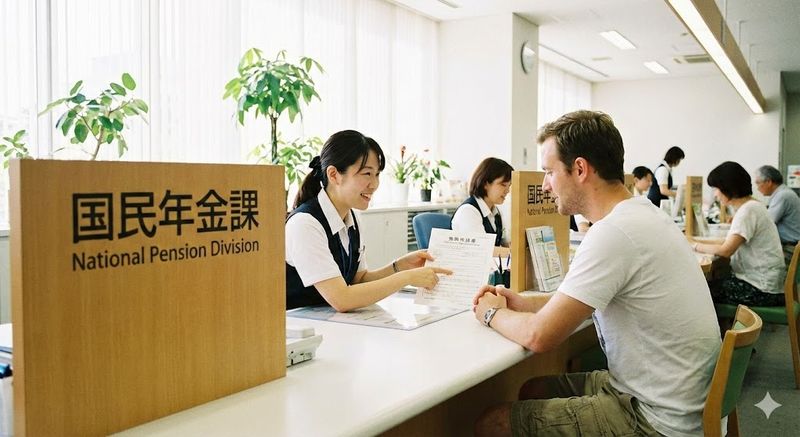
Will I Lose Out When I Return Home? The "Lump-sum Withdrawal Payment"
What foreigners worry about most is, "Will the money I paid come back when I return to my home country?" There is a system called the Lump-sum Withdrawal Payment (Dattai Ichijikin) for this.
The important rules are as follows:
- Period of Full Exemption: Unfortunately, this is not included in the calculation period (number of months) for the Lump-sum Withdrawal Payment. Since you paid ¥0, it is logical that the refund is also ¥0.
- Period of Partial Exemption/Payment: It is calculated according to the amount paid.
You might think, "It's a loss if I don't get money back," but applying for exemption counts towards your "eligibility period." This is useful if you return to Japan in the future to live permanently, or if you receive a pension based on a social security agreement between Japan and your home country in your old age.
If you have already paid pension premiums and want to get the full amount back when you return home, check the calculation method and procedures in the article below. In many cases, an average of ¥300,000 to ¥500,000 is returned.
[Leaving Japan?] How to Get a Full Pension Refund
The 'Lump-sum Withdrawal Payment' you can apply for when leaving Japan. You can get an average of ¥300,000-¥500,000 back, but get ¥0 if you forget the procedure. See the specific calculation method here.
Conclusion
Throwing your pension bills in the trash is the most dangerous choice. "Not being able to pay" is not a crime, but "not following procedures (Unpaid/Mino)" poses a major risk to your future life in Japan.
Go to your city hall to consult immediately, or finish your income declaration (Tax Return) first, and confidently secure your "Exemption."
If you become financially stable in the future, you can "back pay" (Tsuino) to increase your future pension amount or Lump-sum Withdrawal Payment. First, take the legal procedures to protect your current visa and livelihood.


![[2026 Comparison] Rakuten Point vs V Point vs d POINT](/_next/image?url=https%3A%2F%2Fcdn.sanity.io%2Fimages%2Fs5zbl9nu%2Fproduction%2F64764f87e0bd63725773de1998f35969485517e2-1200x630.jpg%3Fauto%3Dformat%26q%3D72%26fit%3Dmax%26w%3D640&w=3840&q=75)