Updated against official, partner, and reviewed site evidence where available.
Last updated: July 27, 2026
Source separation
Official or partner facts are separated from practical notes.
Fast-changing details
Prices, screening, documents, and rules can change.
Recommended next step
For SSW, move from visa rules to job search immediately
Manufacturing, care, and hospitality have close intent-to-conversion fit.
Before applying, check the destination page for current eligibility, from-abroad or domestic application options, required documents, and support languages.
This page contains affiliate links. We may earn a commission from purchases or sign-ups, at no extra cost to you. Learn more
"I want a higher salary." "I want to bring my family to Japan."
For Technical Intern Trainees and international students wishing for this, the most realistic option right now is the "Specified Skilled Worker (SSW)" visa.
Started in 2019, this system evolved into a "de facto permanent residency route" with the 2024 amendments. However, without knowing the correct information, there are risks of being exploited by malicious brokers or not finding a job even after passing the exam.
In this article, we will explain the job details of all 16 SSW fields, the reality of take-home pay, and how to advance to the most difficult "Specified Skilled Worker No. 2" in the easiest to understand way possible.
Check Manufacturing SSW Jobs Now
There are many factory jobs that are 'Dormitory complete' and 'Welcome foreigners'. If you want to secure a place to live and a job at the same time, search here first.
What is Specified Skilled Worker (SSW)? The Decisive Difference from Technical Intern Training
SSW is a "work visa" created to solve Japan's labor shortage. The biggest difference from the previous "Technical Intern Training Program (TITP)" is that you are protected by law as a 'worker'.
Since TITP is ostensibly for "study (international contribution)," changing jobs was basically prohibited. However, SSW is "work," so if conditions are met.
Save this guide for later?
You might need this information again. Bookmark this page to access it anytime.
Press Ctrl + D to Bookmark
Get the Latest Visa Updates
Receive important updates about visa requirements and new residence statuses directly to your inbox.
Share this article
Reading this in English?
Help improve English guides like this
If this guide helped but a phrase felt unnatural, your native check can make the next English article clearer for foreign residents in Japan.
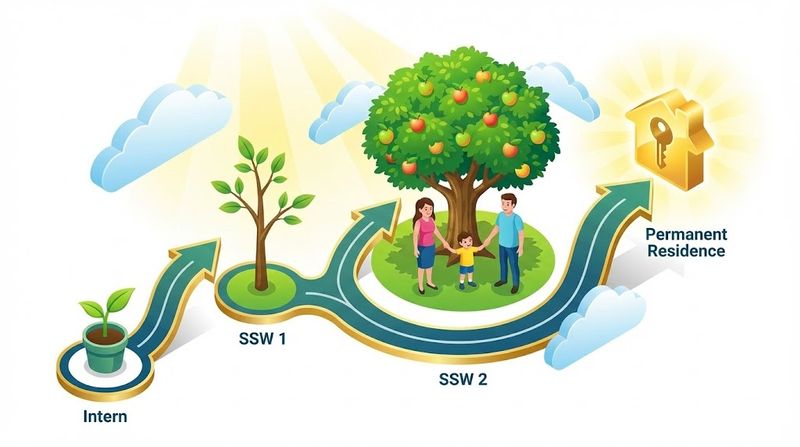
The career path that many people should aim for is the flow of TITP → SSW No. 1 → SSW No. 2 → Permanent Residency.
Item
Technical Intern (TITP)
SSW No. 1 (SSW1)
SSW No. 2 (SSW2)
Purpose
Int'l Contribution / Training
Solving Labor Shortage
Retention of Skilled Workers
Period
Max 5 years
Total up to 5 years
Indefinite (Renewal only)
Family
Not allowed (×)
Basically not allowed (×)
Allowed (Spouse/Child)
Job Change
Basically not allowed
Possible (Conditional)
Possible
Permanent Residency
Not counted
Basically not counted
Counted
Japanese
N5〜N4 level
N4 level required
N3 level required
Important Point:
People who have successfully completed TITP No. 2 can switch to SSW No. 1 in the same field without exams. This is the biggest privilege.
※ For those aiming for highly specialized professions (engineers, etc.) with a university degree or an annual income of 3 million yen or more, please see the separate article "Highly Skilled Professional Visa Point Calculation".
[2026 Latest] List of All 16 SSW Target Fields
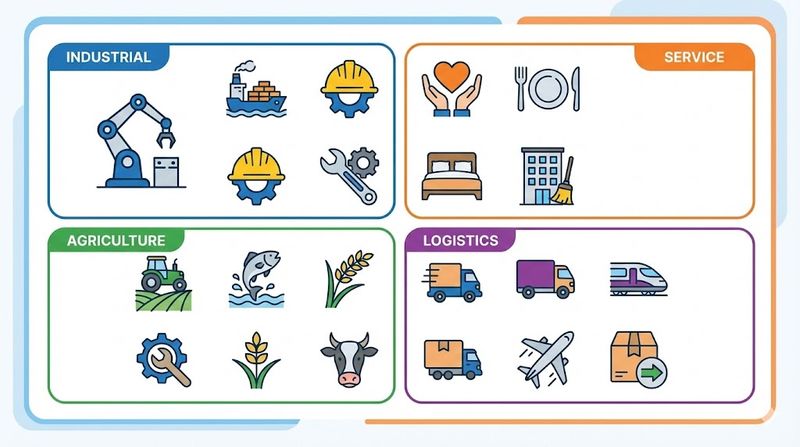
Initially, it was said to be 12 fields (14 industries), but with the 2024 amendments, integration and additions of fields were carried out, and it is currently the following 16 fields.
1. Manufacturing & Industrial (Most Jobs)
This is the best target. The previously separate "Machine Parts," "Industrial Machinery," and "Electric/Electronic" fields have been integrated into the huge "Industrial Product Manufacturing" field.
Industrial Product Manufacturing: Machining, metal press, factory assembly, welding, etc.
Merit: The number of job openings is overwhelmingly high. Line work in factories is central, so it is easy to be hired even with less advanced Japanese conversation skills.
Shipbuilding and Ship Machinery: Welding, painting, etc. for ships.
Construction: Formwork, plastering, civil engineering, interior, etc.
Caution: Salaries tend to be high, but check if it is a "Daily Monthly System" (salary based on daily wages) rather than a fixed monthly salary.
Find Factory & Manufacturing Jobs
Manufacturing is one of the most popular fields in SSW. There are many jobs with dormitories, making it perfect for people who want to keep living costs low and save money.
Food and Beverage Manufacturing: Manufacturing and processing of bento boxes, bread, and side dishes.
Feature: It is factory work, so there is no customer service. A popular field for women.
Food Service: Customer service and cooking in restaurants.
Accommodation: Hotel front desk, customer service, bed making.
Recommended: There are many live-in jobs in resort areas, and there are cases where rent and food expenses become free.
Nursing Care: Physical care, life support.
Strongest Merit: Apart from the SSW route, if you obtain the national qualification "Certified Care Worker," it is possible to change to the Permanent Residency route (Visa 'Nursing Care') without waiting for SSW No. 2.
For Nursing Care Jobs: 'Kaigo Batake'
Abundant nursing care jobs available for those with no qualifications or experience. There is a system to support acquiring qualifications while working.
Specialized in resort hotel and ryokan jobs nationwide. For people who want to save money in a short period with live-in jobs offering free dormitory and meals.
Automobile Repair: Car inspection and maintenance.
Are Exams Difficult? Pass Rates and Japanese Level
To obtain the SSW No. 1 visa, you generally need to pass two exams (excluding transitions from Technical Intern Training).
Japanese Exam:
Japan Foundation Test for Basic Japanese (JFT-Basic) A2 level or higher
Or, Japanese-Language Proficiency Test (JLPT) N4 or higher
Skills Exam:
Specialized exams for each field (Written + Practical test)
Exam Pass Rate (Estimate)
Actually, SSW exams are not that difficult. It is a level you can pass if you prepare properly.
Agriculture, Food Manufacturing, Food Service: Pass rates are high at 60%〜80%.
Construction, Manufacturing: Specialized terms appear so some study is needed, but it is no problem for experienced people.
The highest hurdle is not the exam itself, but "not being able to book the exam." Exams for Food Service and Food Manufacturing are popular, and seats often fill up within minutes of booking opening. Always check the official website.
The Reality of SSW "Take-home Pay" and "Expenses"
This is the most important story. Even though people heard "Salary will go up if I become SSW," troubles where "Take-home pay" (Te-dori) does not change are never-ending.
Beware of the Gap Between Face Value and Take-home Pay
By law, the salary of SSW foreigners must be "equal to or higher than Japanese people." The market price is about 200,000 yen 〜 250,000 yen monthly salary.
However, the following money is deducted from there.
Income Tax / Residence Tax: About 10,000 〜 20,000 yen
Social Insurance (Health Insurance / Pension): About 30,000 yen
Rent / Utilities: 30,000 〜 50,000 yen
Employment Insurance: About 1,000 yen
As a result, take-home pay often becomes about 140,000 yen 〜 160,000 yen. During the TITP era, rent was extremely cheap or taxes were low, so some people feel "I became SSW but I can't save money."
👨
Don't look only at 'Monthly Salary 200,000 yen' on the job posting! Make sure to check if there is rent subsidy or bonuses.
Spotting Malicious Support Organizations and Brokers
SSW No. 1 has the right to receive support from the company. However, there are also bad companies. Please be careful of the following 3 points.
Taking "Support Fees" from you is ILLEGAL
The monthly support cost (20,000 〜 30,000 yen) is something the company pays. If it is deducted from your salary, please consult the "Immigration Services Agency" immediately.
"Deposits" and "Penalty Fees" are ILLEGAL
Contracts saying "Pay 500,000 yen if you quit halfway" are invalid. Do not sign.
Demanding Job Introduction Fees
It is prohibited by law to take money from job seekers (you) for job introductions in Japan.
To "SSW No. 2" for Family Accompaniment and Permanent Residency
Previously, only the 2 fields of "Construction and Shipbuilding" could become SSW No. 2, but now the path to No. 2 has been opened for all fields except Nursing Care.
When you become SSW No. 2, the visa renewal limit disappears, and you can bring your wife (husband) and children from your home country to live together. And, that period is counted as the "working period" necessary for Permanent Residency application.
Conditions to Become No. 2
It differs by field, but the following 2 points are common.
Pass a high-level Skills Exam
Have practical experience in "Management / Supervision"
For example, experience as a "Team Leader (Hancho)" giving instructions to several subordinates or being entrusted with the site is required for several years.
Not just working, but accumulating Japanese ability and trust so that you can be entrusted with a leader role at the workplace is the shortest route to Permanent Residency.
Summary: To Not Fail in Specified Skilled Worker
The SSW system is the best chance for foreigners who want to work and live in Japan for a long time. However, the system is complex, and if you make a mistake in choosing a company, you will waste time.
3 Steps to Avoid Failure:
Study Japanese aiming for N3 level (This is a condition for salary increase and No. 2)
Calculate "Take-home pay" and "Rent" before signing
Use trusted job sites (Do not use suspicious individual brokers on SNS)
First, let's see what kind of job conditions are available on major job sites with a track record in foreign recruitment. Manufacturing jobs with "Dormitory complete" are especially recommended for stabilizing your living foundation.
Search for SSW Jobs
Jobs for factories and manufacturing industries all over Japan are listed. Good conditions fill up quickly, so first register and gather information.
Japan Regional Migration Subsidy: Up to ¥5M to Move Out of Tokyo (Foreigners Eligible?)
Y
Yushi Yamamoto
CEO / Japan Life Expert
Updated on: July 27, 2026
Disclaimer
※ The information in this article is accurate as of the time of writing. Laws and regulations may change, so please always check official sources for the latest information. We assume no liability for any damages resulting from the content of this article.