【2026 Edition】Caregiver Vocational Training & Subsidy Guide for Foreigners | Get up to ¥100,000 & Qualification Routes
Published on January 18, 2026
Updated on October 14, 2026
Author:JapanLifeStart Editorial Team
Work & Study
How this guide is checked
Updated against official, partner, and reviewed site evidence where available.
Last updated: October 14, 2026
Source separation
Official or partner facts are separated from practical notes.
Fast-changing details
Prices, screening, documents, and rules can change.
For foreigners seeking a stable life in Japan, "Care Work" (Kaigo) is currently one of the most reliable career paths. After obtaining the Certified Care Worker qualification and receiving permission to change to the "Nursing Care" status of residence, you may continue working through renewals as long as your residence circumstances meet the requirements. There is no cap on the number of renewals, but each renewal requires permission. Permanent residence is assessed separately.
However, have you given up because "getting qualified costs money" or "studying seems too difficult"?
Actually, Japan has excellent systems that allow you to "get qualified while receiving money." For example, there are programs where you can attend school for free while receiving ¥100,000 per month for living expenses, or systems where up to 80% of your tuition fees are refunded.
In this article, we will fully explain the best value and shortest routes to becoming a Certified Care Worker based on your specific Residence Status (Visa). We have simplified the complex procedures based on the latest information for 2026.
👨
I am currently working under the 'Specific Skilled Worker' visa. Can I get subsidies while working?
👩
Save this guide for later?
You might need this information again. Bookmark this page to access it anytime.
Press Ctrl + D to Bookmark
Get the Latest Visa Updates
Receive important updates about visa requirements and new residence statuses directly to your inbox.
Share this article
Reading this in English?
Help improve English guides like this
If this guide helped but a phrase felt unnatural, your native check can make the next English article clearer for foreign residents in Japan.
Needs review: Approval, visa/tax/legal, availability, and campaign terms are not guaranteed. Confirm on the official or partner page.
Yes! There is the 'Education and Training Benefit' available if you are enrolled in Employment Insurance. In fact, this is often the most financially beneficial case. Let's look at the details.
Find a Caregiver School Near You
The major nationwide school 'Human Life Care' offers extensive support for foreigners. You can search for a classroom near your home and request free brochures.
What is Your Visa Status? Shortest Route Diagnosis
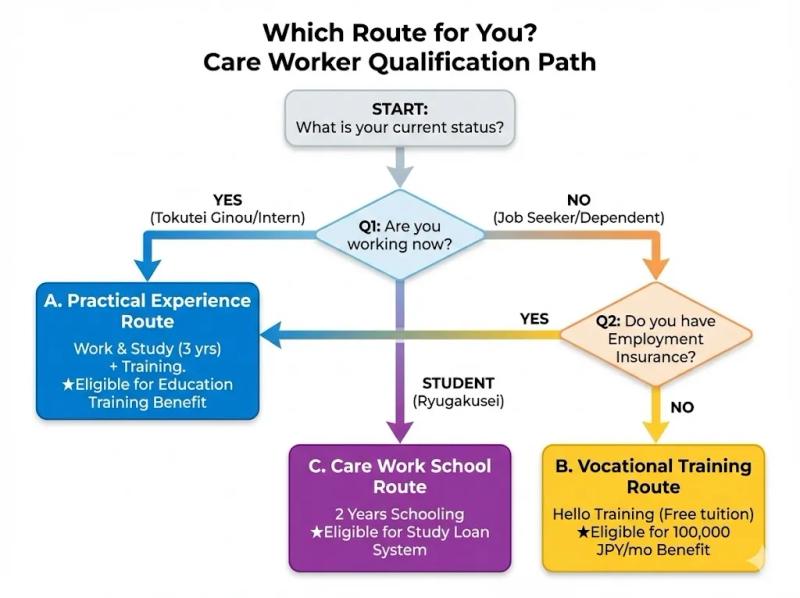
First, let's confirm "which route" you should take to become a Certified Care Worker. The available subsidies and required time differ completely depending on your residence status.
1. Specific Skilled Workers & Technical Interns (Working Route)
If you are already working in Japan, the "Practical Experience Route" is the standard path.
Conditions: Work in a Japanese care setting for 3+ years + Attend "Practical Practitioner Training" (Jitsumu-sha Kenshu).
Merit: You can aim for the qualification while earning a salary.
Note: You must complete 450 hours of Practical Practitioner Training during the 3 years.
2. International Students & Family Stay (School Route)
For current students or those who want to study seriously, there is the "Training Facility Route."
Conditions: Japanese JLPT N2 or higher + Attend a Care Worker Training Facility (Vocational School, etc.) for 2+ years.
Merit: Upon graduation, you can work as a "Certified Care Worker" for 5 years even without passing the national exam (transitional measure).
Note: Tuition is required, but it can effectively become free using the loan system mentioned later.
3. Job Seekers (Vocational Training Route)
If you are currently unemployed or only working part-time, "Public Vocational Training (Hello Training)" is the strongest option.
Conditions: Apply for job seeking at Hello Work.
Merit:Tuition is generally free. Furthermore, if you meet the conditions, you can receive ¥100,000 per month.
Don't Miss Out! Thorough Comparison of 3 "Financial Support" Systems
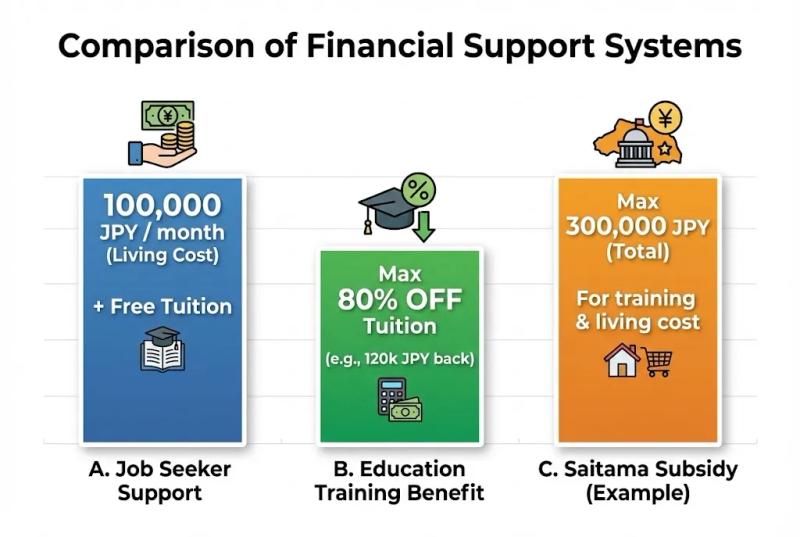
Support systems for obtaining care qualifications fall into three main categories. It is important to choose one (or a combination) that fits your situation.
System Name
Who is it for?
Amount Received (Est.)
Features
A. Job Seeker Support Training Benefit
Job Seekers (No Employment Insurance)
¥100,000 / month + Transport/Rent aid
The strongest system: attend school for free while receiving living expenses.
B. Professional Education & Training Benefit
Workers (With Employment Insurance)
50% to 80% of tuition (Max ¥640k/year)
For those career-building while working. Best for Specific Skilled Workers!
C. Local Municipality Subsidies
Foreigners living in that area
Max ¥100k - ¥300k (e.g., Saitama Pref.)
Can sometimes be used with A or B. Amounts vary by region.
A. "Job Seeker Support System" - Get ¥100,000/Month
This can be used by those who have "no job" or "low income" when taking training at Hello Work (Hello Training).
Eligibility: Household income under ¥250,000/month, personal assets under ¥3 million, etc.
Content: ¥100,000 is paid every month during the training period. Commuting allowance is also provided.
Note: You will not receive it if you are absent. You must attend seriously.
B. "Professional Education & Training Benefit" - Up to 80% Tuition Back
Use this if you are already working under "Specific Skills" etc. and are enrolled in Employment Insurance.
Eligibility: As of the course start date, the qualifying Employment Insurance period must generally be at least 3 years, or 2 years if this is your first receipt of an Education and Training Benefit. The course must be designated for the Specialized Practical Education and Training Benefit. Confirm eligibility with Hello Work before starting. Former insured workers and previous recipients have additional conditions; see the official MHLW Q&A.
Content: If you take a "Practical Practitioner Training" course designated by the Minister of Health, Labour and Welfare, 50% of the tuition comes back. If you get qualified and stay employed, another 20% is added. If your wages rise after the course, another 10% is added.
Example: For a course costing ¥150,000, up to ¥120,000 returns. Your self-pay is only ¥30,000.
[By Case] Real Simulation of Costs and Time
"In the end, how much will it cost me?" We answer this question with 5 specific cases.
Case 1: Mr. A working as Specific Skilled Worker (Age 28)
Situation: 2nd year working at a nursing facility. Annual income ¥3 million.
Goal: Take Practical Practitioner Training and sit for the national exam next year.
System Used: Professional Education & Training Benefit (Employment Insurance)
Cost:
School Tuition: ¥130,000
Benefit (Assuming 70% refund): ▲¥91,000
Actual Cost: ¥39,000
Point: Depending on the facility, the company might pay the remaining self-pay portion. Try consulting with your facility manager.
Case 2: Ms. B Looking for Work (Age 32, Dependent Visa)
Situation: Part-time income under ¥80,000/month. Dependent of husband.
Goal: Wants to get "Initial Training for Caregivers" (formerly Helper Level 2).
System Used: Job Seeker Support System (Hello Training)
Cost:
Tuition: ¥0 (Only text fee ¥5,000 is self-pay)
Training Benefit (3 months): +¥300,000 (Paid as living expenses)
Balance: Plus ¥295,000
Point: Instead of paying money, you get qualified while receiving living expenses. Go to Hello Work first. Since the benefit screening takes time, consider the following method if you need cash immediately.
[Urgent] How to Get ¥20,000 Cash When You Arrive in Japan
Secure some living expenses during your training using TikTok Lite and Rakuten Card campaigns.
Situation: Graduated from Japanese language school (N2 obtained).
Goal: Attend a Care Worker Training Facility (Vocational School) for 2 years.
System Used: Care Worker Study Fund Loan
Cost:
2-Year Tuition: Approx. ¥2 million
Loan: ¥50,000/month + Entrance Prep ¥200,000 + Job Prep ¥200,000 = Total ¥1.6 million Loaned
Point: If you work as a care worker in that region (e.g., Saitama) for 5 years after graduation, repayment of the borrowed money is fully exempted. It becomes a scholarship in practice.
Trick to Make Qualification Costs ¥0
If you want to get qualified without spending money, the dispatch service 'Kaigo Hata' is recommended. They have a system where you can get qualifications like Practical Practitioner Training for ¥0 while working.
Care Worker National Exam: Accommodations for Eligible Candidates
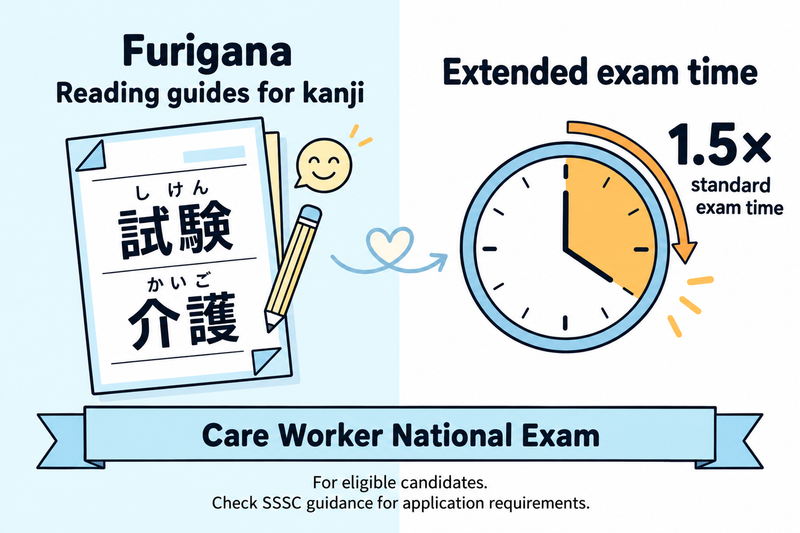
Foreign nationals and naturalized Japanese citizens can request a question paper with furigana and extended exam time when applying. EPA care-worker candidates do not need a separate request.
1. Extended exam time
For candidates taking all parts of the 39th examination on January 31, 2027, the official timetable gives:
Morning: Standard 105 minutes → Extended 160 minutes
Afternoon: Standard 115 minutes → Extended 175 minutes
Eligible candidates receive a question paper with reading guides on every kanji. These are Japanese reading guides. Check eligibility in the official SSSC FAQ.
3. Long-term Work with the "Nursing Care" Status of Residence
A dependent spouse or child of a person holding the "Nursing Care" status of residence may qualify for "Dependent" status, subject to a separate application and assessment. Permanent residence is assessed separately, including residence history, livelihood and tax obligations. Obtaining the qualification or continuing care work does not by itself create a care-specific exemption from permanent residence requirements. Check the ISA permanent residence guidance for the criteria applicable to your application date.
User Review★★★★★5/5
National Exam Passer (From Vietnam)
I was worried about Kanji at first, but thanks to the question paper with furigana, I understood the meanings. The trick to passing is using past exam apps every day to memorize words. I was so happy when my visa changed after passing.
Pass on the First Try Even if You Hate Kanji
For those worried about reading even with furigana, the video learning material 'Ukarundesu' designed for foreigners is perfect. You can study on your smartphone in your spare time.
Step-by-Step Guide: Using Subsidies (Saitama Example)
Here, we introduce the specific flow of applying for subsidies using "Saitama Prefecture," which offers generous support for foreigners, as an example. Other prefectures often have similar systems, so please use this as a reference.
Step 1: Check if You are Eligible
Saitama Prefecture provides subsidies to facilities that accept foreign care personnel.
Subsidy Amount: 2/3 of expenses (Upper limit ¥300,000 per facility, etc.)
Coverage: Training fees, Japanese study costs, translator device purchases, etc.
Although this is a subsidy for the "facility" rather than a direct payment to individuals, a smart method is to use this to find a facility that says, "The company will cover the training costs."
Step 2: Consult at Hello Work
First, go to your nearest Hello Work and say, "I want to receive vocational training for caregiving."
What to bring: Residence Card (Zairyu Card), Passport, Photo (3x4cm)
Keyword: "I want to apply for Kyushokusha Shien Kunren (Job Seeker Support Training)."
If there is no Hello Work training available, or if you want to attend while working, apply to a private school. Be sure to check in advance if it is a designated course for the "Education and Training Benefit."
School Selection Without Failure
'Can I attend while working?' 'Can I use benefits?' First, request free brochures from classrooms near you to see if they suit you.
Q. My visa expires in 1 year. Can I take the exam that requires 3 years of experience?
A. Yes, it is possible. Your period of stay can be renewed (extended). If you are a "Specific Skilled Worker (i)", you can stay in Japan for a total of 5 years. You just need to accumulate 3 years of practical experience and take the exam during that time. Working at the same company is the shortcut to renewal.
Q. I heard care work hurts your lower back. Is that true?
A. People used to say that, but now more facilities are using techniques called "Body Mechanics" and machines like robots and lifts. In vocational training, you will also thoroughly learn "care methods that do not hurt your back."
Q. Can my wife on a Dependent Visa receive vocational training?
A. Yes, it is possible. Even those working part-time within 28 hours a week may be eligible for "Job Seeker Support Training (¥100,000 monthly benefit)" if they meet the income requirements. Please consult with Hello Work.
Summary: Start with "Information Gathering"
The Certified Care Worker qualification is the strongest weapon for foreigners who want to live stably in Japan.
Before giving up because of the cost, take action with these 3 steps:
Go to Hello Work: Check if you can receive training for free.
Check Benefits: See if you are eligible for the "Education and Training Benefit (up to 80%)."
View School Materials: Check what schools are nearby and if they are easy to commute to.
If you use the systems wisely, you can reduce the cost burden to almost zero and obtain a national qualification and a path to permanent residency. Please take the first step today.
Act Now
Search for schools eligible for benefits near your home. Material requests for Human Life Care are free.
Japan Regional Migration Subsidy: Up to ¥5M to Move Out of Tokyo (Foreigners Eligible?)
Y
Yushi Yamamoto
CEO / Japan Life Expert
Updated on: October 14, 2026
Disclaimer
※ The information in this article is accurate as of the time of writing. Laws and regulations may change, so please always check official sources for the latest information. We assume no liability for any damages resulting from the content of this article.