【Free Study Sheet】JLPT Study Plan 2026: How to Pass N2/N1 in 6 Months & Official Resources
Published on January 28, 2026
Updated on July 27, 2026
Author:JapanLifeStart Editorial Team
Work & Study
How this guide is checked
Updated against official, partner, and reviewed site evidence where available.
Last updated: July 27, 2026
Source separation
Official or partner facts are separated from practical notes.
Fast-changing details
Prices, screening, documents, and rules can change.
Affiliate link handling
Some next-step links may be monetized.
Needs review: Approval, visa/tax/legal, availability, and campaign terms are not guaranteed. Confirm on the official or partner page.
💌
Send to Friends (Summary)
•A complete guide to passing the 2026 JLPT (Japanese-Language Proficiency Test). We are distributing a free progress management sheet (Google Sheets). Learn the study hours required for N2/N1, recommended textbooks like Shin Kanzen Master, and efficient self-study methods using Audible and italki.
Great for LINE / WhatsApp sharing
Many Japanese learners set "Passing the JLPT" as their goal, but in reality, endless tears are shed due to "poor planning" or the dreaded "Sectional Pass Mark" (getting a high total score but failing one specific section).
"Which textbooks should I use?" "When should I study?" "How much is enough?"
In this article, we explain a strategic study method with the 2026 exam schedule in mind. Furthermore, we are distributing a free "JLPT Roadmap Management Sheet (Google Sheets)" that you can copy and use immediately. With this, you will no longer be lost on "what to do" from today until the exam day.
JLPT Basics: Know Your Enemy (Dates, Scores, and Cutoffs)
First, start by knowing your enemy. The JLPT is not just a language test; it is also an information war.
2026 Exam Schedule and the Application Trap
As a general rule, the JLPT is held twice a year, on the first Sunday of July and December.
1st Test: Sunday, July 5, 2026
2nd Test: Sunday, December 6, 2026
The biggest point of caution is the "short application period." For example, at some venues in Canada or other regions, the application window may only be open for about 10 days. The worst-case scenario is being ready to study but forgetting to apply. Check the website of your local Host Institution first and set an alert on your calendar.
The Terror of the "Sectional Pass Mark": The 19-Point Wall
JLPT pass/fail determination involves two criteria: "Total Score" and "Sectional Score (Benchmark)." This is the "cutoff" system that plagues many self-learners.
For example, in the case of N1:
Passing Line: Total of 100 points or more (out of 180)
Cutoff Line: 19 points or more in each section: Language Knowledge, Reading, and Listening (out of 60 points each)
Even if you are excellent at Reading and get a perfect 60, resulting in a total score of 120, if your Listening score is 18, you will fail. Neglecting your weak areas is a fatal risk in the JLPT.
[Free Download] Automated Progress Tracker (JLPT Study Planner)
To solve the problem of "not knowing what to study and when," the JapanLifeStart editorial department has created an original progress management tool.
Tool Overview
This Google Spreadsheet visualizes your remaining days and progress rate just by entering the exam date. It also includes progress tracking features for major textbooks like "Shin Kanzen Master."
JLPT Study Planner v2026 (Free)
A Google Sheets template that automatically generates a roadmap to passing. Copy it now to start your study journey.
Open the link above and go to "File" > "Make a copy" to save it to your Google Drive.
Enter your target exam date (e.g., 2026/07/05) in the Dashboard sheet.
Check off daily tasks in the Schedule sheet and just aim to get the progress bar closer to 100%.
[By Level] Realistic "Study Hours" Needed to Pass
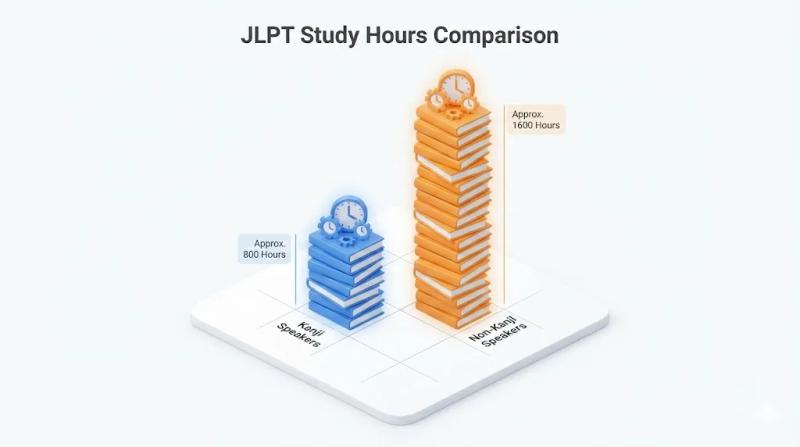
Do not be fooled by sweet words like "Pass N1 in 3 months." Based on data from the US Department of State's FSI and other sources, the realistic study times are as follows.
The Huge Gap Due to Kanji Knowledge
Kanji Background (China, Korea, etc.): Approx. 1,150–1,800 hours to pass N2
If you are from a non-Kanji background and are currently at the N3 level (approx. 1,000 hours studied), you need another 600 to 1,000 hours to pass N2.
If you divide this by a 6-month preparation period (approx. 180 days), it calculates to approx. 3.3 to 5.5 hours of study per day. To secure this time while working, you need the determination to invest all your "gap time," such as commuting hours and lunch breaks. Use the sheet distributed earlier to build a realistic schedule.
Choosing the Strongest Textbooks: "Shin Kanzen Master" vs. "Nihongo So-Matome"
On the bookshelves of successful candidates, you will almost always find the following two series. Understanding their characteristics and using them appropriately is the key to victory.
Nihongo So-Matome
Features: Lots of illustrations, easy to schedule (e.g., 2 pages a day for 6 weeks).
Recommended For: People who want to grasp the big picture first or build a study habit.
Note: This alone may fall slightly short of the N2/N1 actual exam difficulty.
Shin Kanzen Master
Features: Detailed explanations and an overwhelming number of practice problems. It explains even minute differences in grammatical nuances.
Recommended For: People who absolutely want to pass. The bible for N2/N1 takers.
Note: The design is dry and might test your patience, but if you complete it, your ability will be solid.
Conclusion: The golden route is to solidify the basics with "So-Matome" and then polish your skills with "Shin Kanzen Master" (especially for Grammar and Reading).
User Review★★★★★5/5
Editor's Choice
If you are aiming for N2/N1, 'Shin Kanzen Master Grammar' and 'Reading' are essential investments. If you perfect these two books, a passing score is definitely within reach.
Listening Prep: Turning Commutes into a "Classroom"
Time at your desk isn't your only study time. Especially for listening, using "ear gap time" can dramatically increase your study hours.
Train "Immediate Response" with Shadowing
The shortest way to increase your listening score is not just listening, but "shadowing"—pronouncing the audio exactly as you hear it. This improves your reaction speed for the "Immediate Response" questions (answering short questions instantly) that frequently appear in N2/N1.
In addition to textbook CDs, it is effective to use Audible (Amazon Audiobooks) to "ear read" Japanese novels and essays. Readings by professional voice actors offer clear pronunciation, and playback speed can be adjusted.
The first 30 days are free. Solve your listening weakness by 'reading with your ears' during your commute. Learning books like 'ALC Kikutan' are also included in the listening library.
Breaking the Limits of Self-Study: Rely on Conversation & Writing Pros
The textbooks and apps introduced so far (Migii, Todai Easy Japanese) are excellent, but self-study has a fatal flaw. That is the "Lack of Output" and "Correction of Mistakes."
Is the essay you wrote natural Japanese? Are you using the grammar you memorized correctly in conversation?
These questions cannot be solved just by facing a book.
This is where online Japanese lessons come in. italki is particularly suitable for self-learners because there is no joining fee, and you can book professional teachers or community tutors on a per-lesson basis to fit your budget.
Essay Correction: Share the Japanese you wrote via Google Docs and have a teacher correct it.
Grammar Explanation: Ask a teacher specifically about explanations in "Shin Kanzen Master" that you just can't understand.
Conversation Practice: Interview preparation or discussing abstract N1-level topics.
Even just 30 minutes once a week to "have a pro look at your work" will multiply the efficiency of your self-study.
Get Professional Guidance on italki
Don't let your self-study doubts pile up. For around $10/lesson, get 1-on-1 instruction from experienced Japanese tutors. No joining fee.
Passing N2, and then N1, is not the goal. It is a "passport" to opening up your career in Japan.
Employment & Career Change: Many Japanese and foreign companies require N2 or higher as an application requirement. Check your market value by referring to the Comparison of Job Sites for Japanese Speakers.
Highly Skilled Professional Visa: JLPT N1 passers receive additional points (15 points) for the "Highly Skilled Professional Visa," which is advantageous for obtaining permanent residency. N2 also provides 10 points.
If you are an engineer, adding N2+ Japanese skills to your technical skills can lead to a significant salary increase. Please also check the Career Change Guide for IT Engineers for details.
👨
Passing N1 dramatically increased my application pass rate. I became confident speaking in interviews and successfully switched to my current IT company.
Conclusion: Passing Comes from "Planning"
Passing the JLPT is not a result of talent, but of "correct planning" and "consistency."
Copy the [Study Planner] distributed today and set your exam date.
Get reliable textbooks like "Shin Kanzen Master."
Train your ears with Audible during commutes and check your output with italki on weekends.
If you keep this cycle going, you will definitely cross the passing line.
Now, download the sheet and take the first step in your learning journey.
Save this guide for later?
You might need this information again. Bookmark this page to access it anytime.
Press Ctrl + D to Bookmark
Get the Latest Visa Updates
Receive important updates about visa requirements and new residence statuses directly to your inbox.
Share this article
Reading this in English?
Help improve English guides like this
If this guide helped but a phrase felt unnatural, your native check can make the next English article clearer for foreign residents in Japan.
Q: What is the best JLPT study plan for complete beginners?
A: For N5: 3–6 months of consistent daily study (1–2 hours). Start with hiragana and katakana (1–2 weeks), then basic vocabulary and grammar. Use: Genki I textbook, Anki with a 2k vocabulary deck, and JLPT Sensei free practice tests. N4: additional 6–12 months from N5 level. Focus on kanji and grammar patterns.
Q: What are the best free resources to study for the JLPT in Japan?
A: Best free resources: (1) JLPT Sensei (jlptsensei.com) — free grammar and vocabulary lists per level, (2) Anki with community vocabulary decks, (3) NHK Web Easy — real news at N4-N3 level, (4) WaniKani (kanji, free up to level 3), (5) Japanese from Zero YouTube channel for beginners. Library books include Kanzen Master series.
Q: How long should I study each day to pass JLPT N3?
A: Study time estimates to pass N3 from scratch (no prior Japanese): approximately 450–600 hours total. At 1 hour/day: 15–20 months. At 2 hours/day: 8–10 months. Consistency matters more than total time. Focus areas: 370 grammar points, 650 kanji, 3,750 vocabulary. Practice with official past exam papers in the final 2 months.
Q: When and how can I register for the JLPT in Japan?
A: JLPT is held twice yearly in Japan: July and December. Registration opens approximately 3 months before the test. Register at jlpt.jp or through domestic Japanese Language Schools (日本語学校). Fee is ¥4,000–6,000 depending on level. Test sites are in major cities and are announced at registration.
Q: Do JLPT results help foreigners get jobs in Japan?
A: N2 is generally the minimum requirement for office/professional work conducted in Japanese. N1 is required for roles with heavy documentation or client communication in Japanese. IT and engineering roles sometimes accept N3–N2. Having any JLPT certification signals commitment to Japanese study and is valued even in English-heavy workplaces.
Yushi Yamamoto
CEO / Native Japanese Expert
Updated on: July 27, 2026
Disclaimer
※ The information in this article is accurate as of the time of writing. Laws and regulations may change, so please always check official sources for the latest information. We assume no liability for any damages resulting from the content of this article.