
"To get Permanent Residency (PR) in Japan, you must live here for 10 consecutive years."
That is a thing of the past. If you meet the requirements for the "Highly Skilled Professional (HSP) Visa," that period can be shortened to as little as 1 year.
However, many foreign professionals miss this opportunity. The reason is simple: "The point calculation is complicated, and I don't know how many points I'm missing."
In this article, we use our exclusive 10-Second Point Diagnostic Tool to instantly assess your current status. Furthermore, if you are short on points, we explain the "Salary Strategy" to gain points quickly, as well as the "J-Skip (Special Highly Skilled Professional)" system established in 2023.
[Tool Inside] Diagnose in 10 Seconds! HSP Visa Point Check
First, let's check if you have the potential to be certified as a "Highly Skilled Professional" right now. The logic below is specifically calculated for IT Engineers (Highly Skilled Professional 1(b)).
Note: If you want to manually check the details, please refer to the Immigration Services Agency: Point Calculation Table (Official PDF).
I calculated it and got 65 points... I'm 5 points short. What should I do?
Don't worry. Even if you are under 70 points, it is too early to give up. In fact, if you use a "certain method," it is possible to boost your score by 10 points or more starting tomorrow. Before explaining that specific strategy, let's quickly understand the basics of the system.
What is the HSP Visa? A Shortcut to Permanent Residency
The Highly Skilled Professional Visa is a system created by the Japanese government to give preferential treatment to "outstanding foreign talent." Activities are divided into the following three categories, but most people reading this article will likely fall under "1(b)".
- 1(a) Advanced Academic Research Activities: University professors, researchers, etc.
- 1(b) Advanced Specialized/Technical Activities: IT Engineers, corporate specialists, etc.
- 1(c) Advanced Business Management Activities: CEOs, entrepreneurs.
Fast Track to Permanent Residency (Preferential Treatment)
The biggest benefit is the shortened period required to obtain Permanent Residency (PR).
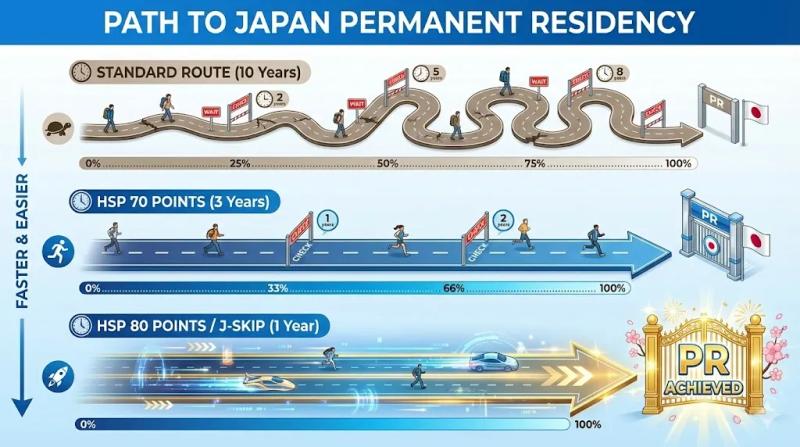
- Standard: Requires 10 years of residence in Japan.
- 70 Points or more: Shortened to 3 years.
- 80 Points or more: Shortened to 1 year.
In other words, if you have 80 points or more, you can start preparing for your Permanent Residency application almost immediately after arriving in Japan. This is the strongest card to hold if you want to take out a housing loan or have freedom in your career choices.
The New Option: J-Skip (Special Highly Skilled Professional)
Starting in April 2023, the "J-Skip" system was launched for high-net-worth individuals who find point calculations tedious.
- Conditions: Master's degree (or higher) + 10 years of work experience + Annual income of ¥20 million or more.
- Benefit: No point calculation needed. Instantly certified as a "Highly Skilled Professional (equivalent to 80 points)."
If your annual income exceeds ¥20 million, you don't need detailed calculations. Consider applying for J-Skip immediately.
How Points Work & The "Key to Winning"
From here, we will dig deeper into how to "hack" the point system, which applies to most people. To give you the conclusion first: The variable easiest to control is your "Annual Salary."
1. Education and Experience
These are items that take time to change.
- Doctorate: 30 points
- Master's degree: 20 points
- Bachelor's degree: 10 points
- 10+ years experience: 20 points
- 3+ years experience: 5 points
2. Japanese Language Ability
- JLPT N1: 15 points
- JLPT N2: 10 points
Having N2 or higher adds significant points, but studying to acquire this from scratch takes months to a year.
3. [Most Important] The Power of Annual Salary
This is the core of the strategy. Depending on your age, simply raising your salary can dramatically increase your points.
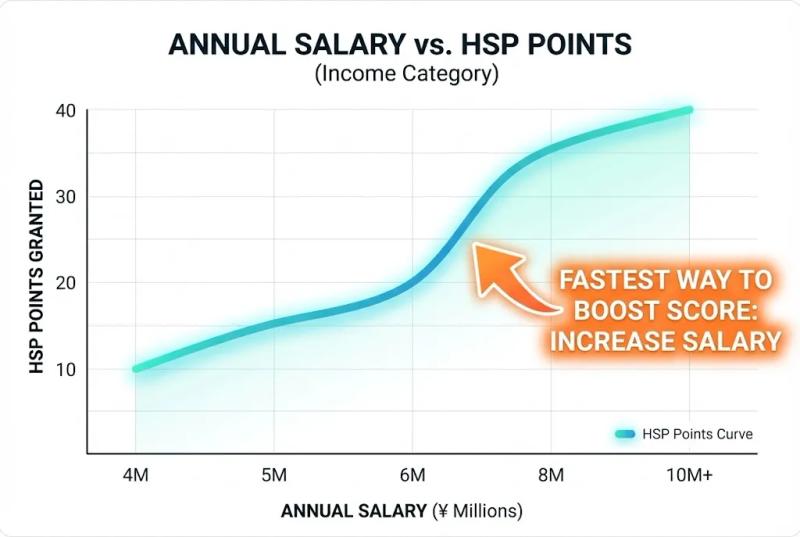
For example, for an IT engineer in their early 30s:
- Annual Salary ¥5 million → 15 points
- Annual Salary ¥8 million → 30 points (+15 points!)
- Annual Salary ¥10 million → 40 points (+25 points!)
I see... so raising my salary is faster than studying for N1?
Exactly. Rather than waiting for a raise at your current company, changing jobs to increase your salary is overwhelmingly faster and a more certain way to acquire points.
Especially in the Japanese IT industry, it is not uncommon for annual salaries to differ by ¥2 million to ¥3 million for the exact same skill set depending on the company. If you are currently stuck in the ¥5-6 million range, check your "market value" with a recruitment agent for high-class professionals.
Often, the salary offer alone is enough to cover the missing 5 or 10 points.
For IT engineers aiming for over ¥8 million, we highly recommend TechGo. They specialize in high-class recruitment, and many users succeed in significantly increasing their salary (and thus gaining massive points).
Gain HSP points instantly with a salary hike
How much is your skill worth? TechGo has many private listings over ¥8 million. Diagnosis is free.
Furthermore, if you are a "Full Stack Engineer" or "Tech Lead" class aiming for over ¥10 million or J-Skip status, you should also use TechClips Agent. They are even more specialized in high-paying Engineer Jobs.
For high-paying engineer jobs
Abundant jobs over ¥10 million. Find the shortest route to HSP 80 points with TechClips Agent.
Hidden Benefits Beyond Points
While the speed of getting Permanent Residency gets all the attention, HSP has major lifestyle benefits.
Bringing Parents
Under a standard working visa, you generally cannot bring your parents to live in Japan. However, under HSP, it is possible if the following conditions are met:
- Household annual income is ¥8 million or more
- Need to care for a child under 7 years old (or a grandchild)
The keyword here is again "¥8 million annual income." Combined household income is acceptable, but it is always better if the main earner increases their salary.
No Employment Restrictions for Spouses
Usually, a spouse on a Dependent Visa can only work "28 hours a week." However, the spouse of an HSP holder can work full-time by obtaining "Designated Activities" status (subject to certain requirements).

For more on finding a spacious home for your family and costs, please see the article below.
Cost of Living & Rent in Tokyo
How much does it cost to bring your family? Rent averages by area and living cost simulation.
Not Just Salary: Strategic Bonus Points
There are "bonus points" that are often overlooked aside from salary increases.
- Graduated from a Japanese University/Graduate School: +10 points
- Graduated from a Designated University (Top Global Universities): +10 points
- This applies to schools ranked high in the list designated by the Minister of Justice. This can be stacked with Japanese university points (Max 20 points!).
- Japanese National Qualifications / IT Exams: +5 to 10 points
- Exams like the "Fundamental Information Technology Engineer Examination" and "Applied Information Technology Engineer Examination" qualify. 5 points for one, 10 points for two or more.
Combining these with the JLPT to boost your base score is a smart strategy.
Streamline your Japanese Learning
Turn commute time into Japanese lessons with Audible. Great for N1/N2 listening prep.
Money Strategy After HSP: Asset Management & Remittance
Once you successfully obtain the Highly Skilled Professional visa and your salary increases, the next issue you face is moving money.
The higher your income, the more opportunities you have to send money home or bring assets from your home country to Japan. However, exchange fees at Japanese banks are extremely high, and you can lose tens of thousands of yen in "hidden costs."
Smart individuals like those qualifying for HSP or J-Skip do not use standard bank transfers. They use Wise to send money at the real exchange rate (mid-market rate).
Save up to 8x on remittance fees
Avoid hidden bank costs. Wise offers transparent fees and real exchange rates for moving salary or assets.
If you are struggling to open a bank account in the first place, please check this guide.
Bank Account Guide for Foreigners
Can you open one with less than 6 months on your visa? Recommended banks and required documents.
FAQ: Frequently Asked Questions
Q. Can a freelancer get a Highly Skilled Professional Visa?
A. It is not impossible, but the difficulty level is high.
HSP is based on a contract with a "Contracting Organization" (company). For freelancers, the documentation to prove stable annual income and continuity of contracts becomes voluminous. The safest route is to get employed by a company first to obtain HSP, get Permanent Residency, and then become independent.
Details: Visa and Income Guide for Freelance Engineers
Q. My salary is less than ¥3 million, but I have 70 points because other scores are high.
A. Unfortunately, you will not be certified.
Highly Skilled Professional (1-b/1-c) has a minimum requirement of "Annual income of ¥3 million." If you fall below this, you will be rejected even if your total score is 100 points. The starting line really is raising your annual income.
Details: Career Change Strategy for IT Engineers to Increase Salary
Conclusion: "Salary Increase" is the Strongest Solution for Missing Points
The Highly Skilled Professional Visa is an "Express Ticket to Permanent Residency" that allows you to live freely in Japan.
- First, calculate your points with the tool above.
- Fill any missing points by checking your salary potential at TechGo rather than studying for N1 immediately.
- Once you exceed 70 or 80 points, start preparing your application right away.
Your skills are likely worth more than your current salary. For the sake of your visa points and your future assets, start by knowing your "fair market salary."
How many points can your skills add?
Salary Up = HSP Point Up. Check high-paying jobs at TechGo and secure your shortest route to Permanent Residency.