I've organized my GitHub perfectly for my Japanese job applications! Now they'll surely see my clean code, right?
Unfortunately, most Japanese HR managers won't read a single line of your code. They are looking at something completely different.
Many foreign engineers harbor a common misunderstanding about job hunting in Japan: "If I have the technical skills, I will be evaluated fairly."
However, in the Japanese recruitment scene—specifically during the document screening phase—most HR (Human Resources) staff come from non-technical, humanities backgrounds. They cannot judge whether code is good or bad. So, where exactly on GitHub are they looking to decide whether to pass or fail a candidate?
The conclusion? They are looking at your "README (Instruction Manual)" and your "Grass (Commit History)."
This article explains the harsh reality of the Japanese hiring process and details how to create a Strategic Portfolio (GitHub) that convinces even non-technical HR staff that "this candidate is excellent." We will also introduce how to differentiate between recruitment agents that evaluate technical prowess versus those that look at potential, depending on your current level.
The Shocking Truth: How Japanese HR Views GitHub
In the Japanese hiring process, before a field engineer ever sees your code, a non-technical HR representative performs the initial screening. While they don't understand technical details, they use a unique set of criteria to judge "whether this person is worth hiring."
They Look for "Diligence," Not "Code"
The first thing HR focuses on is the Contribution Graph (often called "Kusa" or "Grass" in Japan due to the green squares) on your GitHub profile page.
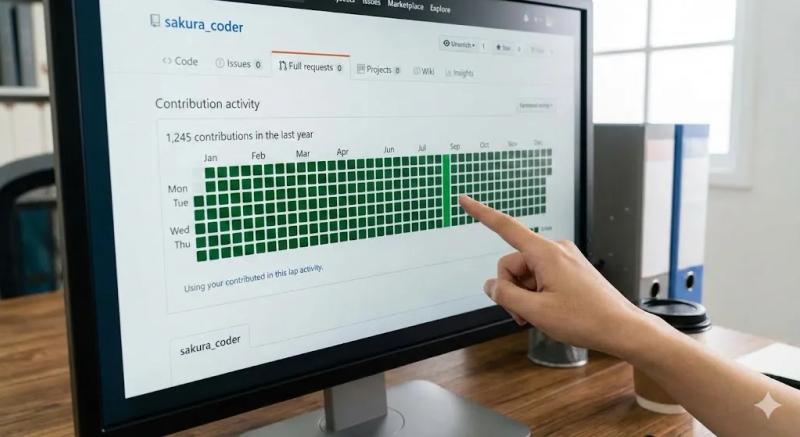
To them, the density and shade of the green squares are not a proof of technical skill, but a proof of "Diligence."
Japanese companies often prioritize potential and character—specifically, "can this person continue to make an effort every day?" and "will they continue learning after joining the company?"—over raw skill sets.
If your "Grass" is sparse or has long gaps, even if you write highly advanced code, you risk being judged as "someone who gets bored easily" or "lacks persistence," significantly increasing the chance of being rejected at the document screening stage.
The "3-Second Wall" and First Impressions
Busy recruiters spend only a few minutes checking a single candidate's GitHub. Your impression is determined in the first 3 seconds after they click your URL.
- Not Deployed (Runs only locally)
- README is in English only
- Layout is broken
These are grounds for "lack of intent," and the browser tab will be closed immediately. Especially for web companies, they will click the URL of the actual app to check if the UI/UX is polished. "Consideration for the user (viewer)" is a critical evaluation point that comes before technical ability.
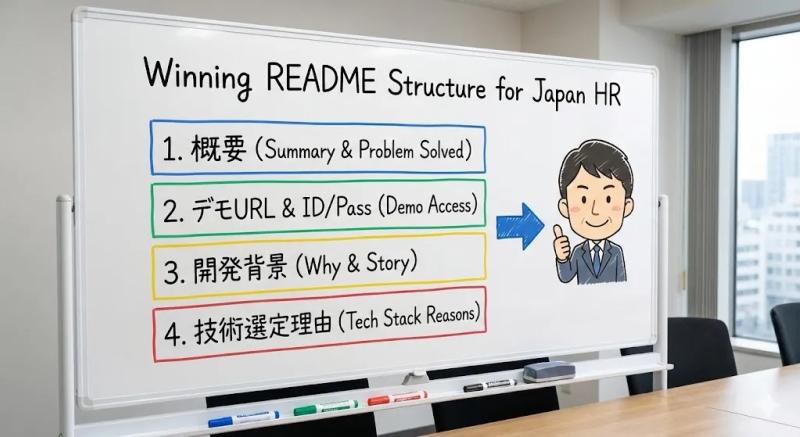
The Absolute Structure of a "Winning README"
Because HR staff cannot read code, they will read the README thoroughly.
The key here is not to write the README as a "Technical Specification," but as a "Sales Document explaining the benefits of hiring you."
Why Japanese Descriptions are Mandatory
You might think, "English documentation looks cooler," or "It's the global standard." However, in Japanese job hunting, Japanese (or bilingual Japanese/English) is mandatory.
A README carefully written in Japanese conveys the following powerful messages to HR:
- Serious Commitment to working in Japan.
- Reassurance that communication will be smooth after hiring.
Recommended Template (Copy & Paste OK)
Use the following structure to cover the information recruiters want to know.
GitHub README Draft Structure
- App Name & 3-Second Summary
- One line explaining "Whose problem does this tool solve and how?"
- Demo
- Most Important. The deployment URL and test account (ID/PASS).
- Embedding GIFs or videos significantly increases the click-through rate.
- Background (Why)
- Why did you build this app? (Disclosing your thought process).
- Tech Stack
- Why did you choose these technologies? (Reason for selection).
- Innovations & Struggles
- How did you handle errors? Use this to appeal your problem-solving skills.
The Unique Japanese "Security Wall" and PDF Strategy
This is a trap many foreign engineers are unaware of, specific to the Japanese corporate environment.
They Can't See GitHub from Office PCs!?
In major Japanese SIers (System Integrators) and financial institutions, security policies are set very strictly.
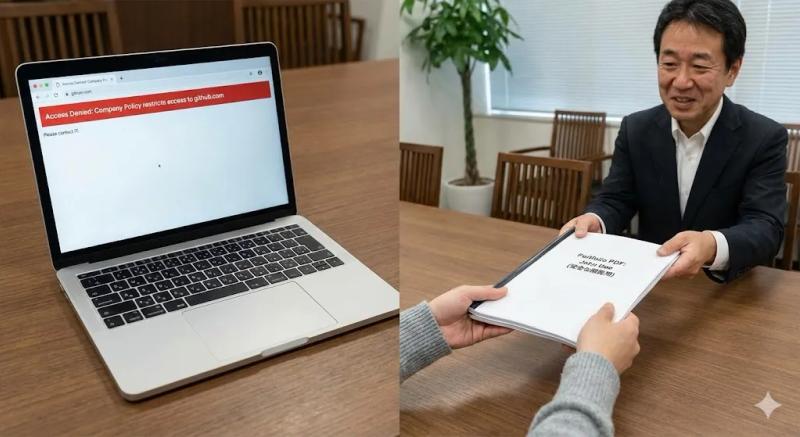
It is not uncommon for access to external sites like GitHub, Heroku, or Vercel to be blocked from HR department PCs.
Even if you create a wonderful portfolio, if the recruiter cannot access it, you might be rejected simply as "Unable to Verify."
The PDF Portfolio as "Insurance"
The strongest method to avoid this risk is "Converting your Portfolio to PDF."
- Screenshots of the top page and main features
- Icons of technologies used
- Summary of the app
Compile these into 1-2 A4 pages as a PDF and submit it along with your CV. Just adding a note saying, "I have attached this in case security policies prevent access," will skyrocket your evaluation as someone who has "Omoiyari" (consideration for others). This is a point that sets you apart from other candidates.
4 Failures (Anti-Patterns) You Must Avoid
Sometimes, things you do with good intentions can backfire. Avoid these four mistakes at all costs.
- The Tutorial Clone
- ToDo lists or calculators that are exact copies of school materials are seen as "lack of independent thought." Always add unique features or change the theme.
- The Silent Commit (Initial Commit Only)
- Uploading everything at the very end is a no-go. It suggests you cannot manage versions with Git because the process of development (trial and error) is invisible.
- The Broken Link (Leaving Errors)
- Clicking a URL and getting a
500 Internal Server Error is out of the question. It implies you are "careless" or "irresponsible." Use free tiers (Render/Vercel, etc.) to keep it running constantly.
- English-Only Documentation
- This gives the wrong message: "I don't intend to adapt to Japan." Even if you have to use DeepL, strictly provide Japanese text.
To ensure you don't fall into a situation where only "Black Companies" (exploitative companies) accept you due to these small mistakes, it is crucial to know the criteria for choosing a company.
5 Hidden Criteria for Foreign Engineers to Spot "Black Companies" Instantly
Which One Fits You? Strategy by Agent Type
Once you are prepared up to this point, it is time to approach companies.
However, the agent you should use differs clearly depending on your current skill level and strengths. If you make a mistake here, you won't even pass the document screening.
To Secure an Offer with Your Current Ability
Do you want to raise your salary with 'Technical Skills' or start your career based on 'Potential'? Check out agents with a proven track record for high income first.
1. TechClips Agent (For Experienced & High-Income Seekers)
This is for those who already have practical engineering experience in their home country or Japan and want "to have their code evaluated fairly."
- Feature: The consultants are active engineers. Therefore, they can evaluate "Code Quality," "Architecture Design," and "Test Code"—things HR cannot see—from a professional perspective.
- Strategy: Don't just show the README; show off clean design and test code (coverage rates, etc.) and use them as negotiation tools for a salary increase.
- Note: It might be difficult for inexperienced candidates to get introductions here.
If you are aiming for an annual salary of over ¥10 million (approx. $65k+) or trying to escape from SES (subcontracting), using a specialized agent like TechClips is an essential route.
The Reality of Foreign Engineer Salaries: The Darkness of SES and the Escape Route to Earning ¥10 Million
TechClips Agent
Active engineers evaluate your code. The place for high-income transitions to in-house development companies.
2. Meiko Career (For Inexperienced & Potential Seekers)
This is for those with little practical experience or who are currently learning Japanese, aiming to "join a Japanese company first and grow."
- Feature: The parent company is an education firm, and they have strengths in supporting foreign nationals. They have many job openings that prioritize "Japanese Ability," "Willingness to Learn," and "Character" over pure technology.
- Strategy: Use your portfolio not as "proof of technical skill," but as "proof of Learning Agility." Appeal your adaptability to Japanese culture through PDF materials and a polite README.
Meiko Career
Specialized support for inexperienced and foreign engineers. Japanese language support and visa consultation included.
Agent Comparison Summary
| Feature | TechClips Agent | Meiko Career |
|---|
| Target | Experienced, High-Income Oriented | Inexperienced, Recent Grads, Foreign Talent |
| Evaluator | Active Engineers | Career Counselors |
| Portfolio Focus | Technical Substance (Code Quality/Design) | Potential (Passion/Communication) |
| Recommendation | People who want to raise salary via skills | People wanting to start a career in Japan |
Conclusion
In the Japanese job market, GitHub is not just a storage space for code. It is a presentation tool to prove your "Diligence," "Consideration," and "Japanese Ability," making recruiters think, "I want to meet this person."
Instead of being pessimistic about the fact that "HR doesn't read code," use it to your advantage. By making an effort to "communicate even in environments where code isn't seen (via PDF and README)," you will stand out from the crowd and be evaluated as top-tier talent.
Start by asking an agent for an objective diagnosis of "how your portfolio looks to Japanese HR."
If you want to understand the entire job change process in Japan more deeply, please refer to this guide as well.
Complete Guide to Recruitment Agents in Japan for IT Engineers & Programmers
Next Step: