[2026] The Salary Reality for Foreign Engineers in Japan: The Dark Side of SES and the "Escape Route" to Earning ¥10 Million
Published on January 22, 2026
Updated on July 27, 2026
Author:JapanLifeStart Editorial Team
Work & Study
How this guide is checked
Updated against official, partner, and reviewed site evidence where available.
Last updated: July 27, 2026
Source separation
Official or partner facts are separated from practical notes.
Fast-changing details
Prices, screening, documents, and rules can change.
Affiliate link handling
Some next-step links may be monetized.
Needs review: Approval, visa/tax/legal, availability, and campaign terms are not guaranteed. Confirm on the official or partner page.
💌
Send to Friends (Summary)
•[2026 Edition] Is the "average" salary for foreign engineers in Japan a lie? Data reveals the stark polarization between low-wage "¥4M SES" roles and high-end "¥10M Foreign Capital" positions. We uncover the "Language Tax"—where better Japanese skills can actually lower your pay—and explain concrete strategies to escape this exploitation and double your income using agents like TechGo and Midworks.
Great for LINE / WhatsApp sharing
"If I become an engineer in Japan, I'll earn an average annual salary of 6 million yen."
If you believe this myth, this article might just save your career.
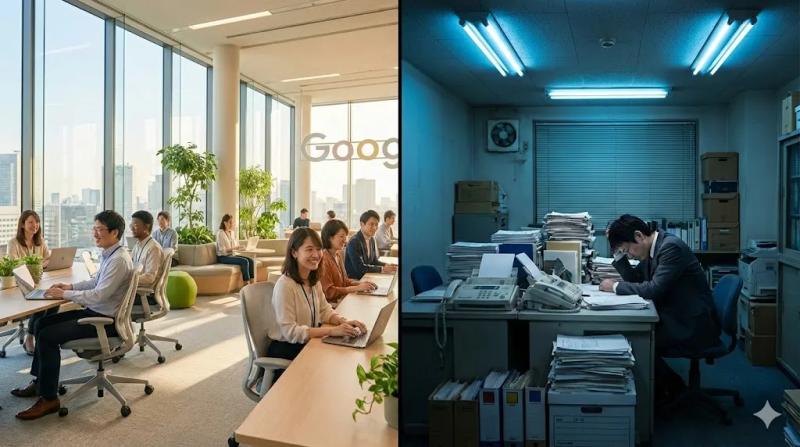
As of 2026, the market for foreign engineers in Japan is ruthlessly "polarized." On one side, there is the global standard world where annual salaries exceed ¥10 million. On the other, there is the world of SES (System Engineering Service / subcontracting), where engineers are exploited for a monthly salary of just ¥200,000.
Many talented engineers are deceived by the statistical magic of Japan's "average salary" and end up working for less than half the compensation they deserve.
In this article, we expose the "raw salary reality of the Japanese IT industry" that doesn't appear in official statistics, and the "Language Tax" trap—where ironically, the better your Japanese, the lower your pay might be. Finally, we present concrete "escape routes" to break free from this structure and earn the compensation your skills warrant (¥10 million/year or more).
What Is Your True Salary Potential?
Working without knowing your market value could cost you millions of yen a year. First, check your worth with TechGo's private job listings.
[2026 Edition] Foreign Engineer Salary Data and "Two Japans"
You must not view the Japanese engineer market as a single entity. There are "two Japans" here, completely disconnected from each other.
The table below shows the realistic annual salary ranges for foreign engineers based on the latest market research.
Category
Target Companies
Japanese Level
Salary Range
Tier 1 (Global)
Foreign IT (Google, AWS), Unicorns
None / Basic
¥8M - ¥25M
Tier 2 (High-End)
Japanese Mega-Ventures (Rakuten, Mercari, etc.)
Business
¥5.5M - ¥12M
Tier 4/5 (SES)
Independent SIers, Subcontracting Software Houses
N1 / Native
¥3M - ¥5M
As you can see, even for the same "Java Engineer" or "Web Developer," the salary differs by 3 to 4 times depending simply on which layer you belong to.
In the Tier 4 and below layers (SES), it is not uncommon for monthly take-home pay to remain around ¥200,000 to ¥250,000. Considering the rising cost of living in Tokyo and the weak yen, this is not a level where you can "thrive"—it is barely a level where you can "survive."
👨
Believe it or not, N1 holders who are fluent in Japanese tend to get hired by low-paying Tier 4 companies more often. This is the true nature of the 'Language Tax'.
Do not trust the averages. Your goal should not be the average, but moving into "Tier 1 / Tier 2."
※ For the reality of living costs in Tokyo, please refer to the following article.
[2026] Living Alone in Tokyo: Costs Start at ¥140k/Month
A realistic breakdown of rent and utilities, plus a guide to cutting fixed costs to save money.
The Real Reason Your Salary Won't Rise: The Dark Side of "SES" and "Commercial Flow"
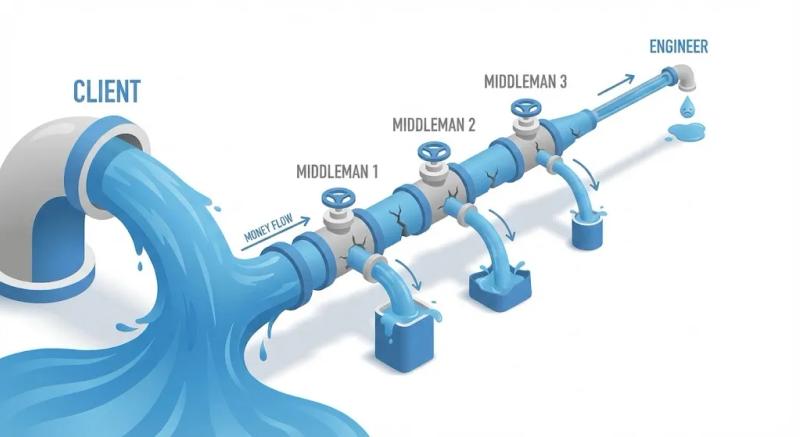
Why is your take-home pay so low? It’s not because your skills are low. It’s because the "Commercial Flow" (Shoryu) is too deep.
The Japanese IT industry has a "multi-level subcontracting structure" similar to the construction industry.
Client (Project Owner)
Prime Contractor (Moto-uke)
Secondary Contractor (SES starts here)
Tertiary Contractor
Your Company
You
In this structure, a margin (commission) is taken every time the contract passes through a company. This is called "Nakanuki" (Middleman Skimming).
Even if the client pays ¥800,000 per month for your work, by the time it reaches your bank account, it has shrunk to ¥250,000. This is the structural exploitation mechanism of SES.
Screams from the Field
On SNS and in communities, the following realities are reported:
Menial Tasks During Standby: When between projects, engineers are forced to do chores that may violate visa conditions (cleaning the office, washing dishes at affiliated restaurants, etc.).
The Trap of "Fixed Overtime": Companies abuse contracts that "include 40 hours of overtime in the base salary" (Minashi Zangyo), forcing long hours without paying additional allowance.
Staying in this place means your salary will never increase. You need to change the structure itself.
※ We explain how Japanese recruitment agents work in detail in the following article.
Complete Guide to Recruitment Agents for IT Engineers
English-friendly job sites, failure patterns when choosing agents, and how to avoid them.
The Paradox: The "Language Tax" Where Better Japanese Means Lower Pay
Normally, higher language ability should lead to higher pay. However, a paradoxical phenomenon is occurring in the Japanese engineer market.
"Engineers with JLPT N1 level Japanese are sucked into low-wage SIers (Tier 4)."
We call this the "Language Tax."
English Environment (Tier 1): Well-funded global companies value "Technical Skills" (Go, Rust, Cloud, etc.) over Japanese ability and pay world-standard salaries.
Japanese Environment (Tier 4): Traditional Japanese SIers value "Japanese Communication" (reading the air) and "Cheapness" over technical skills.
As a result of studying Japanese desperately, you end up trapped in the Japanese "seniority-based wage" and "middleman skimming structure." If you are confident in your technology stack, relying solely on your Japanese language skills as a weapon is dangerous.
Escape Route A to Double Your Salary: High-Class Career Change
Here are the concrete solutions.
This is the route for engineers currently worn out in SES (Tier 4/5) to jump up to Tier 1/2 in one go.
Target: 3+ years of practical experience, modern skills (AWS, Python, React, etc.).
Applying via job sites (like LinkedIn or Indeed) on your own is not always the best strategy. This is because companies often look at your current salary (e.g., ¥4 million) and base their offer on that anchor.
To double your salary, you need a High-Class Specialist Agent who evaluates "your market value" correctly and negotiates with the company.
Recommended Agent: TechGo
If you aim for a high-class career change, [TechGo] will be your strongest partner.
Negotiation Based on Market Value: They negotiate your salary based on "how much your skills sell for in the market," not your "current salary."
Quality of Private Listings: They hold many non-public job openings from mega-ventures and DX-promoting companies in the "¥8M - ¥12M" class that rarely appear in public.
Career Strategy: They excel at proposing career paths (CTO candidates, Tech Leads, etc.) rather than simple matching.
If you are wondering, "Will my skills be enough?", you should at least consult with them. You might discover "skills that sell for a high price" that you hadn't realized you possessed.
Are You Ready to Escape SES?
Your skills might be worth double your current pay. Confirm your true market value with TechGo's private listings.
Escape Route B to Double Your Salary: Freelancing with "Full-Time Security"
The other route is the strategy of ditching the "company signboard" and making the commercial flow shallower (reducing the middlemen). In other words, becoming a freelancer.
Instead of being protected by a company but suffering from heavy skimming, you contract closer to the client. This causes your unit price to jump immediately to ¥800,000+ per month (¥9.6 million+ per year).
However, there are two barriers to freelancing for foreign engineers: "Visa" and "Income Instability." The solution to this is [Midworks].
Recommended Service: Midworks
[Midworks] is a service that gives you the best of both worlds: the freedom of a freelancer and the security of a full-time employee.
User Review★★★★★5/5
Senior Engineer Choice
For foreign engineers who want to freelance but worry about visas and income, Midworks' guarantee system is the ultimate safety net.
Salary Guarantee System: Even if a project ends and there is a gap, there is a system to guarantee your salary (remuneration) on a daily basis (subject to screening). This drastically lowers the risks unique to freelancing.
Benefits Comparable to Full-Time Employees: Support for insurance and tax is generous, making it safe even for those entering the Japanese freelance market for the first time.
High Unit Price Projects: They have an abundance of direct-client projects, making it realistic to aim for double the take-home pay of your SES days.
If you have the "greedy" desire to "avoid risk but raise your salary," this is the optimal solution.
※ Be sure to check the following complete guide for freelance procedures and visa details.
How Foreigners Can Become Freelance Engineers in Japan
Explaining everything from how to maintain your visa to the concrete steps to aim for ¥10 million/year.
We answer the questions you will inevitably face when escaping exploitation.
Q: Is freelancing possible with the "Engineer / Specialist in Humanities / International Services" visa?
A: Yes, it is possible. However, there are conditions.
Even when working as a freelancer (sole proprietorship), the visa category itself does not change. The important things are "having continuous and stable contracts" and "notifying the Immigration Bureau of your contracting organization." Using an agent like Midworks makes it easier to manage visa renewal risks because proving contracts is smoother.
Q: How do Residence Tax and Social Insurance change?
When you switch from full-time employee to freelancer, you switch from Employees' Pension/Social Insurance to "National Pension / National Health Insurance." While the hassle of paying it yourself increases, you gain the ability to claim expenses (part of your rent, PC costs, etc.), so in most cases, the cash (cash flow) remaining in your hand increases significantly.
※ For detailed rules on side hustles and taxes, please check the following article.
Complete Guide to Side Hustles & Crowdsourcing in Japan
Covering visa precautions, tax returns ([Kakutei Shinkoku](/en/money-cards/japan-tax-return-software-guide-2026)), and how to earn with your Residence Card.
In the market for foreign engineers in Japan, your salary will not go up if you just "wait." Will you stay in a place where you are structurally exploited, or will you manage the risk and change your environment? The choice is yours.
Your skills may be worth double your current salary. Start by knowing your "true market value."
Next Step:
To aim for a career upgrade via High-Class Job Change:
Use [TechGo] to check how much your current skills are valued at.
To minimize risk and maximize take-home pay:
Use [Midworks] to search for projects with a monthly unit price of ¥800,000 or more.
First, gather information:
Deepen your understanding of Japan's agency situation with the related articles introduced in the text.
Save this guide for later?
You might need this information again. Bookmark this page to access it anytime.
Press Ctrl + D to Bookmark
Get the Latest Visa Updates
Receive important updates about visa requirements and new residence statuses directly to your inbox.
Share this article
Reading this in English?
Help improve English guides like this
If this guide helped but a phrase felt unnatural, your native check can make the next English article clearer for foreign residents in Japan.
Q: What is the realistic starting salary for a foreign IT engineer in Japan in 2026?
A: Fresh graduates or career changers entering SES (System Engineering Services) companies typically start at ¥3,000,000–3,500,000/year. Those joining in-house development teams at mid-size companies start at ¥3,500,000–4,500,000. Foreign engineer recruits at global tech companies or top Japanese tech firms start at ¥5,000,000–8,000,000+.
Q: How does the salary reality for foreign engineers in Japan differ from expectations?
A: Common gap: many foreign engineers expect Japanese company salaries to match global tech salaries. Reality: traditional Japanese companies pay by seniority, not skill, especially in SES. Annual raises of ¥100,000–200,000 are typical at traditional firms. Modern product companies (mercari, Paypay, Rakuten, global tech) have more market-rate salary structures.
Q: What programming languages command the highest salaries in Japan in 2026?
A: In Japan, Golang, Rust, and Kotlin specialists have high market value. Cloud infrastructure (AWS/GCP/Azure certified), AI/ML engineers (Python + LLM experience), and full-stack engineers with modern frameworks (React, Next.js) also command premiums. COBOL/legacy mainframe skills remain highly paid in banking despite being outdated.
Q: Is the lifetime employment system still common in Japan and how does it affect foreign engineer salaries?
A: The traditional lifetime employment (終身雇用) model is weakening, especially in tech. Major tech companies now practice performance-based pay and mid-career hiring. Foreign engineers are often hired as mid-career specialists at above-average rates. Annual salary reviews (査定) rather than bi-annual promotions are becoming common at forward-thinking companies.
Q: How can foreign engineers negotiate higher salaries in Japan?
A: Tips: (1) Apply via foreign-friendly recruitment agencies (bizreach, en world, Robert Half) who know how to negotiate, (2) Have competing offers — Japanese companies respond to market pressure, (3) N2+ Japanese opens significantly higher-paying roles, (4) Certifications (AWS SA Pro, GCP Professional) justify premium, (5) Apply to gaishikei (外資系) companies for market-rate global pay.
Yushi Yamamoto
CEO / Native Japanese Expert
Updated on: July 27, 2026
Disclaimer
※ The information in this article is accurate as of the time of writing. Laws and regulations may change, so please always check official sources for the latest information. We assume no liability for any damages resulting from the content of this article.