Non-STEM & No Experience: The Fastest Route to Becoming an Engineer in Japan (SES vs. In-House)
Published on January 24, 2026
Updated on July 27, 2026
Author:JapanLifeStart Editorial Team
Work & Study
How this guide is checked
Updated against official, partner, and reviewed site evidence where available.
Last updated: July 27, 2026
Source separation
Official or partner facts are separated from practical notes.
Fast-changing details
Prices, screening, documents, and rules can change.
"I have a Humanities degree (Bunkei), so I can't become an engineer in Japan, right?"
"I've heard that Japanese SES companies are all 'Black Companies' (exploitative)..."
If you are thinking about working as an engineer in Japan, you might be feeling anxious about these rumors circulating online.
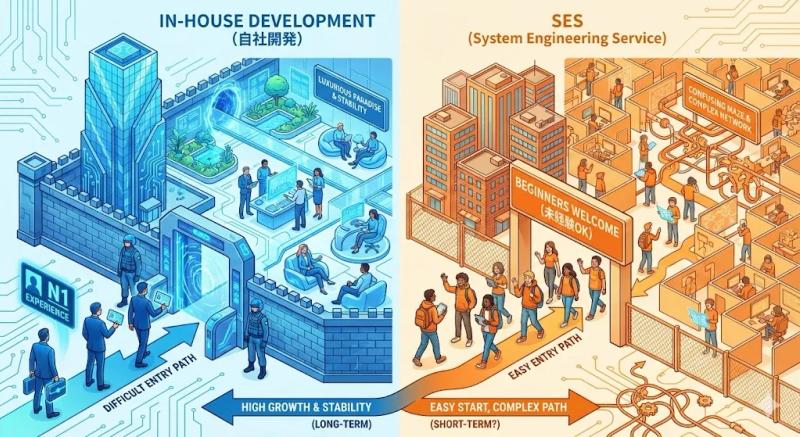
Let me give you the bottom line: It is extremely difficult for a foreigner with a humanities background and no experience to immediately get a job in popular 'In-House Development' companies. Even for Japanese locals, the competition for these positions is incredibly fierce, often with hundreds of applicants for one spot.
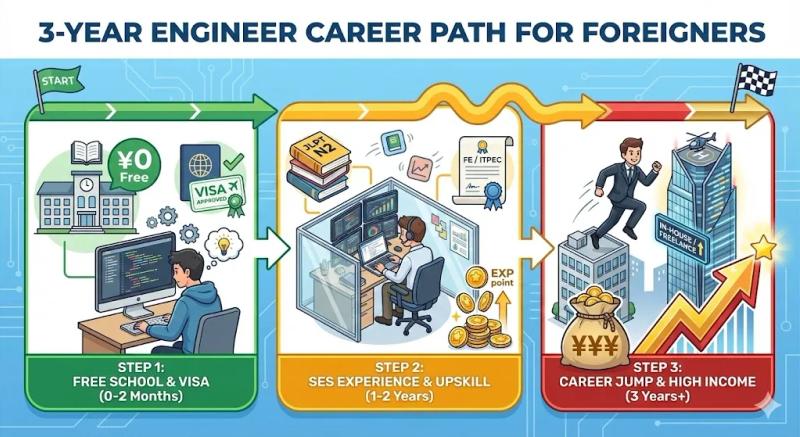
However, if you slightly adjust your strategy, it is entirely possible to start your career as an engineer and obtain a work visa in as little as 2 months.
In this article, I will candidly explain the real structure of the Japanese IT industry (SES vs. In-House) and reveal the most realistic and smart roadmap for humanities-background foreigners to "learn skills while working and aim for a high income in 3 years."
Become an Engineer ASAP for Free
0 Yen tuition and up to 2 months of free rent in a shared house in Tokyo. If you want to aim for IT Infrastructure Engineering from a non-tech background, this is the place.
The Reality of Japan's IT Industry: Should You Aim for "SES" or "In-House"?
When aiming to become an engineer in Japan, you cannot avoid understanding the difference between two working styles: "In-House Development" and "SES." Most foreigners aspire for the former, but the reality is harsh.
Save this guide for later?
You might need this information again. Bookmark this page to access it anytime.
Press Ctrl + D to Bookmark
Get the Latest Visa Updates
Receive important updates about visa requirements and new residence statuses directly to your inbox.
Share this article
Reading this in English?
Help improve English guides like this
If this guide helped but a phrase felt unnatural, your native check can make the next English article clearer for foreign residents in Japan.
Needs review: Approval, visa/tax/legal, availability, and campaign terms are not guaranteed. Confirm on the official or partner page.
1. In-House Development (Web Service Companies)
These are companies that create their own services, like LINE or Mercari.
Pros: High salary (Annual income starts around ¥4 million), skill growth, stylish offices.
Cons: Competition is abnormally high. Without N1 level Japanese and immediate practical experience, you won't even pass the document screening. Recruiters strictly check not just your GitHub code, but also your Japanese ability in the README (documentation).
This is a service where engineers are dispatched to client companies to provide technical support.
Pros:Easy to get hired even without experience. Training programs are available. You can experience various work environments.
Cons: Salaries start low (Monthly ¥200,000 - ¥250,000), you work at client sites so company loyalty is thin, and there is a risk of encountering "Black Companies."
Rather than spending a whole year job hunting for an elusive in-house position, the shortest route is to "first enter an SES company to gain practical experience and a visa."
SES is not the goal. It is a "stepping stone." The smart strategy for foreigners is to use it to build experience and then change jobs for better conditions after 3 years.
👨
Many senior engineers started at small SES companies and now work for major corporations. The priority is to simply 'get into the industry' first.
Can a Humanities Major (Bunkei) Get an Engineering Visa?
When applying for the "Engineer/Specialist in Humanities/International Services" visa, the Immigration Bureau strictly examines the relevance between your "University Major" and your "Job Description."
If you have a STEM degree, there is no problem. But for Humanities majors (Economics, Literature, Sociology, etc.), this is a major hurdle.
Strategy 1: Overcome with Logic
You explain that the "logical thinking," "statistics," and "English ability" learned at university are necessary for IT work (especially infrastructure design or Bridge SE roles). However, this often requires a rationale statement written by a professional administrative scrivener, and the difficulty level is high.
Strategy 2: Prove "Relevance" with Qualifications (Recommended)
This is the strongest passport. If you pass Japan's "Fundamental Information Technology Engineer Examination (FE)" or the "ITPEC" exams conducted in various Asian countries, you satisfy the visa requirements regardless of your major, according to Ministry of Justice regulations.
Humanities graduates should aim to pass this exam before polishing their programming skills.
For Those With No Money: How to Use "0 Yen" Tuition & Rent Schools
Going to a programming school gives you an advantage in employment, but tuition typically costs around ¥300,000 to ¥800,000.
If you have the funds and want to learn in English, bootcamps like "Le Wagon" or "Code Chrysalis" are options, but they are expensive.
For those who say "I don't have that kind of money," there are schools in Japan that become "free on the condition that you get a job."
Net Vision Academy
This is a specialized school for humanities majors and inexperienced people aiming to become "Infrastructure Engineers (Network Engineers)."
Course Content: Acquire "CCNA," the gateway qualification for networking, in as little as 1 month and aim for employment.
Target: Ages 18 to 31.
Biggest Benefits:
Tuition is fully free (Normally costs hundreds of thousands of yen).
Moving Support:Rent is free for up to 2 months at their partnered share house. Perfect for those moving to Tokyo from rural areas or overseas.
Foreigner Support: They have a track record of accepting foreign nationals provided they have N2 level Japanese or higher.
You won't be writing code like a programmer, but demand for infrastructure engineers is stable, making it an excellent entry point to "get a visa and start working in Japan."
User Review★★★★★4.5/5
Net Vision Academy Graduate
I was anxious at first, but thanks to the free share house, I was able to start my life in Tokyo. Because I had the CCNA qualification, finding a job went smoothly even with a humanities background.
Book a Free Counseling Session
99% CCNA pass rate. If you want to debut as an engineer with 0 Yen tuition and rent, start with a free consultation.
If you have a strong desire to "write code in Java or PHP rather than doing infrastructure," the following agents are options.
Annual income varies greatly depending on the development language (e.g., Go language has high unit prices), but if you have no experience, it is safer to start with languages like Java or PHP where demand is high.
Job support specialized for people in their 20s, recent graduates, freelancers, and those with no experience.
Features: Good at connecting young people who lack confidence in their educational background or work history to companies that accept inexperienced staff. For those who just want to become a full-time employee first.
If You Want to be a Dev Engineer
Strong support for full-time employment for inexperienced people in their 20s. Professionals will introduce companies that suit you.
An agent that pledges to "thoroughly eliminate Black Companies."
Features: They screen companies with strict standards regarding annual holidays and overtime hours.
If you strongly feel "I don't want to be exploited" or "I want to avoid traps like 'deemed overtime'" when joining an SES company, this agent provides peace of mind.
Step 2 (Years 1-2): Perseverance
Your initial take-home pay might be under ¥200,000. However, think of this as a period where "you are getting paid to learn Japanese and technology."
Take notes and memorize Japanese terms you don't understand on site.
Acquire additional certifications like AWS or the Fundamental Information Technology Engineer (FE) exam.
Step 3 (Year 3): Escape and Salary Increase
Once you have "3 years of practical experience + Qualifications + N2/N1," your market value rises dramatically. This is when you finally job hunt for "In-House Development Companies" or "Freelance" roles.
If you become a freelancer, an annual income of ¥10 million is not just a dream. It is also effective to use "Reverse Recruiting" (Scout) sites where companies send offers to you.
You don't need to give up on becoming an engineer just because you have a humanities background or no experience. The Japanese IT industry is suffering from a serious labor shortage, and if you choose the right route, the opportunities are endless.
The important thing is not to waste time looking for the "perfect company," but to "act now and start the countdown on your years of experience."
Why not use free resources like "Net Vision Academy" to the fullest and take that first step without taking on financial risk?
Apply for Free Counseling Now
[Limited Monthly Slots] 0 Yen tuition & up to 2 months free rent. Go from Humanities major to Engineer in as little as 2 months.
Japan Regional Migration Subsidy: Up to ¥5M to Move Out of Tokyo (Foreigners Eligible?)
Y
Yushi Yamamoto
CEO / Japan Life Expert
Updated on: July 27, 2026
Disclaimer
※ The information in this article is accurate as of the time of writing. Laws and regulations may change, so please always check official sources for the latest information. We assume no liability for any damages resulting from the content of this article.